Rucking is safe - when you respect the load
Rucking is walking, and walking is one of the safest ways to train. The risk comes from the pack: more weight means more force through the feet, knees, and back, and military research on foot marching shows what happens when that load climbs faster than the body adapts. Knapik's 2014 review lists foot blisters, metatarsal pain, knee problems, and back problems as the common complaints, and an earlier review adds stress fractures and rucksack palsy (Knapik et al., 2004). Its prescription is plain: lighter loads, better load distribution, appropriate physical training, and proper equipment.
Nobody has published injury rates for recreational rucking, so we won't pretend to know how it compares with running, where reported yearly injury incidence ranges from about 19% to 79% depending on the study (van Gent et al., 2007). The military data come from soldiers carrying far heavier loads than most civilians use. What the research does support is that most load-carriage injuries are overuse problems that build over weeks, and the levers that matter (weight, progression, fit, footwear) are ones you control.
This guide is educational, not medical. If you have an injury, pain that persists, or a pre-existing condition, see a clinician for diagnosis and a plan that fits you.
Disclosure: some retailer links in this guide are affiliate links. If you buy through them, Ruck Authority may earn a commission at no extra cost to you. Safety recommendations do not change based on commission.
Assess your risk
This quick assessment considers your weight carried, weeks of experience, frequency, any current pain or previous injuries, and outputs a risk level (low/moderate/high) with specific recommendations for your situation. Use it to calibrate your progression.
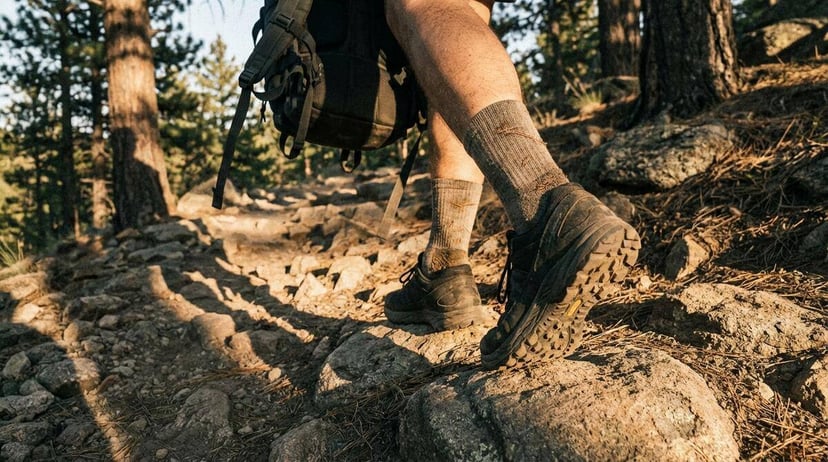
The most common rucking injuries
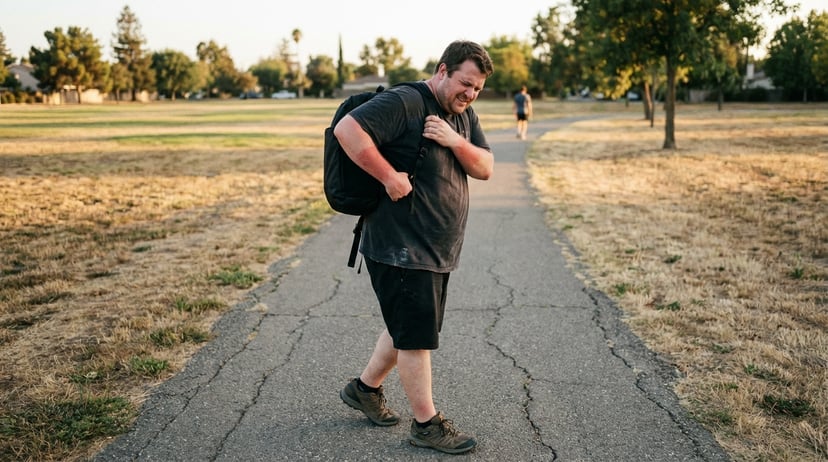
A common complaint, especially in beginners. Pain around the kneecap or the outside of the knee usually follows weight added too fast, long downhill stretches, or a stride that reaches too far.
Prevention: Add load in small steps and change one thing at a time (the 10% rule is a reasonable planning guide, not a proven threshold). Shorten your stride on descents. Squats, lunges, and glute bridges 2-3 times a week build the capacity the knee needs.
For the full clinical breakdown and return-to-rucking progression, read Rucking knee pain.
Diffuse, activity-related pain along the inner edge of the shinbone. A meta-analysis of risk factors found higher odds in women, heavier people, people with more foot-arch drop, and people with a previous running injury (Reinking et al., 2017). Rapid jumps in distance, load, or hills are the usual trigger.
Prevention: Build volume gradually. A 2025 meta-analysis of prevention trials found the strongest support for neuromuscular training (strength and balance work), moderate support for overpronation insoles in people who need them, and no benefit from static stretching or shock-absorbing insoles (Marques et al., 2025). Focal bone pain, pain at rest, or pain at night needs a clinician, because it can be a stress fracture.
For early-warning signs and the recovery protocol, see Rucking shin splints.
Heel or arch pain, worst with the first steps in the morning or after sitting. It is an overload problem of the plantar fascia, often after rapid volume increases, a sudden change of footwear, or tight, weak calves.
Prevention: Supportive shoes, with any big change in drop or cushioning introduced gradually. Progress distance slowly. Calf strengthening, such as slow heel raises, alongside calf mobility.
For the full protocol, see Rucking plantar fasciitis.
Pain in the lower back during or after rucking. Usually mechanical: weight sitting low and far from the spine, excessive forward lean, or a trunk that tires before the legs do. Pain that radiates down a leg, or comes with numbness or weakness, needs assessment. Tight hip flexors are a frequent hidden driver - see our hip flexor fix for ruckers.
Prevention: Keep the load close to your back. Military research favors high placement on even ground and low or mid-back placement on uneven terrain (Knapik et al., 2004). Stand tall rather than folding forward at the hips. Core work: planks, dead bugs, bird dogs.
Soreness in the upper traps and shoulders from strap pressure or poor load distribution. The main cause: all the weight on your shoulders because you're not using your hip belt.
Prevention: Use a hip belt whenever the pack has one. Military load-carriage reviews recommend it because it reduces pressure on the shoulders and improves comfort (Knapik et al., 2004). Keep the shoulders relaxed, and check strap width and padding for your build.
Tingling or numbness in the fingers or arm during rucking. It is a compression or traction injury of the brachial plexus nerves, usually from straps pressing into the shoulder under a heavy load.
Prevention: Lighter loads, wider and better-padded straps, and a hip belt, which a 2016 review lists among the prevention steps (Knapik et al., 2016). If numbness doesn't clear soon after you take the pack off, stop and get it checked.
Full clinical explanation: Numb hands while rucking.
Foot blisters top the list in military load-carriage reviews. They're most likely early on, with new shoes, wet feet, cotton socks, or a long ruck at a new load.
Prevention: Merino or synthetic moisture-wicking socks, never cotton. Remove wet socks immediately after rucking. Break in new shoes on short rucks first. Apply Body Glide Original to heels, sides of feet, and toes before heading out.
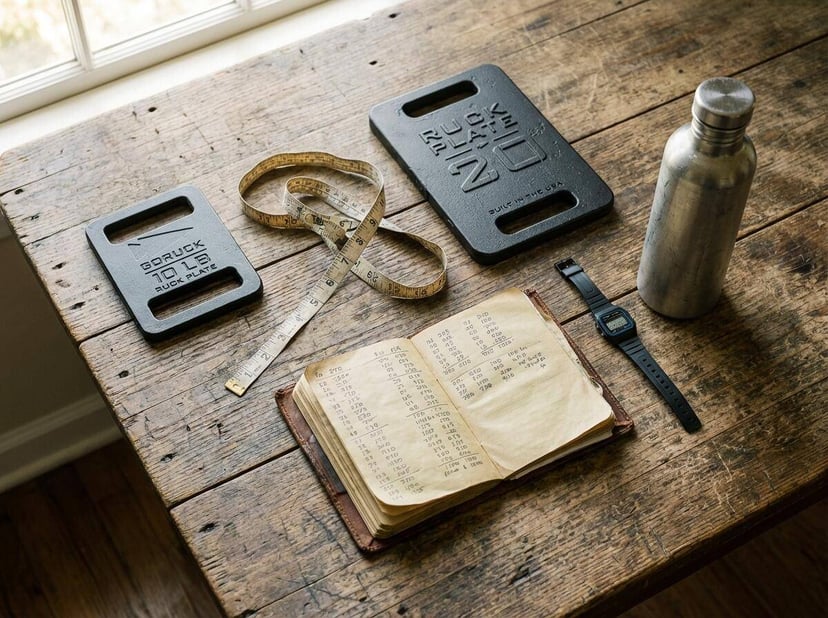
The prevention framework: progress one variable at a time
The simplest rule that holds up: change one thing at a time, in small steps, and let a week or two pass before the next change. Weight, distance, pace, and hills are four separate variables. Raise one, hold the rest.
For weight: add a few pounds at a time. Going from 20 to 22 or 25 lb is a step; going from 20 to 30 lb is a leap.
For distance: add a quarter to half a mile to your longest ruck, not double it.
Never add weight and distance in the same week. If you're adding load, keep distance flat. If you're adding distance, keep load flat.
The 10% rule (no more than a 10% weekly increase) is a reasonable way to size those steps. Treat it as a planning guide, not a safety guarantee: a systematic review found very limited evidence linking any specific weekly increase to injury, and one included study found no difference between 10% and 24% weekly increases in runners, while increases above 30% trended riskier (Damsted et al., 2018).
The reason to go slowly is that tendons and bone adapt more slowly than your heart and lungs. Your breathing can tell you a heavier ruck is fine weeks before your shins or feet agree.
In a 2007 gait study, each 8 kg (about 18 lb) of added military load produced a roughly proportional rise in vertical and front-to-back ground-reaction forces, and higher vertical forces have been linked to overuse injuries (Birrell, Hooper & Haslam, 2007). A 2023 study found that a backpack of 15% of body weight shortened stride and raised cadence, especially uphill, and that carrying the same load on the front was harder on posture than on the back (Mexi et al., 2023).
Those findings don't set a safe number. They explain why load and hills compound, and why the tissues absorbing those forces need time between increases.

The prehab routine: 8 exercises in 15 minutes
Prehab is strength and control work done before anything hurts. The best evidence for it in lower-leg injuries comes from shin splints: in a 2025 meta-analysis of prevention trials, neuromuscular training (strength, balance, and movement-control work) had the clearest preventive effect (Marques et al., 2025). This 8-exercise routine takes 12-15 minutes and covers the feet, calves, glutes, quads, core, and shoulders. Do it 2-3 times a week.


That's it. The only kit you need is a resistance loop band for the clamshells and, optionally, a foam roller for afterward. No routine makes injury impossible, but this one builds capacity in the places load carriage stresses most.
For progressions, variations, and form cues, see the full rucking prehab routine.
Tracking heart rate and recovery
Monitoring your heart rate during rucking helps you stay in the right intensity zones for adaptation while avoiding overtraining. A Garmin Instinct 3 Solar provides reliable zone tracking without overthinking it, giving you real-time feedback that keeps you from overextending.

When to push through vs when to stop
Not every ache is a sign to stop rucking. But some are. Here's the decision tree:
Muscle soreness (DOMS) from a previous ruck. Delayed onset muscle soreness is normal and expected. It means your muscles were stressed and adapted. Rucking actually feels better once you warm up.
General fatigue. If you feel flat and tired but without pain, that's often just low energy for the day. Rucking often fixes this as you warm up.
Mild stiffness in the first 5 minutes. Your joints are cold. Once you've been moving for 5 minutes, they warm up and feel fine.
Pain that doesn't improve after 10 minutes of walking. If something hurts for the first mile and then you forget about it, that's usually not serious. If something hurts the entire ruck, that's a signal to modify.
Recurring aches in the same spot across multiple rucks. Occasional soreness is normal. Soreness in the exact same location every single ruck is a pattern that suggests tissue irritation.
Compensation patterns (limping, favoring one side). If you're favoring your right knee or left foot to avoid pain in your left knee or right foot, you're loading other tissues asymmetrically. Stop and address the underlying issue.
Reduce your load or distance by 20-30% for one week, then progress more slowly.
Sharp or stabbing pain. This is different from soreness or aching. Sharp, stabbing pain often indicates acute injury or nerve involvement.
Numbness or weakness that doesn't resolve within minutes of adjusting your straps. Tingling fingers from strap compression usually goes away when you loosen the straps. If it persists despite adjustment, something else is going on.
Swelling in any joint. Swollen knees, ankles, or shoulders point to something beyond normal exercise stress.
Pain that worsens as you continue rucking. If you take 5 more steps and the pain gets worse, stop. Don't push through.
Any sensation you'd describe as "something isn't right." Your body is smart. If your intuition says something is wrong, listen to it. Rest a few days and reassess.
Stop rucking, rest for 3-7 days, and see a clinician if it doesn't resolve. Focal bone pain, pain at night, or weakness warrants an appointment sooner.

Recovery and mobility
Rucking creates stress on your body. Recovery is where the adaptation happens.
Post-ruck routine (5-10 minutes): After every ruck, spend 5-10 minutes stretching. Target your calves, hip flexors, shoulders, and thoracic spine. These are the tissues under most load during rucking.
Weekly mobility session (15-20 minutes): Once per week, do a dedicated mobility and dynamic stretching session. See Rucking Mobility Guide for specific routines.
Sleep (7-9 hours per night): The recommended range for adults, and the cheapest recovery tool there is. Consistently short sleep makes hard training harder to absorb.
Nutrition: Protein and carbohydrate in the next meal after a long ruck, and water to rehydrate. This matters more the harder and longer the ruck.
Active recovery: On rest days, easy walking, swimming, yoga, or light stretching promotes blood flow and recovery without additional stress.
Track your recovery: Heart-rate variability trends can help show whether you're adapting or digging a hole. Our guide to the vagus nerve and HRV for ruckers explains how to read it and when to back off.
If you want a percussion tool for general post-workout recovery beyond rucking, our sister site Kit Authority's best massage guns for recovery breaks down the options.
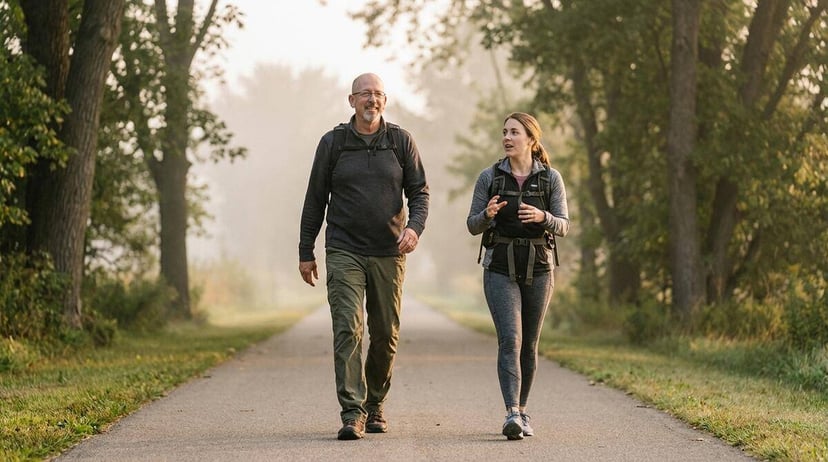
Special populations
Rucking over 50
If you're over 50, you can absolutely ruck. But progression should be more conservative than for younger people.
Start lighter: Begin with 8-12 pounds, not 15-20. Your connective tissue has less natural elasticity, so it needs more time to adapt.
Progress slower: Add weight every 3-4 weeks instead of every 1-2 weeks. This gives your bones and joints adequate time to adapt.
Joint considerations: Pre-existing arthritis, lower bone density, or previous joint injuries may require medical clearance and specific modifications.
The upside: Weight-bearing exercise supports bone health, though the evidence for loaded walking specifically is mixed. A 5-year program of weighted-vest exercise plus jumping maintained hip bone density in postmenopausal women (Snow et al., 2000), while a 2025 trial found that wearing a weighted vest during weight loss did not prevent hip bone loss in older adults (Beavers et al., 2025). Rucking is good training; it isn't an osteoporosis treatment.
See our rucking for seniors guide for age-specific progressions and research-backed recommendations.
Rucking with previous injuries
Back injuries: Get medical clearance from a healthcare professional. Start with 5-10 pounds. Prioritize core strengthening-this is non-negotiable. Avoid rucking if it reproduces your original pain.
Knee injuries: Use a shorter stride (faster cadence, shorter steps). Stay lighter on weight. Do quad strengthening regularly. Consider a knee brace if recommended by a professional.
Shoulder injuries: Hip belt is mandatory-it transfers load away from your shoulders. Keep loads light. Gradually load the shoulder straps as you progress.
Arthritis: Loaded walking can actually support joint health when scaled correctly. Our guide to rucking with arthritis covers what the research says and how to manage load on affected joints.
Always get medical clearance before starting rucking if you have significant injury history. Your doctor or physical therapist can give you personalized guidance based on your specific situation.
The best injury prevention tool is boring: start lighter than you think you need to, progress slower than you want to, never skip the warm-up or prehab, and pay attention to the signals your body is sending. The ruckers who stay injury-free year after year are the patient ones.
The prevention stack
Blisters are the most common load-carriage injury, so the feet come first: shoes that fit, merino or synthetic socks, and a small foot-care kit (tape, balm, patches). Gear supports good progression; it doesn't replace it.
Three pieces of kit cover friction, recovery, and monitoring: an anti-chafe balm for hot spots, a foam roller for post-ruck tightness, and a watch that makes it easy to see when your training load is climbing.
| Role | Pick | What it prevents |
|---|---|---|
| Anti-chafe | Body Glide Original | Heels, sides of feet, known hot spots. Fits in a pocket. |
| Foam roller | TriggerPoint GRID | Post-ruck calf, quad, and hip tightness. Comfort, not a treatment. |
| Watch | Garmin Instinct 3 Solar | Heart-rate zones, weekly load, and recovery trends in one place. |
Go deeper
- Rucking knee pain - types, causes, and fix - biomechanics research, symptom decision tree, and return-to-rucking progression
- Rucking plantar fasciitis - prevention, treatment phases, and footwear recommendations
- Rucking shin splints - early signs, what prevention evidence supports, and stress-fracture red flags
- Rucking foot care and blister prevention - socks, lacing, hot spots, and what to carry
- Numb hands while rucking (rucksack palsy) - why straps compress the brachial plexus and how to refit the pack
- Hip flexor stiffness after rucking - what to try and when to get help
- Rucking with arthritis - what the research says about loaded walking and sore joints
- HRV and the vagus nerve for ruckers - using recovery data to decide when to back off
- The rucking prehab routine - 8 exercises targeting feet, knees, hips, back, and shoulders
- Rucking mobility guide - warm-up, cool-down, and recovery routines
- Is rucking bad for your back? - what the science says about loaded walking and spinal health
- Rucking for seniors - safe-start guide for adults over 50
Frequently Asked Questions
Intermittent knee pain under load often indicates early-stage patellofemoral irritation or IT band tightness. Drop your load by 20-30% for two weeks and focus on the quad strengthening and glute bridge exercises from the prehab routine. If pain persists or worsens, see a healthcare professional before continuing.
Get it assessed first. Walking has lower impact per step than running, so some people tolerate it better, but the pack adds load to the same tissue. Start very light (5-10 pounds), wear supportive shoes, add calf strengthening, and progress slowly. Stop if heel pain builds during the ruck or is worse the next morning.
Footwear issues typically cause blisters, hot spots, or arch pain that starts within the first 15-20 minutes and gets worse throughout the ruck. Form issues usually manifest as knee pain, back pain, or fatigue patterns that develop after 30+ minutes under load. If you're getting foot pain immediately, it's likely your shoes.
Mild soreness lasting 24-48 hours is normal, especially when starting out. But 2-3 days of soreness suggests you're carrying too much weight on your shoulders instead of transferring load to your hips through the hip belt. Make sure your hip belt is snug and positioned correctly on your hip bones, not your waist.
Muscle fatigue feels like burning, heaviness, or general tiredness in large muscle groups (quads, glutes, calves) and often improves briefly when you slow down or rest. Pain you should stop for is sharp, localized to joints or specific spots, worsens when you continue moving, or causes you to limp or change your gait.
Either works, but most people find it easier to stay consistent by doing prehab on rest days. If you do it on ruck days, complete the prehab routine before you ruck as a warm-up, not after when you're already fatigued. The key is hitting it 2-3 times per week consistently rather than perfect timing.
It depends on the injury and how early you respond. A hot spot or mild ache caught early may need only a few lighter sessions. Established overuse injuries take longer: in one study of athletes with shin splints, a graded return-to-running program took about three months on average to reach 18 minutes of pain-free running (Moen et al., 2012). A clinician can give you a realistic timeline for your own injury, which is one more reason to progress slowly in the first place.