
- Warm up with moving drills before you add load.
- Save long static holds for after the ruck or separate mobility sessions.
- Prioritize hips, ankles, calves, thoracic spine, chest, and shoulders.
- Five minutes after every ruck is more useful than one long session you rarely do.
Why mobility matters for ruckers
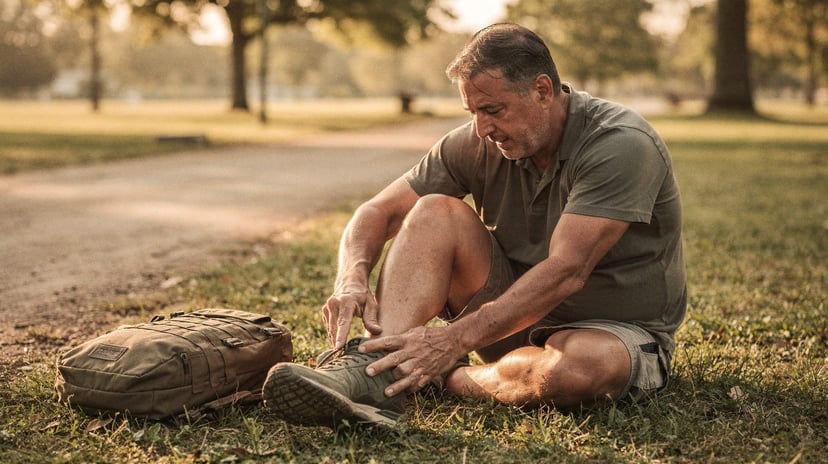
Rucking is repetitive. Over the course of a 10-mile ruck, you're taking roughly 15,000 identical steps under load. That's 15,000 repetitions of the exact same movement pattern, with your hips in a slightly forward position, your shoulders slightly rolled under the pack, and your ankles plantarflexed (pointing downward).
Do that every week for a few months without mobility work, and your body adapts by tightening. Your hip flexors shorten from being held in that flexed position. Your shoulders round slightly, matching the position of being under load. Your ankles stiffen from the repetitive plantarflexion. Your lower back loses some extension mobility because you're moving in a narrow range.
These adaptations don't hurt right away. But by month 3 or 4, they stack up. Your hips get tight enough to affect your gait. Your shoulders start rounding enough to pull on your neck. Your ankles become stiff enough that you can't land properly, so your knees compensate. Injuries follow.
The fix is simple and costs nothing: targeted mobility work. Just 10 to 15 minutes, 2 to 3 times per week, prevents most of these problems. Add a 5-minute post-ruck cool-down on every training day, and you've effectively eliminated the slow accumulation of tightness that leads to injury.
- 01
Opplert and Babault reviewed dynamic stretching research and found it can improve range of motion while fitting better with performance demands than long static holds.
- 02
Simic, Sarabon, and Markovic found that pre-exercise static stretching can temporarily reduce strength and power. That is why this guide uses dynamic movement before rucks and longer holds after.
Pre-ruck warm-up (5 minutes)
Your pre-ruck routine is not about stretching. Static stretching - holding a stretch for 30 seconds - actually reduces muscle performance for a short time if done before activity. Instead, your goal is to raise your core temperature, lubricate your joints, and activate the muscles that will stabilize you under load.
Leg swings (10 repetitions each direction per leg): Stand with one hand on a wall or railing for balance. Swing one leg forward and backward 10 times in a controlled motion. Then swing it side to side across your body 10 times. Repeat on the other leg. This wakes up your hip flexors, glutes, and hip stabilizers, and it takes your hip through a large range of motion.
Walking lunges with twist (8 repetitions each side): Step forward into a lunge, then rotate your torso toward the front leg. Hold for a second, return to center, and step forward with the other leg. This combines a hip flexor stretch with thoracic rotation and quads activation. You're preparing your hips, spine, and legs for loaded movement.
Ankle circles (10 repetitions each direction per foot): Stand on one leg and draw circles with your other foot - 10 circles one direction, 10 the other. This mobilizes your ankle joint and improves proprioception (your sense of where your foot is in space). Ankle stability is foundational for all loaded walking.
Arm circles (10 forward, 10 backward): Slow, controlled arm circles in both directions. This prepares your shoulder girdle for the weight of the pack and primes your rotator cuff. Don't rush these - let them be deliberate and full range.
Cat-cow (8 repetitions): On your hands and knees, alternate between arching your back (cow) and rounding your spine (cat). This mobilizes your entire spine, especially your thoracic spine and lower back, which will be under load during your ruck.
Two-minute easy walk: Before you put on the pack, walk at a comfortable pace for 2 minutes. Get your heart rate up slightly, let your muscles warm up, and establish your walking rhythm. Then load the pack and begin your ruck.
This entire routine takes about 5 minutes and sets your body up for success. The warm-up is not about stretching; it's about preparation.
Post-ruck cool-down (5-8 minutes)
This is where most ruckers fail, and it's the single biggest regret people express when they develop chronic tightness or injury. They finish the ruck, take off the pack, and go straight to the couch or car.
Your post-ruck cool-down is the highest-ROI habit you can build. Now that your muscles are warm and your nervous system is already engaged, they're most receptive to lengthening and returning to their baseline range of motion. This 5-minute window is more valuable than 30 minutes of stretching on a rest day.
Perform all of these stretches with a relaxed posture, holding each for about 30 seconds. You're not trying to be flexible; you're trying to signal recovery and gently return your muscles to their pre-ruck length.
Calf stretch (wall lean, both legs): Face a wall, place your hands on it, and step one leg back until you feel a stretch in the calf. Keep your heel down and your body straight. Hold 30 seconds each leg. Your calves have been in plantarflexion for miles; this releases that.
Hip flexor stretch (kneeling lunge position): Kneel on one knee (use a pad if you need it), step the other foot forward, and gently press your hips forward. You'll feel a stretch along the front of your back hip. Hold 30 seconds each side. This is crucial because hip flexors tighten quickly under load.
Hamstring stretch (standing or seated): If standing, keep one leg straight and bend forward from the hips, letting your torso fall toward your leg. If seated, extend both legs and gently fold forward. Hold 30 seconds. Your hamstrings are in a lengthened position under load, and they benefit from this gentle return.
Chest and shoulder doorway stretch: Place your forearm on a doorframe with your elbow at 90 degrees and step forward gently. You'll feel a stretch across your chest and anterior shoulder. Hold 30 seconds. The pack weight pulls your shoulders forward; this gently reverses that position.
Thoracic spine rotation (seated or lying): If seated, cross your arms over your chest and gently rotate side to side. If lying on your back with knees bent, drop one knee toward the opposite arm. Hold 30 seconds each direction. This restores rotation to a spine that's been locked in forward flexion.
Quad stretch (standing): Pull one foot toward your glute, keeping your torso upright. Hold 30 seconds each leg. Your quads have been working hard; this returns them to a lengthened position.
Finish with 30 seconds of deep breathing, standing tall with your arms at your sides. This signals your nervous system that the work is done and recovery has begun.
Weekly deep mobility session (15-20 minutes)
On at least one rest day per week, dedicate 15 to 20 minutes to deeper mobility work. This is where you address accumulated tension that daily cool-downs miss, where you work on chronic tightness, and where you build resilience in the tissues that matter most for loaded walking.
You'll need a foam roller for most of these. A standard 12-inch foam roller costs $15 to 25 and lasts for years. New to rolling? Our sister site Kit Authority's how to foam roll guide covers technique and pressure basics, and their foam roller picks compare densities.
Foam roll calves (60 seconds each leg): Sit on the ground with your legs extended, place the foam roller under one calf, and roll from your ankle to your knee. Apply as much pressure as you can tolerate. Your calves are dense tissue and benefit from aggressive self-massage. Do 60 seconds each side.
Foam roll quads (60 seconds each leg): Face down on the ground with the foam roller under your quads. Roll from your hip toward your knee. This is tender tissue; apply firm pressure but don't injure yourself. 60 seconds each leg.
Foam roll IT band (60 seconds each leg): Lie on your side with the foam roller under your hip and IT band area (upper outer thigh). Roll up and down this region. Expect this to be uncomfortable. It's where a lot of tension accumulates in ruckers. 60 seconds each side.
Foam roll upper back (60 seconds): Lie on your back with the foam roller under your upper back at mid-scapula level. Support your head with your hands and gently roll up and down the thoracic spine. This is crucial for counteracting the rounded-shoulder posture that packs create. 60 seconds.
Pigeon pose or figure-four stretch (60 seconds each side): Sit with one leg extended and the other leg bent in front of you (pigeon), or lie on your back and cross one ankle over the opposite knee while pulling your lower leg toward you (figure-four). Either position deeply stretches the glutes and hip external rotators. Hold 60 seconds each side. If you only do one stretch for tight hips, this is it.
World's greatest stretch (8 repetitions each side): Step forward into a lunge, place your hands on the ground, rotate toward your front leg, then extend your arm overhead. This single movement combines hip flexor stretching, thoracic rotation, and hip mobility. Do 8 controlled repetitions each side.
Thoracic spine extension over foam roller (10 repetitions): Place the foam roller perpendicular to your spine (supporting your mid-back) and gently extend backward over it, hands supporting your head. This directly reverses the flexed position you're in during loaded walking. Do 10 controlled repetitions.
Banded shoulder dislocates (15 repetitions): Hold a resistance band or light stick with a wide grip (about 3 to 4 feet apart), raise it overhead, and pull it behind your body in an arc, then return it over your head. This mobilizes your shoulder joint and counteracts the internal rotation that pack straps create. 15 smooth repetitions.
Deep squat hold (60 seconds): Squat to the deepest position you can hold with your feet flat on the ground. Stay there for 60 seconds. This isn't a strength exercise; it's mobility work. It opens your ankles, hips, and knees simultaneously. If you can't hold it, hold for as long as you can and work up to 60 seconds over weeks.
Ankle dorsiflexion stretch (30 seconds each): Kneel on one knee, place the other foot in front with your toes tucked under (toes pointing back), and gently press your hips forward. You'll feel a deep stretch along the top of your foot and anterior ankle. Hold 30 seconds each. This reverses the plantarflexion you've been in all ruck.
This session takes 20 minutes and should leave you feeling noticeably less tight than before. The earlier you establish this habit, the less you'll need it as a corrective measure.
Mobility by problem area
If you're experiencing specific tightness, these targeted approaches will address the root cause.
Tight hips (most common)
Hip tightness is nearly universal in ruckers, and it's the most common cause of lower back strain and knee pain because tight hips force compensation throughout the chain. When your hips can't move properly, your lower back takes over. When your lower back takes over, your knees suffer.
Rucking tightens your hip flexors because you're holding them in a flexed position for hours. Add sitting at a desk all day, and your hip flexors are borderline shortened.
Your fix: daily hip flexor stretching (30 seconds each side, every single day), pigeon pose (the single best hip mobility movement), 90/90 stretches (lying on your side with your hip at 90 degrees and knee at 90 degrees, gently pressing your top knee toward the ground), and the couch stretch (one foot elevated on a couch, hips pressed forward). Do at least one of these every day, and all of them 2 to 3 times per week. Your hips will open up noticeably within 3 weeks.
Rounded shoulders
Pack straps pull your shoulders forward and inward. Over time, this creates a rounded-shoulder posture that persists even when you're not rucking. Rounded shoulders affect your breathing, your neck, and your upper back stability.
Your fix: doorway stretches (place your forearm on the doorframe with elbow at 90 degrees, step forward), band pull-aparts (hold a light resistance band, pull it apart in front of your body against resistance), thoracic extension work (foam rolling your upper back, extension over a foam roller), and wall angels (stand with your back and arms against a wall, slide your arms overhead and back down while maintaining contact with the wall). These directly reverse the position you're in under load. Do these 2 to 3 times per week.
Stiff ankles
Repetitive plantarflexion under load stiffens your ankles. Stiff ankles reduce your ability to land properly, which throws more stress on your knees and hips.
Your fix: ankle dorsiflexion stretches (toes tucked under, hips pressed forward), ankle circles (full range of motion in both directions), calf raises through full range of motion (stand on the edge of a step and go up and down through your entire ankle's range), and eventually single-leg balance work on uneven ground. These restore dorsiflexion mobility, which improves your foot mechanics during walking.
Footwear that allows natural ankle mobility matters too. Check our Salomon XA Pro 3D or explore more in our shoes by terrain guide to find shoes that support ankle movement without restricting dorsiflexion.
Lower back tightness
Your lower back gets hammered during loaded walking because it's asked to stabilize a load while your hip flexors and core fatigue. Lower back tightness is often a sign of core fatigue and excessive forward lean.
Your fix: cat-cow (mobilizes your entire spine), child's pose (gently decompresses your lower back), dead hangs (hang from a pull-up bar for time, which decompresses and lengthens your spine), and knee-to-chest stretches (lying on your back, gently pulling one knee toward your chest). These decompress and lengthen your lower back. Also address your core strength with the prehab routine, because weakness is often the root cause of lower back tightness.
Recovery tools worth the investment
Two items return the highest ROI of any recovery purchase you can make. The foam roller addresses the tissue tightness that mobility drills can't reach on their own, and proper trail shoes prevent the ankle-restriction problems that mobility work has to reverse week after week.
| Role | Pick | Why it pays for itself |
|---|---|---|
| Foam roller | TriggerPoint GRID | Textured surface targets fascia better than flat rollers. Lasts 5+ years for $30. |
| Shoes | Salomon XA Pro 3D | Real arch support + ankle stability. Stops the mobility-work treadmill you're stuck on with worn-out shoes. |
Not all recovery gear is created equal. Some tools return massive value for modest cost; others are marketing hype.
Foam roller ($15-25): This is non-negotiable. A standard 12-inch foam roller is the single best recovery investment you can make. It costs almost nothing, lasts for years, and directly addresses soft tissue tightness. The TriggerPoint GRID is the one we keep recommending - the textured surface targets fascia better than a flat roller.
Lacrosse ball ($5): Use this for targeted trigger point work on feet (especially arch fascia), glutes (often harboring tight spots), shoulders, and anywhere else you have a tender point. It's small enough to carry and versatile. Cheap and effective.
Proper footwear ($100-200): After a foam roller, this is your next mobility investment. Shoes with arch support and ankle stability prevent the mobility restrictions that mobility work has to reverse. Spending on supportive gear now saves you months of tight hips and stiff ankles later. The Salomon XA Pro 3D is a great choice, or find the right fit in our best rucking shoes guide.
Massage gun ($50-150): Convenient and feels good, but not essential. If you enjoy using it and consistency matters more than the tool, this is worth it. Otherwise, a foam roller does most of what a massage gun does for much cheaper.
Yoga mat ($15): Makes floor stretches and foam rolling more pleasant. Not essential, but it beats doing mobility work on bare tile or concrete.
Skip these: Cryotherapy, compression boots, expensive recovery gadgets, weighted recovery devices, and anything else marketed as a shortcut to mobility. Consistency with simple tools beats sporadic use of expensive ones every time.
Your shoes matter too - stiff or poorly fitting footwear limits ankle mobility and forces compensations up the chain. And if your pack doesn't fit properly, no amount of mobility work will fix the postural problems it creates. Our best rucking backpacks guide covers fit and sizing in detail.
The 5-minute post-ruck cool-down is the single highest-ROI habit you can build as a rucker. It takes almost no time and prevents the slow accumulation of tightness that leads to injury at month 3 or 4. Do it while your muscles are still warm - don't go straight to the couch.
Frequently Asked Questions
No, save static stretching for after your ruck when muscles are warm. If you're tight from yesterday, spend an extra minute on the dynamic warm-up movements like leg swings and walking lunges, which mobilize joints without reducing muscle performance.
Most ruckers see noticeable hip opening within 3 weeks of consistent daily hip flexor stretching and weekly pigeon pose work. The key is daily consistency rather than longer, sporadic sessions.
Absolutely not. The 5-minute post-ruck window when muscles are warm is more valuable than 30 minutes of stretching on a rest day, and the weekly session addresses different accumulated tension that daily cool-downs miss.
Start with lighter pressure and shorter durations (30 seconds instead of 60), or use a lacrosse ball for more targeted work on specific tight spots. IT band rolling is uncomfortable for everyone, but you shouldn't be in acute pain.
Mobility work helps, but chronic postural changes often need strengthening too. Focus heavily on the doorway stretches and band pull-aparts, but consider that your pack fit might be contributing to the problem if it's pulling your shoulders forward excessively.
Try the ankle dorsiflexion stretch with your toes tucked under - if you feel it primarily in your calf, it's muscle tightness. If you feel restriction in the front of your ankle joint itself, that's true ankle stiffness and needs the specific ankle mobility work outlined.
Both. Do the 5-minute post-ruck cool-down only on training days while muscles are warm, but the weekly 15-20 minute deep session should happen on a rest day when you can focus entirely on mobility without fatigue.


