
Why rucking stresses the plantar fascia
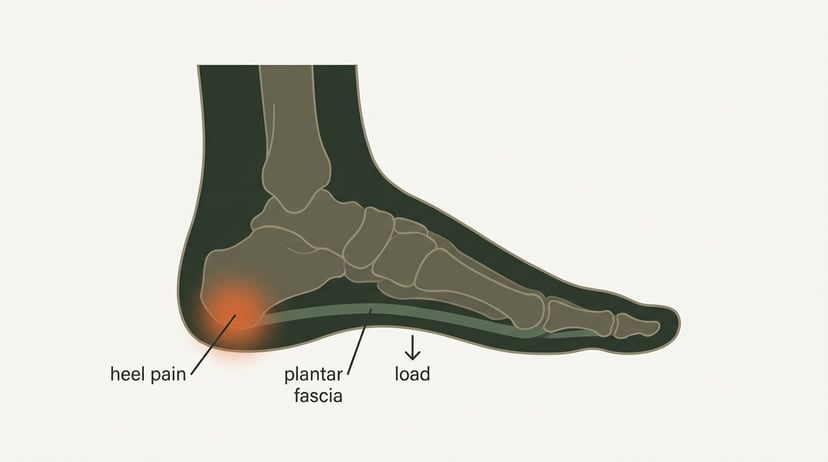
The plantar fascia is a thick band of connective tissue running along the bottom of your foot from your heel to your toes. Every time you take a step, this fascia stretches and absorbs impact. It's designed to handle this work - your body adapts to load over time.
But add 20 to 40 pounds to your frame, and everything changes. Your ground reaction forces - the force your foot experiences with each step - increase by 15 to 25 percent. Combined with the repetitive nature of rucking (thousands of identical steps per hour), this becomes a significant stress on the plantar fascia.
Now, this stress is manageable if you progress gradually and have mobility work to balance it. But if you increase distance too fast, have chronically tight calves, wear shoes without good arch support, or have a foot structure that's mechanically disadvantaged (very flat arches or very high arches), the plantar fascia can become overloaded faster than it can adapt.
Most people who develop plantar fasciitis from rucking didn't have a sudden, traumatic injury. They had weeks of overuse that they didn't notice until suddenly, one morning, they couldn't walk.
Symptoms and diagnosis
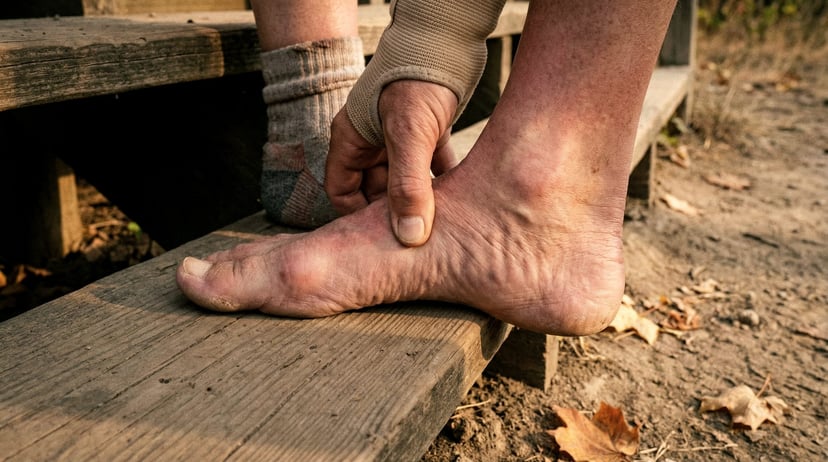
Plantar fasciitis has a very recognizable signature. The classic symptom is sharp heel pain with your first steps in the morning. You wake up, put your feet down, and there's an immediate stabbing pain in your heel or along your arch. Often it eases a bit as you walk around and your foot warms up, but it returns after sitting for a long time.
Some people feel the pain along the entire arch rather than just the heel. Others describe it as a sharp, localized tenderness you can feel by pressing on the bottom of your foot, especially along the inside edge of your arch.
The pain gets worse after long periods of sitting - your foot shortens while you're resting, tightening the fascia. Then you stand up and suddenly stretch it, causing pain. This is why it's often worst in the morning or right after rucking.
Interestingly, many people report that the pain eases once they start moving during a ruck. The tissue warms up, and the repetitive motion actually feels better. But then pain returns once they stop. This on-off pattern is classic for plantar fasciitis.
To distinguish this from other foot pain, ask yourself: Is the pain worse in the morning with first steps? Is it along the heel or arch specifically? Does it ease as you warm up? If you answer yes to these, plantar fasciitis is almost certainly what you're dealing with.
Treatment protocol
Plantar fasciitis is frustrating because it's slow to respond to treatment. Unlike an acute injury that improves week-to-week, fasciitis often takes 6 to 8 weeks to fully resolve even with perfect adherence. But it does respond reliably to the right combination of load management, stretching, and strengthening.
Acute phase (first 1-2 weeks)
Your immediate goal is to reduce inflammation and prevent further microtrauma. Reduce your ruck distance by 50 percent - if you've been doing 5-mile rucks, drop to 2 to 3 miles. Reduce weight proportionally.
Ice your foot after activity for 10 to 15 minutes. A frozen water bottle under your arch works perfectly - you get the ice benefit while simultaneously doing a massage. Do this immediately post-ruck while inflammation is highest.
Stretch your calves three times daily. Calf tightness is commonly associated with plantar heel pain. A 30-second wall calf stretch (standing facing a wall, one leg extended behind you, gentle forward lean) takes 2 minutes total for both sides and is non-negotiable. Do this morning, afternoon, and evening.
Use a tennis ball to roll your arch. Place the ball on the ground and roll your foot over it, applying pressure. Do this for 2 to 3 minutes per foot. This combines massage with gentle loading in a pain-tolerable range.
If you have access to over-the-counter anti-inflammatory medications and appropriate for you, NSAIDs can help reduce inflammation, especially for the first few days. Talk to your doctor about this if you're uncertain.
The key point: don't stop walking entirely. Resting completely often prolongs recovery. Walking gently and with reduced load keeps blood flow to the area, maintains muscle strength, and prevents deconditioning. You're managing the load, not eliminating it.
Strengthening phase (weeks 2-6)
Once acute inflammation has dropped, it's time to build capacity in your foot. Your plantar fascia needs to be stronger to handle rucking loads.
Calf raises: Eccentric calf raises (lowering slowly) are particularly effective. Stand on the edge of a step, rise up on your toes, then lower yourself down slowly over 3 to 5 seconds. Do 3 sets of 12 repetitions. Start on two legs; progress to single-leg as your foot strengthens.
Towel scrunches: Place a small towel on the ground and use your toes to scrunch it toward you. This engages the small intrinsic muscles of your foot and arch. Do 3 sets of 15 repetitions.
Arch doming: Without curling your toes, try to create a dome in the arch of your foot by pulling the ball of your foot toward your heel. Hold for 2 seconds, repeat. Do 3 sets of 15. This directly strengthens the muscles that support your arch.
Foot intrinsic exercises: Single-leg balance (10 to 20 seconds per foot) helps your foot stabilizers engage. Slowly progress to balancing on one foot on a slightly unstable surface like a pillow.
Pair this strengthening with continued calf stretching - your foot is getting stronger, but if your calf remains tight, you're fighting upstream resistance.
Return to full loading (weeks 6-8)
Once pain has dropped significantly (you're barely noticing it), you can start adding volume back. Use the 10 percent rule: increase either distance or weight by no more than 10 percent per week. If you're at 3 miles comfortably, the next week you could do 3.3 miles. Then 3.6 miles the week after.
Your symptom guide is morning pain. If you wake up with no heel pain, you're improving. If morning pain returns even slightly, you've added volume too fast. Step back one week and progress slower.
Most people can return to their baseline within 6 to 8 weeks if they're consistent with all three components: load management, stretching, and strengthening.
Prevention
Three pieces of kit do most of the prevention work. Shoes with a firm heel counter and structured arch keep load off the fascia, an aftermarket insole upgrades the arch support of any shoe you already own, and a boot with a rockered outsole handles repeat-flare recovery.
| Role | Pick | What it prevents |
|---|---|---|
| Trail shoes | Salomon XA Pro 3D | Firm heel counter + real arch support. Stops the heel-strike collapse that radiates into the fascia. |
| Insole | Superfeet Green | Aftermarket arch support for shoes with a removable insole. A firmer arch than most stock insoles. |
| Boots | Salomon Quest 5 GORE-TEX | Mid-rise + rockered outsole. Reduces fascia strain across long rucks if you've had repeat flares. |
Once you've had plantar fasciitis, you're at higher risk for it recurring. Prevention is your best investment.
Daily calf stretching is non-negotiable. Even on non-ruck days, 30 seconds each side of wall calf stretches will keep your calves from tightening up. It is one of the simplest prevention habits to keep.
Invest in footwear with good arch support. When rucking, wear shoes designed for hiking, work boots, or specifically supportive running shoes - not minimalist shoes, not flats, and not worn-out shoes. Your feet are the foundation of load distribution. Try the Salomon XA Pro 3D or explore our shoes by terrain guide to find options by environment so you can match footwear to your rucking surface.
If you have flat feet or very high arches, consider over-the-counter orthotic insoles. Superfeet Green insoles have solid arch support and work in most shoes. They're not custom, but they're a huge upgrade from flat insoles.
Progress distance and weight slowly. The 10 percent rule isn't just for rehab; it's preventive. Your plantar fascia needs time to adapt to increased load.
Post-ruck foot rolling with a tennis ball or frozen water bottle addresses small amounts of tension before it accumulates. Ten minutes of rolling once or twice per week prevents the buildup that leads to plantar fasciitis.
Footwear recommendations for plantar fasciitis
Shoes are not the only solution to plantar fasciitis, but they're part of it. If your shoes provide poor support and you add loaded walking, plantar fasciitis becomes much more likely.
Look for shoes with structured arch support - you should be able to feel a distinct arch support when you run your hand inside the shoe. Your feet should feel supported, not sinking or rolling.
Firm heel counters are important. The heel counter is the rigid part of the shoe that wraps your heel. A firm counter helps stabilize your heel and reduces excessive motion that stresses the fascia.
Moderate cushioning in the heel is good; too much cushioning can actually reduce stability. A midsole that's supportive but not mushy is ideal.
Avoid minimalist shoes, flat shoes, or worn-out shoes with no structure. Don't switch to barefoot rucking as an experiment if you have or have had plantar fasciitis - your foot needs support to load safely.
If you're in the market for rucking shoes specifically, look at hiking boots or structured trail shoes. Running shoes can work if they have good arch support, but boots are often better for loaded walking because they provide more ankle stability and typically have firmer arch support.
If your rucks are mostly on pavement, a structured road shoe fits the same checklist without the weight of a boot. The Brooks Adrenaline GTS 25 is the stability pick in our pavement shoe guide: a 10mm drop, GuideRails that limit excess side-to-side motion, and balanced cushioning, in widths from narrow to extra wide. It suits the return-to-loading weeks, when you want support on familiar flat routes. It won't treat the fascia on its own, so keep the calf work going.

Firm heel counter, GORE-TEX waterproofing, aggressive tread. Great structure for plantar fasciitis sufferers who need stability over long distances.

Full ankle support, rockered outsole reduces fascia strain. Best choice if you've had repeat PF flare-ups or ruck on technical terrain.

Wide toe box reduces forefoot compression. Zero-drop, so it suits people already used to low-drop shoes; not a first switch during a flare.
For more options and detailed terrain-specific guidance, try the Salomon Quest 5 GORE-TEX or see our Best Rucking Shoes by Terrain guide.
If you're starting from zero and want a complete setup that includes supportive footwear, our budget rucking starter kit includes shoe recommendations paired with other essentials you'll need.
The single best thing you can do for plantar fasciitis prevention: stretch your calves for 30 seconds each side, every single day. Calf tightness is commonly associated with plantar heel pain, and the stretch takes less than two minutes.
Frequently Asked Questions
Don't stop completely, but reduce your distance by 50 percent and drop weight proportionally. Complete rest often prolongs recovery because it reduces blood flow and leads to deconditioning.
Recovery takes 6 to 8 weeks minimum with consistent treatment. Your best progress indicator is morning pain - if you wake up with no heel pain, you're improving. If morning pain returns after increasing activity, you've progressed too fast.
Eccentric calf raises (lowering slowly off a step) directly strengthen the calf muscles that support your plantar fascia, while stretching only addresses tightness. The article emphasizes that building capacity in your foot is more effective than just trying to lengthen tight tissues.
Over-the-counter orthotics like Superfeet Green can help significantly if you have flat feet or very high arches. They're not custom but provide much better arch support than flat insoles, especially under rucking loads.
Yes, this is classic plantar fasciitis behavior. The tissue warms up during activity and the repetitive motion actually feels better, but pain returns once you stop and the fascia cools down and tightens again.
No, avoid minimalist shoes or barefoot rucking if you have or have had plantar fasciitis. Your foot needs structured support to handle rucking loads safely, not less support during the healing process.
Plantar fasciitis has a specific pattern: sharp heel or arch pain with first steps in the morning, pain after sitting that eases as you warm up, and tenderness you can feel by pressing along the inside edge of your arch.


