The short answer

To start rucking for weight loss, carry 10-15 lbs for 20-30 minutes, 2-3 times per week, at a pace where you can still talk. Do that for two weeks before adding distance or weight. Your first goal is not to suffer. Your first goal is to make loaded walking repeatable.
The simple beginner prescription:
| Starting point | Ruck weight | Frequency | Distance or time | Goal |
|---|---|---|---|---|
| New to exercise | 10 lbs | 2x/week | 20 min or 1 mile | Finish pain-free |
| Walks regularly | 15 lbs | 2-3x/week | 30 min or 1.5-2 miles | Build consistency |
| Already trains | 15-20 lbs | 3x/week | 2 miles | Add weekly volume |
| Returning from injury | 5-10 lbs | 2x/week | 15-20 min | Rebuild tolerance |
Rucking works for fat loss because it increases the cost of walking without turning every session into a hard run. Added load raises metabolic demand, but the movement pattern stays familiar, repeatable, and low skill. For most beginners, that combination beats a harder workout they only do for three weeks.
The five-item weight-loss kit
Walking consistency is what produces fat loss, so the right gear is whatever keeps you walking 3-4 times per week without friction. Five items cover most of it: a pack you'll actually grab, a steel plate that doesn't shift, walking-friendly shoes, blister insurance, and one bottle of water. For the full breakdown with budget and premium picks for each slot, see our best rucking gear for weight loss guide.
| Role | Pick | Why it earns the slot |
|---|---|---|
| Pack | 5.11 RUSH 24 | Entry pack with a plate sleeve. Big enough for a 30-min walk + water, small enough to wear on a 3-mile loop. |
| Weight | Titan Fitness Ruck Plate | Steel plate that sits flat against your back. Start at 10-15 lbs, add a second plate when the first feels light. |
| Shoes | Salomon XA Pro 3D | Cushion + arch support for daily walking miles. Reduces joint stress that derails consistency. |
| Anti-chafe | Body Glide Original | Chafing is an avoidable reason to skip a session. Apply before, not after. |
| Hydration | Nalgene 32oz Wide-Mouth | One bottle = 60-90 min of summer rucking. Drop an electrolyte tab in if you sweat heavy. |
This is the kit that gets you to month 3 without "I should buy something else" friction. The educational sections below cover calorie math, the progressive load protocol, and what to do when the scale stalls.
How many calories does rucking burn?
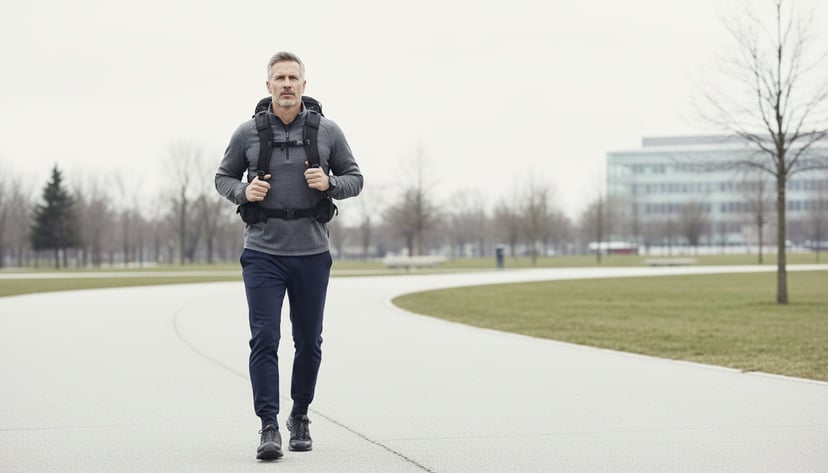
The science behind rucking calories is rooted in military research. The Pandolf equation, developed in 1977 and refined by Santee in 2001, is the gold standard for predicting energy expenditure while carrying a load. Unlike generic calorie calculators that assume level terrain and no load, the Pandolf equation accounts for five key variables:
- Your body weight - heavier people burn more calories
- The weight you're carrying - the load itself requires energy to move
- Your walking speed - faster = more calories per minute, but the relationship isn't linear
- Terrain grade - uphill is exponentially more expensive; downhill slightly less so
- Surface type - soft surfaces (sand, mulch, grass) burn more calories than hard pavement
A 180-pound person carrying 30 pounds at 3.5 miles per hour on flat pavement burns about 410 calories an hour, against about 365 walking the same route without a pack. That 13 percent is less than a lot of rucking content promises. The bigger lever is the route: the same ruck up a 5 percent grade is about 635 calories an hour. Pandolf tends to under-predict heavy loads, so treat these as conservative.
Use the rucking calorie calculator below when you want to calculate your rucking calories by body weight, load, pace, terrain, and duration instead of relying on broad averages.
The Ruck Authority Progressive Load Protocol
Most weight-loss rucking programs fail for one of two reasons: they start too heavy, or they chase intensity before the habit exists. The Ruck Authority Progressive Load Protocol fixes that by sequencing the stress in the order your body can actually adapt to it:
- Load first: start with a light, stable pack.
- Frequency second: build from 2 rucks per week to 3-4.
- Distance third: add weekly miles once your joints feel normal.
- Intensity last: add hills, pace, or heavier weight only after the base is built.
For beginners, the protocol is intentionally conservative:
If a percentage and a fixed weight disagree, use the lighter number. A 120-pound beginner does not need the same starting load as a 220-pound beginner, and an already active person may tolerate more volume than someone coming off the couch. The protocol is a starting point, not a dare.
The Pandolf equation (1977, updated by Santee 2001) remains the most validated predictor of metabolic cost during loaded walking. It accounts for body mass, load mass, walking speed, terrain grade, and terrain coefficient. Our calculator uses the original 1977 equation, on flat and uphill ground.
The individual variation is important to note: these are estimates based on average metabolism and efficiency. Some people burn slightly more, some slightly less, but the Pandolf equation is accurate enough for practical planning-and importantly, it's directionally correct across populations.
Why rucking works for fat loss (when other things haven't)

It's sustainable
Running has a dropout rate that should concern the fitness industry. Studies consistently show that 50% of recreational runners sustain an injury serious enough to affect training within a single year. Even among those who don't get injured, the perceived difficulty is a barrier: running feels hard to most people, and the more something feels hard, the fewer days per week you'll do it.
Rucking, by contrast, feels like walking-because it is walking, just with weight. The barrier to starting is near zero. You don't need special genetic advantages for running. You don't need to be "a runner." The first ruck doesn't feel impossible. This matters more than any other factor for fat loss, because adherence is the strongest predictor of success. The best program is meaningless if you quit after three weeks. The moderate program you actually do is worth infinitely more.
It keeps you in the fat-burning zone
There's a common misconception that you need to hit a high heart rate to burn fat. The science actually points in the opposite direction: Zone 2 cardio, defined as 60-70% of your maximum heart rate, is the sweet spot for sustained fat oxidation. At this intensity, your body preferentially uses fat as fuel rather than glycogen.
Rucking naturally puts most people into Zone 2 without you even trying. A casual ruck at 3.5 mph with 30 pounds sits right in that zone for most fitness levels. A GPS watch with heart rate monitoring like the Garmin Instinct 3 makes this easy to verify in real time - you'll know you're in the zone without guessing. In contrast, running often pushes beginners into Zone 3 or even Zone 4 (80-90% max HR), which is glycolytic and less fat-efficient.
For the complete breakdown of Zone 2 physiology and how to structure your rucking for maximum fat oxidation, see our Zone 2 rucking guide.

It builds muscle while burning fat
Every ruck you do involves a loaded carry. Loaded carries, with weight distributed across your shoulders and back, activate your posterior chain, core, leg stabilizers, and other stabilizing muscles throughout the body. This is stimulus for muscle growth.
Running, by contrast, is largely catabolic at higher volumes: your body will actually break down muscle tissue for fuel. This is especially true if you're doing high-volume running on a caloric deficit. More muscle mass means a higher resting metabolic rate, which means more calories burned even when you're sitting on the couch. Rucking provides a modest anabolic stimulus, particularly valuable for sedentary beginners who have muscle-building potential.
The load itself moves the scale
The best controlled evidence that carrying weight changes body composition comes from weighted-vest trials, and in 2026 they were pooled for the first time.
A 2026 meta-analysis in Osteoporosis International (Wang et al.) combined nine randomized trials covering 368 middle-aged and older adults. People who exercised wearing a weighted vest lost about 2.7 kg more body fat than those who kept their usual activity. More useful for anyone already active: adding the vest to an existing exercise program removed a further 0.7 kg of fat compared with the same exercise without it. The authors rated the fat-mass evidence high certainty. These were vests rather than packs and the participants were mostly older adults, so treat the numbers as the direction of the effect, not a forecast for your own ruck.
It doesn't require recovery like running does
A well-trained runner can handle 4-5 running sessions per week, but this requires a ton of aerobic capacity and comes with injury risk. Most recreational ruckers can handle 4-5 rucking sessions per week indefinitely. Why? The impact on your connective tissue (tendons, ligaments) is substantially lower. Your joints recover faster. Your nervous system isn't hammered by repetitive high-impact forces.
More sessions per week means more total calorie burn, which means faster fat loss. Four one-hour rucks a week at 400 to 600 calories each (flat to hilly) is 1,600 to 2,400 calories of activity, a little under half of which you would have burned sitting still anyway. Paired with a modest food deficit, that adds up.
Rucking vs running vs walking: the calorie comparison
Calories an hour: walking, rucking, running
A 180 lb person. Walking and rucking at 3.5 mph on pavement unless noted
- Walking, no pack365
- Ruck, 20 lb395
- Ruck, 35 lb420
- Ruck, 30 lb, 5% grade635
- Jog, 5 mph710
- Run, 6 mph840
Walking and rucking from the Pandolf load-carriage equation (the model in our calculator), which tends to under-predict heavy loads; running from the Compendium of Physical Activities METs, as in the calculator's comparison table. On flat ground load adds modestly; grade adds a lot.
| Activity | Cal/hr (150 lb) | Cal/hr (180 lb) | Cal/hr (220 lb) | Joint impact | Sustainability |
|---|---|---|---|---|---|
| Walking 3.5 mph, flat | ~305 | ~365 | ~445 | Low | Very high |
| Rucking 20 lbs @ 3.5 mph, flat | ~335 | ~395 | ~475 | Low-moderate | High |
| Rucking 35 lbs @ 3.5 mph, flat | ~360 | ~420 | ~500 | Moderate | High |
| Rucking 30 lbs @ 3.5 mph, 5% grade | ~545 | ~635 | ~760 | Moderate | High |
| Jogging 5 mph | ~595 | ~710 | ~870 | High | Moderate |
| Running 7 mph | ~785 | ~945 | ~1,155 | Very high | Low-moderate |
The chart makes the tradeoff visible: running burns more calories per hour than rucking, but that difference often becomes meaningless if you can only sustain running 2 times per week due to injury or fatigue. Four hilly one-hour rucks at about 600 calories burn more in a week than two 45-minute runs at about 630. Walking and rucking figures come from the Pandolf equation; running from Compendium of Physical Activities METs, the same sources our calculator uses.
For the full head-to-head breakdown including detailed calorie tables, injury comparisons, and individual variation, read Rucking vs running: which burns more fat?
The rucking weight loss program
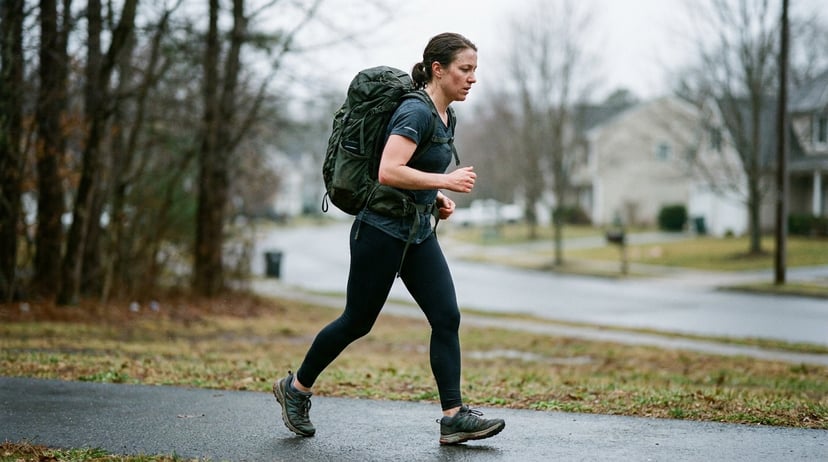
The protocol above gets you through the first eight weeks. The following 12-week framework is the broader program for turning that start into a real fat-loss block. Each phase builds on the previous one, gradually increasing the stress on your system to drive adaptation.
Phase 1: Foundation (Weeks 1-4)
The first month is about building the habit and letting your body adapt to loaded walking. Your tendons, ligaments, and stabilizer muscles haven't done this before. Your feet need to toughen up. You need to find good routes and integrate rucking into your schedule.
Keep the load light - this is not the time to carry 40 pounds. A 15-20 pound load feels like something at first, but it's not heavy enough to cause problems if your form is decent. A purpose-built ruck plate like the Titan Fitness cast iron sits flat against your back and won't shift mid-stride the way dumbbells or water bottles will. The pace should be conversational: you should be able to talk, maybe not sing, during the ruck.
At 3 times per week, you're creating a stimulus without overloading the system. This frequency is also sustainable for almost anyone - it doesn't require rearranging your entire schedule.
Phase 2: Build (Weeks 5-8)
By week 5, your body has adapted. Your connective tissue is stronger. Your aerobic base is higher. Now you can increase frequency, load, and distance.
The jump to 4 times per week is where the real calorie burn starts to happen. You're now doing roughly 1,000-1,700 calories of rucking per week (not counting your regular daily expenditure). You're adding distance gradually-a half mile per week is sustainable and won't shock your system.
The load increase is also gradual: add 5 pounds from week 1 to week 5. This respects the 10% rule and gives your body time to adapt. As your distances grow, footwear matters more - trail shoes like the Salomon XA Pro 3D give you grip and stability that regular sneakers won't. One of these four sessions per week should be your longer ruck (3-4 miles), which builds aerobic capacity and mental toughness but isn't so long that recovery becomes an issue.
Phase 3: Burn (Weeks 9-12)
By phase 3, you're a functional rucking athlete. Your body is adapted. This is where the fat loss is most dramatic. You're doing 4-5 sessions per week at roughly 300-560 calories each, more on the hill day. That's about 1,500-2,700 calories per week from rucking alone, before we even talk about your baseline metabolism or any deficit you're creating through nutrition.
The intensity is introduced through hills rather than speed. A hilly ruck with moderate weight burns more calories than a fast flat ruck, with less injury risk and better sustainability. One session per week includes hills; the others are flat or mixed terrain at a moderate pace.
Nutrition guidelines for rucking weight loss
Rucking creates the opportunity for fat loss through caloric expenditure. Nutrition determines whether you actually realize that opportunity or accidentally eat back all the calories you burn.
The cardinal rule: Don't eat back all your rucking calories. A common mistake is "I just burned 500 calories, so I can eat an extra 500 calories today." At best, this means your rucking effort created zero deficit. At worst, you slightly overcompensate and gain weight while exercising consistently.
Instead, use your rucking as a contributor to your overall caloric deficit, not as an excuse to increase intake.
Protein is critical. Aim for 0.7-1.0 grams of protein per pound of body weight. This is especially important when you're in a caloric deficit because your body will preferentially break down muscle for fuel. Adequate protein tells your body to spare the muscle and use fat instead.
Don't create an excessive deficit. A moderate deficit of 500 calories per day (1 pound per week) is sustainable. A 1,000-calorie deficit per day is aggressive and often backfires: your energy crashes, your recovery tanks, and you become vulnerable to injury. Combined with loaded exercise, an aggressive deficit is a recipe for joint problems.
Hydration matters more with rucking. Add 12-16 fluid ounces of water per 30 minutes of rucking beyond your normal daily intake. You're carrying weight, which increases your metabolic heat. You need the hydration for thermoregulation and to maintain blood volume for oxygen delivery. For longer rucks, LMNT Electrolyte Variety Pack replenishes sodium and electrolytes, especially critical during longer or hotter sessions. A pack with good weight distribution helps you carry hydration comfortably - see our best rucking backpacks guide for packs designed to handle full loads.
Timing around rucks: A light carbohydrate 30-60 minutes before a ruck (a banana, a slice of toast with almond butter) provides glycogen without causing digestive discomfort. Post-ruck, consume protein and carbs within 60 minutes to replenish glycogen and provide amino acids for recovery.

We are not registered dietitians. These are general guidelines based on sports nutrition research. If you have significant metabolic concerns or are managing a medical condition, consult a professional for personalized nutrition planning.
Want the dietitian's full protocol? Ruck Fit by Kayla Girgen (Mayo Clinic-trained RD, CPT, LD) is the only rucking book on the market that pairs training programs with serious nutrition protocols - including blood-sugar management, meal planning calibrated to ruck volume, and body-composition strategy. The W.W. Norton paperback runs $16. See our 2026 rucking books reading list for context on where it fits vs the rest of the field.
Can rucking be your only exercise?
For fat loss specifically, yes: rucking alone will create a caloric deficit and burn fat. However, fat loss isn't the same as comprehensive fitness. We dig into this question in detail in our dedicated article: Can rucking be your only exercise?
The short answer: add 1-2 days per week of strength training (even light bodyweight work) to preserve muscle mass and improve body composition beyond just scale weight.
Tracking your progress
The scale is a poor short-term feedback mechanism for body composition change. A 1-2 pound daily fluctuation based on hydration, sodium intake, and the menstrual cycle is completely normal and tells you nothing about fat loss.
Instead, track weekly averages: weigh yourself daily and average the week, then compare week-to-week. You should expect 1-2 pounds of fat loss per week at a moderate deficit. For a realistic picture of what changes at 30, 60, and 90 days, see our rucking before and after timeline.
Also track:
- Circumference measurements (waist, hips, chest)-often these change before the scale does
- Progress photos (every 4 weeks)-visual change is sometimes more motivating than scale weight
- Rucking metrics: load, distance, pace, heart rate, RPE-you're looking for pace to improve at the same weight, or the ability to carry more weight at the same pace
A GPS watch with built-in heart rate makes the rucking-metric piece automatic. The Garmin Instinct 3 is the rucker's pick - rugged, multi-week battery, accurate Zone 2 tracking. If you want a do-everything lifestyle tracker rather than a rugged outdoor watch, our sister site Kit Authority's Garmin Vivoactive 5 review covers that everyday-fitness option.
Early on (weeks 1-4), the scale may not move as much as you'd hope. This is often because you're building muscle as you're losing fat. Your body composition is improving even if the scale is slow. Trust the process. By week 8, momentum is usually visible.

Common weight loss mistakes with rucking
A 30-pound load in week 2 sounds ambitious. It usually results in injury, which derails consistency far more than a lighter load ever would. The 10% rule (10% load increase per week) feels slow. It works.
You burned 500 calories rucking? Great - that doesn't mean you get to eat an extra 500 calories. Your rucking session is part of your total weekly caloric deficit, not an excuse to increase intake.
Rucking burns calories. Strength training preserves muscle mass in a deficit, which is critical for body composition. They work together. Add 1-2 days of bodyweight or gym work to the program.
Rest days are when adaptation happens. Rucking 6-7 days per week in a caloric deficit piles up fatigue, which makes the deficit harder to hold. Don't count on extra sessions to speed up your metabolism either: a meta-analysis of exercise trials, MacKenzie-Shalders et al. (2020) in the Journal of Sports Sciences, found that aerobic training did not raise resting metabolic rate, while resistance training raised it by about 96 calories a day. 4-5 rucks a week plus two short strength sessions is the sustainable sweet spot.
Weight loss is nonlinear. Some weeks you'll drop 3 pounds. Some weeks you'll plateau for two weeks. Some weeks you'll go up 2 pounds before dropping 5. This is completely normal. Zoom out and look at the 4-week trend, not the daily noise.
The most effective fat loss strategy with rucking is boring: moderate load, moderate pace, 4-5 times per week, slight caloric deficit, adequate protein, consistent sleep. Intensity and complexity come after you've proven you can be consistent.
The weight-loss kit
For fat loss specifically, three items matter most: a pack with a plate pocket that keeps load against your upper back (not your lumbar), a plate heavy enough to drive intensity without forcing pace, and cushioned shoes that keep your joints quiet over daily sessions. That's it.
If you'd rather not assemble those one at a time, the starter kit lists a pack, plate, socks, anti-chafe, and water in three price tiers, with a shoe added from the standard tier up. Pick the tier that fits and add pieces as the plan progresses.
Go deeper
- Rucking vs running: which burns more fat? - data-driven comparison with calorie tables and injury risk
- Can rucking be your only exercise? - what rucking trains vs what it doesn't
- How many calories does rucking burn? - Pandolf equation, MET values, and our calculator
- Zone 2 rucking guide - the science of loaded low-intensity cardio for fat loss
- Rucking for women - weight recommendations, cycle-aware programming, and gear fit
- How heavy should your ruck be? - our weight calculator and progression guide
- Ruck weight calculator - find your recommended starting weight
- The 5 rucking books worth reading in 2026 - led by Kayla Girgen's Ruck Fit, the only book on the market that pairs rucking programs with serious nutrition protocols (Girgen is a Mayo Clinic-trained registered dietitian)
- Long-term rucking for weight loss: a periodization approach - how to avoid plateaus and keep losing past month three
- The rucking afterburn effect - how weighted walking keeps burning calories even after you stop
- Progressive overload for weight-loss rucking - keep burning fat as you get stronger
Frequently Asked Questions
Start with 10-15 lbs, ruck 2-3 times per week, and keep each session to 20-30 minutes for the first two weeks. After that, add one extra weekly ruck or add distance before adding more weight. The best beginner target is 8-12 weekly miles with a moderate load, not one brutal heavy session.
Most people see measurable changes in body composition around week 4-6, with more dramatic fat loss becoming visible by week 8-12. Early weeks often show minimal scale movement because you're building muscle while losing fat, so circumference measurements and progress photos are better indicators than the scale alone.
You'll still lose fat, just at a slower rate. Three quality rucks per week at 400-500 calories each creates a meaningful 1,200-1,500 calorie weekly deficit from exercise. The key is consistency over frequency, so 3 sustainable sessions beats 5 sessions you can't maintain long-term.
A light carb 30-60 minutes before (banana, toast) provides energy without digestive issues, then protein and carbs within 60 minutes after for recovery. Don't fast before rucks thinking it burns more fat, this often leads to poor performance and overeating later, which cancels out any theoretical advantage.
Water retention from new exercise stimulus, muscle inflammation from adaptation, and potential slight muscle gain while losing fat can mask scale progress early on. This is completely normal and usually resolves by week 4-6 as your body adapts to the loaded walking stimulus.
No, 4-5 days per week is the sustainable maximum for most people. Daily rucking in a caloric deficit elevates cortisol, suppresses recovery, and often leads to water retention and increased appetite that actually slows fat loss. Rest days are when adaptation and fat loss actually happen.
Reduce load by 5-10 pounds and check your shoes, most joint pain comes from too much weight too soon or inadequate footwear cushioning. If pain persists beyond a few days of reduced load, take a full rest week. Pushing through joint pain during loaded exercise usually leads to injuries that derail consistency entirely.
Outdoor rucking typically burns 10-15% more calories due to wind resistance, uneven terrain, and the need for constant balance adjustments that indoor surfaces don't require. The Pandolf equation assumes outdoor conditions, so treadmill estimates may be slightly high unless you add a 3-5% incline to compensate.