- Talk to your doctor first if you have been inactive for six months or more, or have osteoporosis, a joint replacement, heart disease, or balance problems.
- Week 1: 5 lb for half a mile, twice. By week 4: about 12 lb for 2 miles, three times a week.
- After that, add about 2 lb every 2-3 weeks. Hold the weight whenever something hurts beyond ordinary soreness.
- Gear is simple: a pack with a hip belt, supportive shoes with good grip, and trekking poles if balance is a concern. The 4-week protocol is below.
The senior-starter kit
Five items that handle the bone-density + cardiovascular + joint-friendly use case for adults 50+. Lighter loads, more cushion, real tracking - the gear emphasis shifts from "maximum performance" to "sustainable mileage for decades."
| Priority | Item | Why this one |
|---|---|---|
| 1 | A well-fitting pack with a structured back panel (5.11 RUSH 24, GORUCK Rucker 5.0) | A structured pack helps keep the load stable and close to the back. Fit and a conservative starting load matter more than brand. |
| 2 | A ruck plate at 5-10% bodyweight (compare current Titan Fitness and GORUCK options) | Per Snow et al. (2000), weighted-vest walking at 5-10% bodyweight increased femoral neck bone density. Start at the LOW end of that range. |
| 3 | Garmin Instinct 3 Solar GPS watch | Multi-week battery + Zone 2 heart rate tracking. Zone 2 is the longevity zone - aerobic base without joint-pounding intensity. The watch you'll actually keep wearing. |
| 4 | Darn Tough Light Hiker merino socks | Lifetime warranty - mail back any hole, they replace. Cotton + walking + aging skin = blisters that don't heal as fast. Merino is non-negotiable. |
| 5 | Body Glide Original anti-chafe | Apply before, not after. Older skin is more friction-sensitive. This is the cheapest insurance you'll buy. |
Why rucking is especially good for adults over 50
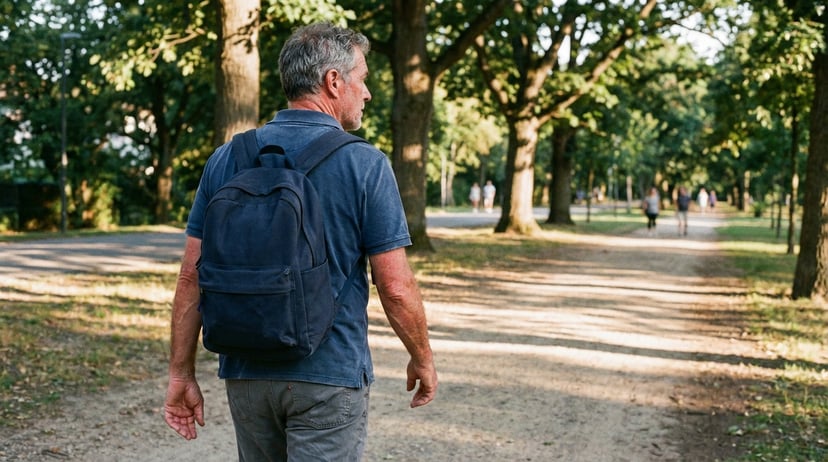
Rucking isn't just a trendy fitness tool-it's one of the most effective and practical exercises for older adults. Here's why:
Bone density protection. Osteoporosis is a genuine health threat after 50, particularly for women entering and past menopause. Bone responds to load. Medications help, but loaded walking is one of the most effective non-pharmacological interventions. Unlike high-impact running (which is hard on arthritic joints), rucking provides bone-building stimulus without excessive joint stress. You're using natural loading, not fighting gravity.
Balance and fall prevention. Falls are the leading cause of injury-related death in older adults. A heart rate monitor like the Garmin Instinct 3 Solar helps you train in the right intensity zone. Rucking itself improves proprioception (body awareness) and balance by challenging your stability under load. The shifting weight in a pack and the slight forward lean demand constant micro-adjustments from your stabilizer muscles and balance systems. Over weeks, this dramatically improves your ability to catch yourself if you stumble.
Cardiovascular health. Sustained rucking at a conversational pace is Zone 2 cardio-the training zone most effective for reducing cardiovascular disease risk, improving aerobic efficiency, and building endurance. You're building the aerobic base that allows you to walk with grandkids, travel, and maintain independence.
Functional strength. Carrying groceries, navigating stairs, playing with grandchildren, and moving around daily life require strength. Rucking builds practical strength that directly translates to functional capacity. You don't need to look strong-you need to be strong enough to do what you want to do.
Low-impact loading. Unlike running (which involves impact forces of 2-3x bodyweight), walking is genuinely low-impact. Adding load increases the training stimulus without adding joint stress. Your knees and hips get strengthened without the pounding.
Social aspect. Group rucks are hugely popular among older adults. The combination of exercise, outdoor time, and social connection addresses multiple dimensions of health simultaneously. Loneliness is a genuine health risk; group rucks are a built-in social structure.
Cognitive benefits. Outdoor walking is linked to reduced dementia risk and improved cognitive function. Add the challenge of loaded walking and varied terrain, and you're engaging cognitive systems. The combination of physical challenge and environmental variety is protective for brain health.
The clearest evidence comes from Snow et al. (2000) in the Journal of Gerontology, a 5-year randomized trial of weighted-vest exercise in postmenopausal women. Participants who kept walking with a vest preserved hip bone mineral density at the femoral neck and trochanter, while the control group lost bone at both sites. Cleveland Clinic (2024) recommends rucking as a high-return, low-skill option for adults in this age bracket. The stimulus works by applying progressive mechanical stress to bones, which triggers remodeling and strengthening - particularly relevant when pharmacological options have limits and side effects.
Before you start

Medical clearance is a good idea if you fall into these categories:
- Sedentary for the past 6+ months
- History of joint replacement surgery
- Diagnosed osteoporosis or osteopenia
- Cardiac conditions or history of heart disease
- Balance disorders or dizziness
- Recent surgery or recovery
If you're already reasonably active, walking regularly without issues, and have no major health conditions, you likely don't need formal medical clearance. Just use common sense: start light and slow, and listen to your body.
The most important principle: there is zero rush. You have decades ahead of you to ruck. Spending an extra month getting a slow, safe start pays massive dividends in consistency and injury prevention.
Starting weight recommendations for adults over 50
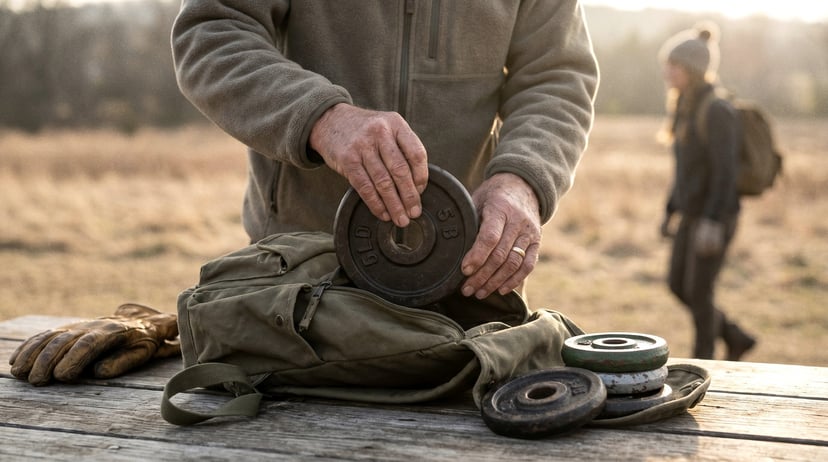
Start lighter than you think you need. A common mistake is comparing yourself to younger ruckers or trying to "make up for" years of inactivity by jumping to heavier loads. This is how injuries start.
Conservative starting weight: 5-10 pounds, regardless of your bodyweight. This sounds almost too light, but there's wisdom here. Tendons and ligaments lose elasticity with age. Bone density may be lower. Your nervous system needs time to adapt to the novel stimulus of loaded walking. A 5-pound pack barely feels like anything-which is exactly the point. You're not trying to crush yourself in week one; you're establishing a habit and allowing your tissues to adapt.
Why not heavier? A 70-year-old starting with 25 pounds is significantly different from a 35-year-old starting with 25 pounds. Your metabolic recovery capacity, collagen turnover rate, and joint resilience are different. The research on aging physiology consistently shows that slower progressions produce better long-term outcomes.
Progression: add 2 pounds every 2-3 weeks, not the 5-pound jumps some younger ruckers use. This pace allows your tissues to adapt properly. Use Darn Tough socks and Body Glide Original to prevent blisters from the start - foot problems compound quickly in older adults. Over a 12-week period, you'll go from 5 pounds to 15-20 pounds, which is substantial progress without overloading your system.
Maximum recommended load for most older adults: 15-25% of bodyweight. This is lower than the general 20-30% guideline because of individual variation in bone density, joint health, and conditioning. A 150-pound 60-year-old with osteopenia shouldn't be rucking 45 pounds. A 200-pound 65-year-old in good health can work toward 40-45 pounds. Context matters.
Safe starter protocol over 60 (first 4 weeks)
If "build slowly" feels too vague, this is the prescription. Print it, stick it on the fridge, and check the box each week.
| Week | Weight | Distance | Frequency |
|---|---|---|---|
| Week 1 | 5 lb | 0.5 mi | 2 sessions |
| Week 2 | 8 lb | 1 mi | 2 sessions |
| Week 3 | 10 lb | 1.5 mi | 3 sessions |
| Week 4 | 12 lb | 2 mi | 3 sessions |
Finish week 4 without sharp joint pain or persistent next-day soreness? Move into the 8-week program below. If anything in weeks 1-4 hurts in a "not just soreness" way, hold the current weight and let the body catch up before progressing.
The 8-week senior-start program
This progression balances structure with safety and allows for adaptation at each phase:
Weeks 1-2: Foundation building
- Weight: 5 lbs
- Distance: 0.5-1 mile
- Frequency: 2x/week
- Terrain: Flat, familiar terrain (park, flat neighborhood streets)
- Pace: Very easy, conversational
- Rest days: 48-72 hours between sessions
The goal is to feel comfortable carrying a pack and establish the habit. Distance and pace matter less than consistency and recovery. You'll likely feel minimal soreness; this is correct.
Weeks 3-4: Light stimulus
- Weight: 5-8 lbs
- Distance: 1 mile
- Frequency: 2x/week
- Terrain: Flat, some variety (different routes, adding slight inclines)
- Pace: Easy, conversational
- Rest days: 48 hours between sessions
Your body is starting to adapt. You might feel moderate soreness in your legs or glutes after the first ruck; this is normal and should improve by day 3. If soreness lingers beyond 72 hours, your progression is too aggressive.
Weeks 5-6: Volume increase
- Weight: 8-10 lbs
- Distance: 1-1.5 miles
- Frequency: 2-3x/week
- Terrain: Mix of flat and gentle rolling terrain
- Pace: Easy to moderate, still conversational
- Rest days: 48 hours minimum between sessions
You're building a real fitness base now. Three rucks per week is approachable if recovery is good. If you're not sleeping well or feeling excessive fatigue, dial back to 2x/week.
Weeks 7-8: Establishing baseline
- Weight: 10-12 lbs
- Distance: 1.5 miles
- Frequency: 3x/week
- Terrain: Varied (flat, rolling, some stairs or inclines)
- Pace: Easy to moderate, still sustainable
- Rest days: 48 hours minimum
By week 8, rucking feels normal. Soreness is minimal or absent. You're breathing harder but can still have a conversation. This is the foundation you build future progression on.
The principle throughout: extend the timeline, not the load. A common mistake is adding weight too quickly. Patience here compounds into years of rucking. Someone who spends 8-12 weeks getting a solid base at light loads will ruck forever. Someone who jumps to 25 pounds in week 2 will get injured and quit.
Special considerations
Joint health
Knee and hip arthritis are genuinely common in adults over 50, and they don't disqualify you from rucking. But they do require adjustments.
Start with lighter weights (5 lbs, not 15) and give your joints several weeks to adapt. Use supportive footwear with good arch support and traction. Consider trekking poles if your balance is shaky-they're not a sign of weakness, they're a legitimate training tool that reduces load on your knees and hips by 15-20%.
If your knees or hips hurt while rucking, the instinct might be to stop rucking. More often, you just need to reduce the weight (drop from 10 lbs to 5 lbs) and give your joints more time to adapt. Reduce weight before reducing frequency. Three rucks per week at 5 pounds often works better than two rucks per week at 12 pounds for people with joint issues.
Balance
A loaded pack shifts your center of gravity slightly forward and changes your proprioceptive feedback. If balance is a concern, start on flat, even surfaces. Concrete paths and sidewalks are fine for the first month. Avoid roots, rocks, and uneven terrain until you're confident on level ground.
Trekking poles help tremendously with balance and are widely used by older adults. They reduce the load on your lower joints and provide stability during uneven terrain. They also normalize the movement pattern-you're using them like an older adult uses them, not as "training gear."
Graduate to uneven terrain gradually, once flat walking feels easy and your proprioceptive system has adapted.
Bone density
If you have a diagnosis of osteoporosis or osteopenia, rucking is genuinely protective. Loaded walking builds bone density more effectively than most other interventions. Start very light (5 lbs) and progress slowly, but proceed confidently that rucking is helping your bones.
Get medical clearance before starting, but don't be surprised when your doctor-especially your physical therapist-encourages rucking. It's exactly what's prescribed for bone health in older populations.
Recovery
Recovery takes longer after 50, and that's okay. Plan for 48 hours between rucks minimum during the first month. Your sleep matters even more-poor sleep compounds poor recovery. Hydration needs increase with age, partly because your thirst mechanism becomes less sensitive. Drink water proactively, not just when thirsty.
Protein intake becomes more critical for muscle synthesis. Make sure you're eating adequate protein at every meal. Your musculoskeletal system needs the building blocks to adapt to training stimulus.
Gear for older adults
A few items make rucking much safer and more comfortable:
Pack with a hip belt (mandatory). A pack with a padded hip belt is essential, not optional. It distributes load to your pelvis and hips rather than overloading your shoulders and spine. Don't try rucking with a pack that puts all the load on your shoulders.

Supportive shoes with good traction. Your feet are now carrying extra load, and your balance is being challenged. Good shoes prevent twisted ankles and shin splints. Trail-specific shoes provide better traction on varied terrain than road running shoes.
Trekking poles (optional but recommended for the first month). They reduce stress on knees and hips, improve balance, and provide a sense of security. Using poles is normalized among older adults, so there's no social awkwardness. They'll likely become one of your favorite training tools.
Lighter starting weights. Use a 5-10 pound sandbag or small dumbbell for your initial weight, not a 20-25 pound plate. A sandbag distributes weight and is easier to hold than a single hard object.
For detailed gear recommendations, see our rucking gear guide or start with our budget starter kit.
Rucking at 55 is not the same as rucking at 25-and that's fine. The benefits are arguably greater for older adults (bone density, balance, functional strength). The key is patience. Two months of consistent light rucking will change how you move and feel every day.
Related reading
- Rucking training programs - structured plans for every goal, including the maintenance program
- How often should you ruck? - frequency guidance with recovery factors
- Is rucking bad for your back? - research on loaded walking and spinal health
- Rucking injury prevention - the 10% rule, prehab routine, and when to stop
- How heavy should your ruck be? - weight calculator and progression guide
- Ruck weight calculator - find your recommended starting weight
- Prefer a vest over a pack? Our sister site Kit Authority's weighted vest walking for beginners is the gentler on-ramp
Frequently Asked Questions
Joint issues don't disqualify you from rucking, but they require lighter starting weights (5 lbs maximum) and slower progression. Get medical clearance first, then focus on perfect form with minimal load rather than pushing weight increases.
The weight feels light because your cardiovascular system is doing the work, not just your muscles. You should feel moderately winded after 15-20 minutes of walking with proper pace - that's your heart and lungs adapting, which is exactly what improves bone density and cardiovascular health.
Rucking is precisely the weight-bearing exercise recommended for bone density. The article notes it's one of the most effective non-pharmacological interventions for osteoporosis, providing progressive mechanical stress that triggers bone remodeling without high-impact joint stress.
Soreness lasting beyond 72 hours means your progression is too aggressive. Drop back to lighter weight (from 8 lbs to 5 lbs) and extend your rest periods to 72 hours between sessions until soreness resolves within 48 hours.
The 8-week program maxes out at 3 times per week with 48-hour minimum rest periods. Recovery capacity genuinely decreases with age, and the article emphasizes that extending timeline rather than frequency produces better long-term outcomes for older adults.
The pack does shift your center of gravity forward, which is why the program starts on flat, familiar terrain for the first month. Trekking poles reduce fall risk by 15-20% and are widely normalized among older adults - they're training tools, not mobility aids.
The article doesn't specify timelines for measurable health outcomes, focusing instead on the 8-week foundation program. Bone density improvements require progressive load over months to years, while balance and cardiovascular adaptations typically occur within the first few months of consistent training.