
- Rucking is not automatically bad for knees, but more load means more force to manage.
- Pain at the front, outside, below, or inside of the knee describes a pattern; it does not diagnose one weak tissue.
- If you can walk normally, first reduce the aggravating dose. Stop and get assessed for major swelling, locking, giving way, or rapidly worsening pain.
- Rebuild one variable at a time. The percentages in this guide are conservative editorial starting points, not a tested rucking treatment protocol.
Is rucking bad for your knees?
Short answer: rucking is not automatically bad for your knees, but no activity is universally safe for every knee. The useful question is whether the load, distance, pace, and terrain fit your current capacity.
Rucking uses a walking gait, but the added weight is not mechanically neutral. In a military load-carriage study, Birrell, Hooper, and Haslam found that ground-reaction-force measures rose proportionally as load increased. That does not prove that recreational rucking causes knee injury; it does explain why reducing the load is a rational first response when symptoms appear.
Training-load jumps and movement capacity are plausible parts of the picture, but knee pain rarely has one universal cause. A systematic review of running-related injuries found only limited evidence linking sudden load changes with injury, and it did not validate a universal 10% threshold. Rucking-specific evidence is thinner, so this guide uses conservative adjustments rather than pretending to diagnose a single cause.
Muscles and tendons adapt to progressive loading, which is why the answer is not always permanent avoidance. For patellar tendon pain, a randomized trial found better 24-week outcomes with progressive tendon-loading exercise than with eccentric exercise alone. That trial studied diagnosed patellar tendinopathy, not rucking, so its direct lesson is progressive, tolerable loading—not a promise that every sore knee should keep training.
One important caveat: if you have a pre-existing knee condition like a torn meniscus, severe arthritis, or a history of ACL injury, you need medical evaluation before starting a rucking program. Rucking can be rehabilitative for many conditions, but it's not universal. Talk to a sports medicine doctor first if you're uncertain.
- 01
Breda and colleagues compared progressive tendon-loading exercise with eccentric therapy for patellar tendinopathy. The useful takeaway for ruckers is progressive loading, not complete avoidance.
- 02
Clinical Management of Patellar Tendinopathy identifies load management plus progressive tendon loading as the most consistent treatment direction for diagnosed patellar tendon pain.
- 03
The international patellofemoral-pain consensus supports exercise therapy—especially combined hip- and knee-focused work—and allows tailored supporting interventions such as foot orthoses.
- 04
Birrell, Hooper, and Haslam showed that added load increases ground reaction forces. That supports the practical rule: when pain appears, reduce load and distance before adding more work.
- 05
No cited trial tested this article's exact ruck-weight reduction, pain ceiling, or return timeline. Those figures are conservative editorial starting points and should yield to symptoms and individual assessment.
Identify your knee pain type
Before you adjust training, describe where the pain is and what provokes it. Location can narrow the possibilities, but patellofemoral-pain guidance calls for history and physical examination; it does not support diagnosing one weak muscle from a pain map alone.
| Pain location | What it may feel like | Possible pattern—not a diagnosis | Conservative first move |
|---|---|---|---|
| Front / around the kneecap | Dull ache, often worse on stairs, squats, or downhill | Patellofemoral pain is one possibility | Reduce the provoking load; use combined hip-and-knee exercise if appropriate |
| Outside of the knee | Burning or rubbing on the outer knee | Lateral-knee or IT-band-related pain is one possibility | Reduce provoking distance and hills; assess hip control and gait |
| Below the kneecap | Local tenderness that worsens with loading | Patellar tendon pain is one possibility | Reduce the provoking dose; use progressive tendon loading if the pattern is confirmed |
| Inside of the knee | Pain along the inner joint line | Several joint, tendon, or movement causes are possible | Avoid self-diagnosing from location; seek assessment if it persists, locks, or swells |
Front of knee (patellofemoral)
This is the most common rucking knee pain. You'll feel it under or around the kneecap, usually a dull ache that gets worse with stairs, downhill, or long rucks. The pain might feel like it's coming from directly behind the kneecap or along the inside edge of it.
Patellofemoral pain is not simply a weak-VMO problem. A current review describes a mix of joint stress, kinetic-chain factors, training errors, behavior, and pain sensitivity, with treatment individualized to the person (Sisk and Fredericson, 2019). Combined hip- and knee-focused exercise has better support than trying to isolate one small portion of the quadriceps.
Outside of knee (IT band syndrome)
You'll feel a burning or rubbing sensation on the outside of the knee, usually developing gradually over the course of a ruck or appearing the day after. Some people describe it as tightness on the lateral knee.
The IT band is a thick fascial structure, so treating it as a rope that can simply be stretched longer is an oversimplification. Hip strength, gait, terrain, and a rapid distance increase may all matter, but outside-knee pain does not prove glute weakness. If reducing the provoking dose does not settle it, an examination is more useful than guessing at one muscle.
Below the kneecap (patellar tendinopathy)
Pain in the tendon that connects your kneecap to your tibia (shinbone) - you'll feel it directly below the kneecap, often aching and tender to the touch. It typically gets worse going downhill and might feel better once you warm up. This is the classic overuse pattern: your quads and patellar tendon are being loaded faster than they can adapt.
Load matters for tendon symptoms, but the diagnosis should not come from location alone. A clinical review supports load management combined with progressive tendon loading for patellar tendinopathy. That evidence supports a graded approach after the pattern is identified; it does not prove that every below-kneecap ache is tendinopathy.
Inside of knee (medial)
Pain along the inside of the knee joint or medial joint line has several possible sources. Foot motion and hip control may contribute, but pain here can also involve structures that cannot be distinguished with a web article.
Footwear fit and a temporary prefabricated foot orthosis can be reasonable comfort experiments for some patellofemoral presentations; the 2018 consensus treats orthoses as an individually selected supporting intervention, not a universal fix. The insole below is therefore a fit option, not a diagnosis or treatment guarantee.
The fix: a 3-phase approach
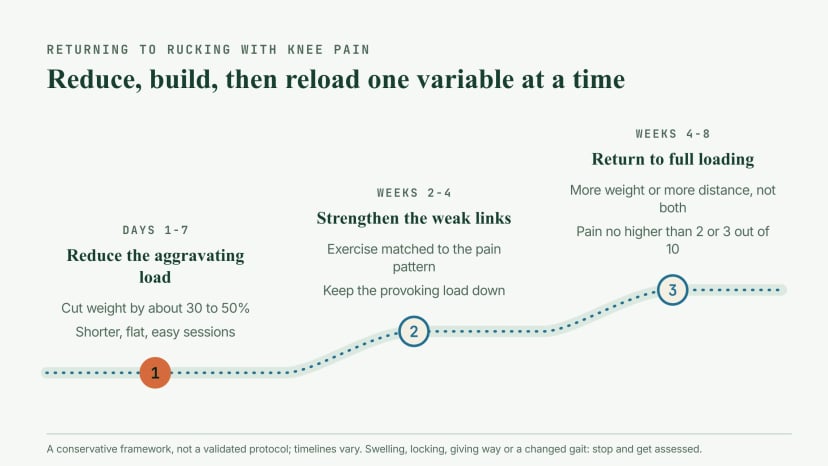
This is a conservative return-to-ruck framework, not a validated treatment protocol. Its evidence-supported parts are load management and progressive exercise for specific overuse conditions; the exact percentages, exercise menu, and timeline are Ruck Authority's practical translation for recreational ruckers.
Phase 1: Reduce the aggravating load (Days 1-7)
The first decision is whether you can still walk with a normal gait and without escalating symptoms. Do not use a deload to push through locking, giving way, major swelling, significant weakness, or rapidly worsening pain.
If ordinary walking is comfortable, use a deload as a starting experiment: reduce ruck weight by roughly 30 to 50 percent, shorten the distance—often by about half—and choose flat terrain. If you've been carrying 30 pounds, that might mean 15 to 20 pounds for a short, easy session. These numbers are deliberately conservative editorial guardrails, not values established by a rucking clinical trial.
For diagnosed patellar tendinopathy, published guidance favors load management and progressive loading over indefinite avoidance (Rosen et al., 2022). That does not mean every painful knee should stay under a pack. Use symptom-tolerable movement when appropriate; stop and get assessed when it is not.
Reassess after each easy session and again the next morning. If the same reduced session still changes your gait, raises pain meaningfully, or leaves symptoms worse the next day, stop rucking and seek individual guidance rather than repeatedly testing it.
Phase 2: Strengthen the weak links (Weeks 2-4)
Exercise can build capacity, but the pain location does not prove one muscular imbalance. Choose the closest pattern below as a starting menu, and get assessed if the response is poor or the diagnosis is uncertain.
For a patellofemoral pattern: The international consensus supports combined hip- and knee-focused exercise, not VMO isolation as a universal answer. Wall sits, controlled step-ups, and a hip-strength exercise are practical options. Start with a tolerable range and resistance; the set-and-rep prescriptions below are examples, not clinical dosing.
For an outside-knee pattern: Hip-abductor work such as clamshells, side-lying leg raises, or banded walks can be a useful capacity exercise, but outside-knee pain does not by itself confirm weak glutes. Pair the exercise with a reduction in the distance, hills, or pace that provokes symptoms.
For confirmed patellar tendinopathy: Progressive tendon loading has stronger support than declaring one eccentric drill the universal gold standard. In a randomized trial, progressive tendon-loading exercise produced better 24-week clinical scores than eccentric exercise alone. A slow squat progression may be part of that work, but a clinician can match the range and load to irritability.
For medial knee pain: Do not assume the answer is adductor strength or an insole. Reduce the provoking load and consider an assessment, especially if pain is on the joint line, follows a twist, or comes with swelling, catching, or locking.
Pair all of this with the mobility work from the Rucking Mobility Guide, especially hip flexor and calf stretches.
Phase 3: Gradual return to full loading (Weeks 4-8)
Once ordinary walking and the reduced session are comfortable, rebuild one variable at a time: weight, distance, pace, or terrain. The familiar 10% rule can be a conservative planning heuristic, but a systematic review found very limited evidence for a universal training-load threshold.
For example, if 15 pounds for 2 miles is comfortable during the session and the next morning, the next step could be 16 to 17 pounds at the same distance, or 15 pounds for about 2.2 miles—not both. A 2-to-3-out-of-10 ceiling is an editorial monitoring cue, not a diagnostic test. Any pain that changes your gait, keeps climbing, or remains worse the next day is a reason to step back.
Do not promise yourself a fixed 4-to-8-week recovery. Tendon trials and clinical guidelines operate over weeks to months, but an individual's timeline depends on the actual condition, symptom duration, training history, and response to load.
Prevention going forward
Once symptoms settle, the goal is to build enough capacity that ordinary training changes are less provocative. No routine can guarantee that knee pain never returns.
Start doing a prehab routine 2 to 3 times per week. The Rucking Prehab Routine takes 15 minutes and targets the exact joints and muscles stressed by loaded walking. This should become non-negotiable, especially in the first 8 to 12 weeks of rucking.
If you overstride under load, experiment with shorter, quieter steps and a cadence around 100 to 110 steps per minute. Treat that range as a coaching cue, not a medically established target; comfort, terrain, height, and pace all change the right cadence.
Use the 10% rule as a guardrail, not a law. Its real value is that it discourages large simultaneous jumps. Do not move from 10 to 15 miles or from 20 to 30 pounds in one step, and do not add hills at the same time. The evidence supports avoiding abrupt load changes more clearly than it supports any single percentage (Damsted et al., 2018).
Choose footwear for fit, terrain, and a stable feel under your load. No shoe can treat an undiagnosed knee problem, and more support is not automatically better for every foot. A shoe or insole is a comfort and load-management choice alongside training changes.
If most of your rucking is on pavement and your current shoes feel flat or worn by the end of a session, a cushioned road shoe is a simple footwear change to try while you rebuild distance. The Hoka Bondi 9 is the top pick in our pavement shoe guide: a max-cushion road shoe with a 5mm drop, available in wide widths. Walk in it unloaded first, keep the rest of the plan the same, and judge it by how the knee feels the next morning. Cushioning changes comfort; it does not change the diagnosis.
The Salomon Quest 5 GORE-TEX is one high-support footwear option for people who prefer a structured boot. A fitted plate such as the Titan Fitness ruck plate can keep the load from shifting inside a compatible pack. Neither product treats knee pain; the relevant benefit is predictable fit and load placement.
If you are already using a knee brace, Body Glide Original can reduce skin friction where the brace rubs. It does not change the source of the knee pain.
For a complete guide, see Best Rucking Shoes by Terrain.
Finally, keep lower-body strength work in the week if you tolerate it. One or two sessions built around movements such as squats, hinges, step-ups, or lunges can build capacity outside the ruck itself. For footwear options organized by surface and fit rather than treatment claims, use our best rucking shoes by terrain guide.
When to see a professional
Only an individual assessment can determine whether knee pain needs professional care. Mild symptoms that steadily settle after reducing the provoking load may be reasonable to monitor, but the following signs lower the threshold for a sports-medicine or physical-therapy assessment.
If pain persists after 2 weeks of deloading and proper strength work, something more complex might be happening. You could have a structural issue like a meniscal tear, early arthritis, or a tendon that needs more specialized treatment.
Swelling that doesn't resolve after a few hours of rest - or swelling that comes back with each ruck - is another red flag. A little puffiness is normal; persistent fluid is not.
Locking or catching sensations (your knee feels like it's catching or getting stuck momentarily) or giving way (your knee buckles unexpectedly) suggest structural damage that won't resolve with prehab alone.
Pain at rest or pain that repeatedly wakes you deserves attention because it does not follow the simple "only when loaded" pattern. It does not identify one specific diagnosis on its own.
Finally, if you have a history of ACL, MCL, or meniscal injuries, get cleared by a professional before starting a rucking program. Previous injuries change the equation significantly.
For patellofemoral pain, consensus guidance supports combined hip- and knee-focused exercise. For patellar tendinopathy, clinical reviews and a randomized trial support load management with progressive tendon loading. Those findings come from diagnosed conditions, not from a rucking-specific trial, so this article's percentages and return steps remain editorial starting points rather than treatment guarantees.
Related reading
- Rucking prehab routine - 15-minute routine that targets the joints and muscles most stressed by loaded walking
- Best rucking shoes by terrain - shoes with proper support prevent the foot instability that causes knee compensation
- How heavy should your ruck be? - use our weight calculator to choose a conservative load before adding distance or hills
- Ruck plate comparison - if you're adjusting your load, know your plate options
Frequently Asked Questions
If you can walk normally and symptoms do not keep rising, a much lighter, shorter, flat session can be a reasonable test. The 30-50% load reduction and half-distance suggestion are conservative editorial starting points. Stop instead of testing a deload if pain changes your gait or comes with significant swelling, locking, giving way, or weakness.
Seek assessment promptly for substantial swelling, locking, giving way, an inability to bear weight normally, rapidly worsening pain, or a recent injury. Persistent symptoms despite reducing the provoking load are another reason to be assessed. A web article cannot rule out a structural or medical cause.
Downhill walking increases the braking forces on your quads and patellar tendon with each step, especially under load. If you have patellofemoral pain or patellar tendinopathy, avoiding hills during your recovery phase prevents aggravating these structures while they heal.
The exercise may not match the condition, the rucking dose may still be provocative, or the pain may have another cause. Stop using the 10% rule as proof that the plan is safe and get an individual assessment if symptoms are not trending better.
A brace may change comfort for some people, but it does not diagnose or automatically correct the cause. Patellofemoral guidance is clearer on exercise and education than on bracing, so treat a brace as an optional supporting tool rather than the whole plan.
There is no reliable rucking-specific 4-to-8-week promise. The timeline depends on the diagnosis, symptom duration, previous capacity, and response to load. Progress only when the current session is tolerable during the ruck and is not meaningfully worse the next day.
A secured load is easier to carry predictably than loose weight that moves inside the pack. That is a sensible equipment choice, but no cited study shows that a particular ruck plate treats knee pain. Reduce total load first when symptoms appear.


