The short answer

Recreational rucking can train trunk endurance, but it also increases spinal and muscular demand. The risk depends on the load, duration, pack fit, progression, health, and symptoms. Military studies using 40-60% of body weight for long marches describe a different exposure from a 30-minute neighborhood ruck with 20-25 pounds, but that difference does not make every recreational load safe for every back.
What the military research shows
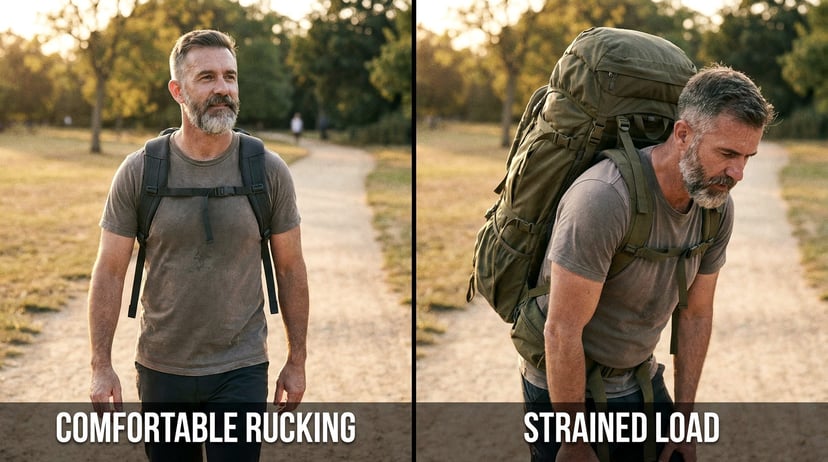
Much of the load-carriage injury research comes from military populations. Its load, distance, pace, equipment, and limited recovery must be considered before applying it to recreational rucking.
Military studies show increased rates of lower back injury in soldiers carrying loads exceeding 40% of bodyweight over extended durations (4-12 hours). These studies typically involve loads of 60-100+ pounds for 20-40+ kilometers. The researchers were investigating occupational hazards in contexts where soldiers have no choice but to maintain pace and distance despite fatigue and pain.
Multiple investigations report greater spinal compression and back symptoms with heavy loaded marching. Some studies using loads below 25% of body weight found short-term changes that resolved during follow-up, but that should not be turned into a universal 24-hour recovery rule.
This is the critical distinction: occupational load carriage (a soldier's job, performed daily, at heavy loads, often in compromised conditions) is not the same as fitness rucking (a deliberate training activity, done intermittently, at moderate loads, in controlled settings).
Loaded-marching studies report greater spinal stress at loads above 40% of body weight over long distances. Findings at lower loads vary by protocol and population, so no body-weight percentage guarantees safety or full recovery within 24 hours.
What recreational rucking does for your back

Loaded walking requires the back and trunk muscles to hold posture under load. That can train endurance when the dose is appropriate.
Spinal erector activation. The erector spinae run along the spine and help maintain posture under a pack. Repeated, tolerable loading may improve endurance. Rehabilitation programs sometimes use loaded carries, but the exercise and dose are selected for the individual.
Core endurance. The abdominal wall, obliques, multifidus, and other trunk muscles help control the load. A 30-60 minute ruck can provide sustained work, but more duration or load is not always better.
Posture awareness. A pack gives immediate feedback when it shifts or pulls away from the body. That may help a rucker notice posture, but carryover to sitting posture is not guaranteed.
Bone loading. Bone responds to mechanical load, and rucking is weight-bearing. Direct evidence for vertebral bone-density gains from recreational rucking is limited, especially in people with osteoporosis or fracture risk.
Loaded carry practice. Farmer carries, suitcase carries, and rucking all involve moving under load, but the position and duration differ. Safety in one exercise does not prove safety in another; both need an appropriate load and progression.
When rucking CAN cause back problems
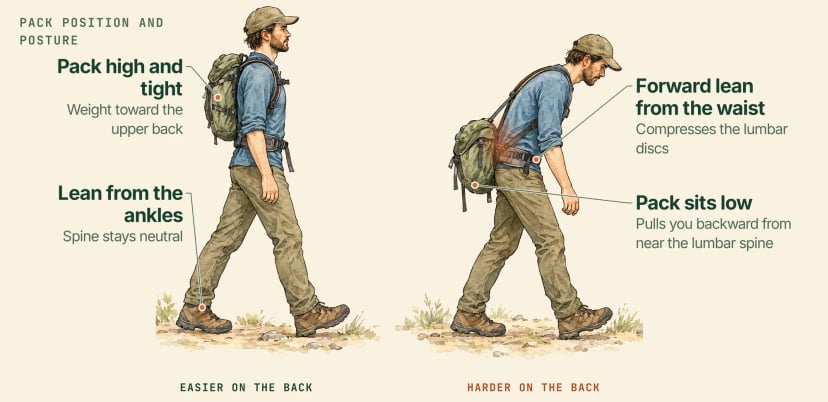
Rucking may contribute to back pain in several situations. Avoiding them can reduce risk but cannot prevent every problem.
Weight too heavy for your current fitness level. If you jump from no rucking to 35 pounds, your stabilizer muscles aren't prepared for the load. Your form breaks down under fatigue, and your tissues absorb stress they're not ready to handle. Start lighter than you think you need to.
Weight positioned too low in the pack. A pack that sits low on your back (near your lumbar spine) pulls you backward and forces forward lean from your lower back, not your ankles. This compresses your lumbar discs and overloads the erector spinae. Proper pack positioning is high and tight against your spine, with weight distributed toward your upper back and shoulders.
Excessive forward lean from the waist. Instead of leaning from your ankles (which keeps your spine neutral), leaning from your waist (bending forward at the L4-L5 junction) compresses your discs. This is a form error that creates localized stress exactly where most back pain originates.
Weak core providing insufficient stability. If your core muscles can't brace against the load, your spine has to work harder to stay stable. Each step compounds the problem. This is why beginners with weak cores sometimes develop back soreness even at modest weights.
Pre-existing disc issues not being managed. If you have a known herniated disc, stenosis, or previous serious back injury, rucking needs to be progressive and often requires specific modifications or professional guidance.
Sudden load jumps. No weekly increase is automatically safe. Add one variable at a time, and reduce the progression when soreness, pain, gait, or recovery worsens.
How to protect your back while rucking
Gear can improve fit and comfort, but it cannot remove spinal risk. The table shows two structured packs and an optional recovery tool.
| Role | Pick | What it protects |
|---|---|---|
| Pack | 5.11 RUSH 24 | Internal frame sheet. Keeps the load high and tight against the spine instead of pulling backward at hour two. |
| Heavy-load pack | Mystery Ranch 2 Day Assault | Futura yoke and frame designed to transfer some load to a compatible hip belt. |
| Recovery | TriggerPoint GRID Foam Roller | Optional tool for lats and upper-back mobility; it does not diagnose or treat the cause of low-back pain. |
These practices can reduce avoidable fit and progression problems:
Load the pack correctly. The top of your pack should sit at your shoulder blades or slightly higher. The weight should be pressed firmly against your spine (not floating away from your back), and straps should be snug. A proper hip belt distributes weight to your hips rather than overloading your shoulders and upper back. The weight should feel directly underneath you, not pulling you backward. A well-designed pack like the 5.11 RUSH 24 makes this much easier - poor pack geometry can't be compensated for with form alone.
Use a hip belt when the pack is designed for load transfer and it improves comfort. A pack such as the Mystery Ranch 2 Day Assault has a frame and belt system for this purpose. A belt is not automatically required above 20 pounds, and a poorly fitted belt can create other pressure points.
Train the trunk directly if needed. Dead bugs, bird dogs, planks, side planks, farmer carries, and suitcase carries are options. Ten minutes three times per week is one sample dose. A prehab routine can build capacity, but it does not guarantee injury prevention.
Lean from your ankles, not your waist. When climbing hills or leaning forward, the movement should come from your ankles and hips, not from flexion at your lower back. Keep your spine relatively neutral. This maintains the integrity of your discs and prevents localized lumbar compression.
Progress gradually using the 10% rule. Add no more than 10% to your volume (weight + distance) per week. If you rucked 2 miles at 20 pounds this week, next week could be 2.2 miles at 20 pounds, or 2 miles at 22 pounds-not both. This allows your tissues to adapt.
Use mobility work if it helps. Cat-cow, child's pose, and knee-to-chest stretches are options after a ruck, but no movement is safe or useful for every back condition. Stop any drill that increases pain or neurological symptoms.
If you already have back pain
If you have existing back pain, ask a doctor or physical therapist about loaded walking before you start, especially with a herniated disc, stenosis, prior surgery, fracture risk, or neurological symptoms.
Once cleared, start conservatively: very light loads (5-10 pounds), short distances (0.5-1 mile), and easy pace. The goal is to build tolerance gradually. Focus on core strengthening before adding substantial load. Many people with back pain benefit from doing a prehab routine for 2-3 weeks before their first ruck.
A hip belt may improve comfort when the pack frame and torso fit allow load transfer. It does not make rucking appropriate for an injured or painful back.
During and after rucking, monitor symptoms. Stop for sharp or worsening pain, radiating pain, numbness, weakness, loss of coordination, or changes in bowel or bladder control. Seek urgent medical care for severe neurological symptoms.
If pain develops, stop the session and assess the cause before trying again. A lighter load may help in some cases, but persistent, recurrent, radiating, or severe pain needs clinical evaluation.
Ask what load, duration, terrain, population, and symptoms a claim refers to. A 20-pound recreational ruck differs from an 80-pound, 12-hour march, but neither exposure predicts the response of every person.
Frequently Asked Questions
Get medical clearance first. A herniated disc, stenosis, prior surgery, or neurological symptoms need individual guidance on whether loaded walking is appropriate and what limits apply.
Pack position, forward lean, fatigue, load, terrain, and an underlying condition are all possible causes. Stop the painful session, review fit and load, and seek assessment when pain recurs or persists.
There is no universal 24-hour recovery rule. Every-other-day sessions are a conservative starting point, but pain or poor recovery may require more time and clinical guidance.
Total volume, which means weight plus distance combined. If you rucked 2 miles at 20 pounds this week, next week could be 2.2 miles at 20 pounds OR 2 miles at 22 pounds, but not both increases simultaneously.
Dull muscle fatigue or soreness in your back muscles is normal adaptation. Sharp pain, pain that radiates into your leg, or pain that gets worse as you continue rucking are warning signs to stop and potentially get checked out.
Rucking can train trunk endurance and make pack posture easier to notice. It does not guarantee better sitting posture or relief from desk-related back pain.