The Short Answer

Tick prevention while rucking isn't one product, it's a system. Treat your clothes with permethrin, repel exposed skin with picaridin, seal the ankle attack zone with treated socks, and run a post-ruck check protocol within two hours of finishing. Skip any one layer and the system leaks at that point.
The good news: the whole system costs about $50 to set up, takes 20 minutes once a season, and protects you for months. The bad news: 2026 is forecast as a heavy tick year across the eastern US and Midwest, and a casual "spray some bug stuff before I go" approach won't cut it for ruckers spending two-plus hours in tick habitat.
This guide walks the four layers in order from highest-leverage to lowest, with the specific products that work for rucking - not generic hiking advice.
Why Ruckers Face Higher Tick Risk Than Casual Hikers

Three things stack against you when you're rucking through tick habitat:
Pack rub clears topical repellent fast. A standard DEET application on your shoulders and upper back gets ground off by the pack straps within the first mile. By hour two of a loaded ruck, those zones are unprotected even though you remembered to spray.
Sweat dilutes skin repellents. A loaded 45-minute walk produces dramatically more sweat than the same distance hiked unloaded. DEET and picaridin both lose effectiveness as they get diluted - that's why community feedback from long-distance hikers consistently emphasizes layered defenses over relying on a single topical application.
Time-on-feet in habitat compounds exposure. Most casual hikers spend 30-60 minutes in tick habitat per outing. A serious rucker doing a 6-mile loop or training for a GORUCK event is in habitat for two to four hours. The probability of tick contact scales with time, and every brush against tall grass or low brush is another opportunity for attachment.
The defense system below addresses each of these directly. Permethrin doesn't sweat off because it's bonded to the fabric. Picaridin doesn't damage your synthetic gear the way DEET does. Treated socks cover the ankle zone where pack-strap rub doesn't matter. The post-ruck protocol catches anything that got past the chemical layers.
The Four-Layer Defense System

Each layer addresses a specific failure mode:
| Layer | What it does | Where it fails on its own |
|---|---|---|
| 1. Permethrin-treat clothing | Kills ticks on contact with treated fabric | Doesn't cover exposed skin (face, hands, neck gap) |
| 2. Picaridin on exposed skin | Repels ticks from any skin not under treated clothing | Sweats off over hours; doesn't help below the boot line if pants ride up |
| 3. Mechanical barrier socks | Seals the ankle attack zone (where ticks climb up from grass contact) | Only protects feet/ankles; depends on tucking pants in |
| 4. Post-ruck protocol | Catches any tick that hitched a ride home before it attaches | Reactive, not preventative - relies on actually doing it |
Build all four. Skipping any one of them creates a predictable gap.
Layer 1: Permethrin-Treat Your Ruck Clothes
This is the single highest-leverage move in tick prevention. Permethrin bonds to fabric fibers when sprayed on, lasts 6 weeks or 6 wash cycles per treatment, and kills ticks on contact when they touch the treated fabric. Used by the US military for over a decade, registered with the EPA, recommended by the CDC.
The category-defining product is Sawyer's Premium Permethrin Clothing, Gear & Tents Trigger Spray (24oz). One bottle treats 2-3 full outfits. Spray the outside of your ruck pants, shirt, hat, and socks until damp. Hang to dry for 2-4 hours. You're done for six weeks.
The why-this-matters: permethrin is the only tick prevention layer that doesn't degrade during the ruck itself. Sweat doesn't wash it off. Pack-strap rub doesn't clear it. Sun doesn't break it down at any meaningful rate inside a 6-week window. You apply once, then forget about it until the season ends or you've washed the gear six times.
A few application rules from the technical literature:
- Spray outside, not in your bedroom. Permethrin is toxic to cats during the wet drying phase (it's safe once dry). Apply outdoors or in a garage with the cat elsewhere.
- Treat socks separately from boots. Sock treatment is core to the ankle defense; boot treatment is optional and harder to redo.
- Don't waste it on synthetics that won't bond well. Cotton, wool, synthetic blends, polyester all bond fine. Avoid leather and rubber - the treatment slides off rather than bonding.
- Apply 2-4 hours before you'll wear the clothing. Wet permethrin is irritating to skin and toxic to cats; dry permethrin is neither.
Treat in batches at season start. Most ruckers find it easier to dedicate one Sunday in early May to treating their entire kit at once - pants, shirts, socks, hats, and a pack cover - rather than re-treating piecemeal as items get washed. Mark your calendar 6 weeks out for the next round.
Layer 2: Picaridin on Exposed Skin
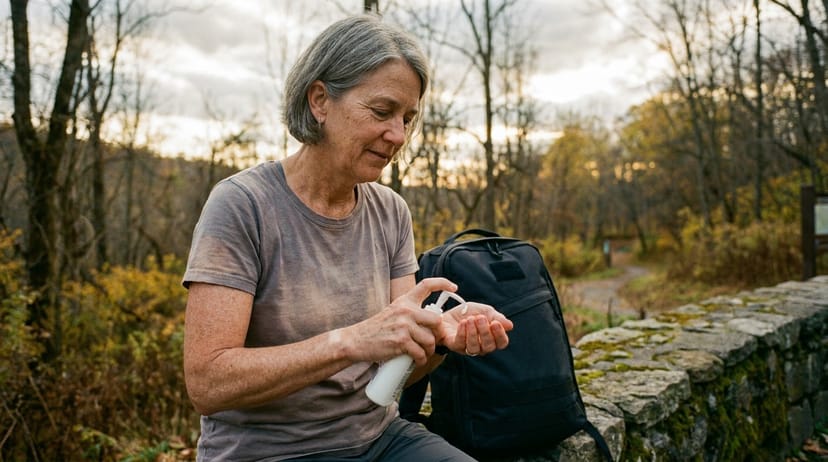
Wherever your treated clothing has gaps - wrists, neck, lower face, hands, the strip of ankle between sock and pant cuff - you need a topical repellent. The historical answer was DEET. The current answer for ruckers is picaridin.
The advantage isn't effectiveness. CDC guidance treats 20% picaridin and 30% DEET as equivalent against ticks. The advantage is what picaridin doesn't do: it doesn't dissolve synthetic pack straps, it doesn't damage hydration hose bite valves, it doesn't wreck watch bands or sunglasses lenses. DEET does all of that.
The lotion form (vs. spray) matters for ruckers specifically. Heavy sweat dilutes spray-applied repellent faster than lotion-applied, which absorbs into the skin's outer layer and clings better through hours of sweating. That's why the 20% Picaridin Insect Repellent (Lotion, Twin Pack) is the format we reach for - and the combo pairs a 4 oz lotion with a 4 oz pump spray. Pack both in checked luggage for travel events: at 4 fl oz each they sit above the TSA 3.4 fl oz carry-on limit, so they get pulled at security.
Application strategy:
- Apply 5-10 minutes before you put on your ruck. Lotion needs time to absorb. Sprayed-on-then-immediately-pack means most of it ends up on the inside of your shirt, not protecting skin.
- The lotion holds up to 14 hours and the spray up to 12, so one morning application covers most rucks. Reapply sooner if you are sweating hard or swimming. Carry a 4oz bottle in an external pack pocket. The 14-hour duration claim is for low-sweat conditions; loaded rucking cuts that significantly.
- Skip the face, hit the neck. Picaridin can sting if it gets near eyes during sweat. Apply to neck, behind ears, jawline, but not to the forehead.
- Hands matter more than you think. When you brush against vegetation, your hands often make first contact. Hit the back of the hands and wrists.
Layer 3: Mechanical Barriers - The Ankle Attack Zone
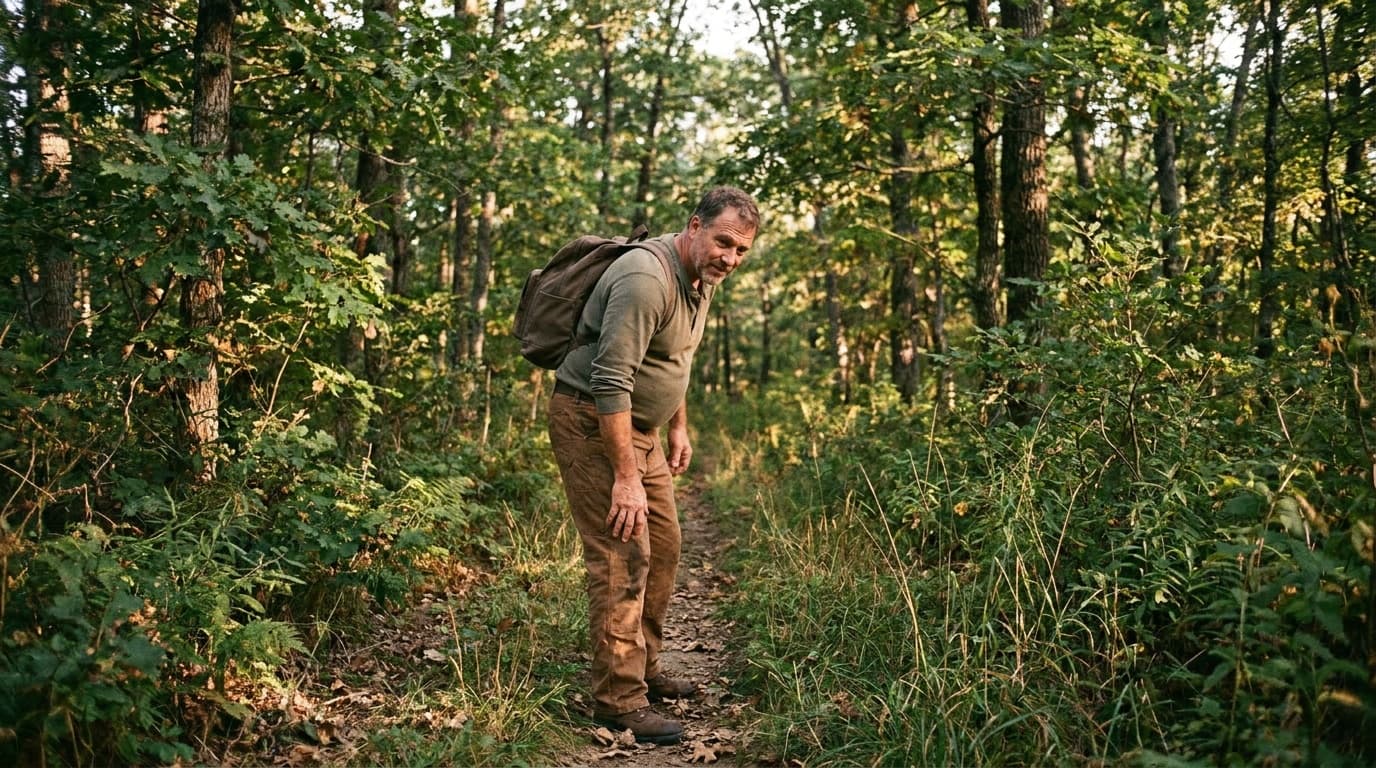
Ticks don't drop from trees. They climb. Most attachment happens at or below the calf, with the ankle being the single highest-risk attachment point on a rucker's body. The defense is a tall-cuff sock with permethrin treatment, with your pant cuff tucked into the sock to seal the entry path.
There are two ways to get a permethrin-treated tall sock for ruck use, and the right answer depends on how you want to spend your time and money.
Path A: DIY-Treat a Merino Sock You Already Own
If you're already running merino socks for your rucks (and most serious ruckers are), the better path is to treat your existing socks with the Sawyer Permethrin from Layer 1. Merino's moisture management is significantly better than the synthetic blends used in most factory-treated socks - especially over multi-hour loaded movement.
The Darn Tough Hiker Boot Full Cushion is the rucker pick for this path: taller crew height to fully cover the ankle zone, heavier cushion that holds up at 30+ lb loads, and a lifetime no-receipt warranty so you're not afraid to treat it aggressively.
Treatment is the same as for clothing: spray the outside of the sock until damp, hang to dry for 2-4 hours, treat both pairs in a rotation so you can wash one while wearing the other. You get all the benefits of merino moisture management with the tick-killing protection of permethrin, at lower cost-per-pair than factory-treated alternatives.
Path B: Buy a Factory-Treated Sock
If you don't want to DIY-treat, or you need treated socks NOW with no time to spray-and-dry, factory-treated synthetic socks are the convenient alternative. The Insect Shield Midweight Hiking Sock is the pick here - the permethrin is bonded at manufacture, lasts 70 wash cycles (vs. 6 for DIY treatment), and works straight out of the package.
The trade-off: synthetic blends don't manage moisture as well as merino during long rucks, and the cushion isn't on par with dedicated hiking socks. For short rucks (under 90 minutes) it's a reasonable convenience pick. For multi-hour training, the DIY-treated merino path wins on comfort.
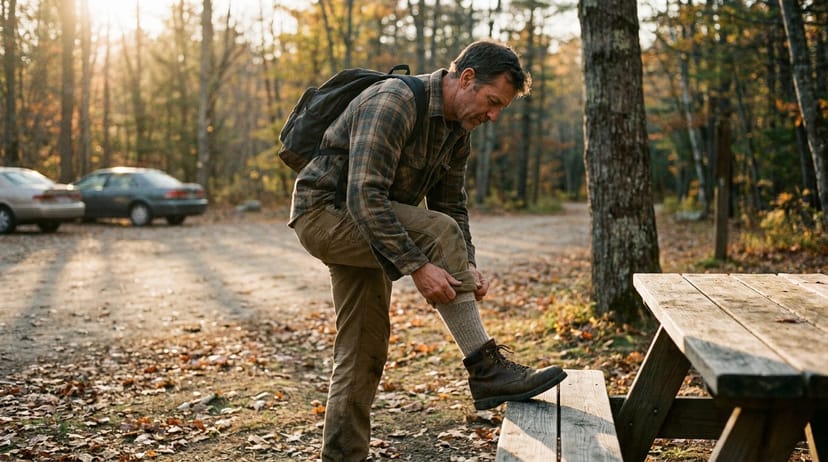
Either way, tuck your pants into the sock cuff. This isn't optional - it's the whole point of the tall-cuff design. Ticks crawl up. If your pant cuff is loose around the ankle, ticks have a clear path past the sock barrier and onto your unprotected calf.
Why light-colored pants help. Beyond the chemical and mechanical layers, wearing light-colored pants during ruck training in tick habitat makes it dramatically easier to spot ticks crawling on you before they attach. Dark pants hide ticks until they've reached the waistband. This is a free upgrade with zero downside other than the dirt-showing fashion penalty.
Layer 4: The Post-Ruck Protocol
The chemical and mechanical layers reduce contact and attachment risk, but no system is 100%. Layer 4 catches whatever got through. It's reactive, not preventive - and it depends entirely on you actually doing it.
The protocol, in order, within 2 hours of finishing your ruck:
- Strip your clothing immediately when you get home. Don't sit on the couch first. Don't unpack your ruck. Strip down where you can put the clothes directly into the dryer.
- Run the clothes through a dryer on high heat for 10 minutes before washing. Heat kills ticks; water alone doesn't. Wash afterward as normal.
- Shower within 2 hours of finishing. This both reduces the window for tick attachment and gives you the chance to feel anything walking on you.
- Do a full-body tick check. Feel-and-see. The high-risk zones in order: behind the knees, groin/inseam, armpits, around the waistband, behind the ears, scalp. A handheld mirror helps for the hard-to-see spots. Have a partner check your back if possible.
- Check your gear. Ticks can hide in pack straps, hat brims, and shoe laces. Don't leave the unchecked pack on your bedroom floor.
The 2-hour window matters because attached-tick disease transmission risk is roughly proportional to attachment time. Lyme transmission generally requires 24-36 hours of attachment. If you find and remove a tick within 4 hours of attachment, your transmission risk approaches zero. The protocol is designed to find them before they attach at all.
What to Do If You Find a Tick Attached
This is where the sub-$10 product earns its place in your kit. Don't try to remove an attached tick with your fingernails, tweezers from your pocket knife, or any of the folk remedies (matches, petroleum jelly, fingernail polish). All of those increase the chance the tick regurgitates pathogens into the wound, which is the worst possible outcome.
The right tool is a tick remover or precision-tip tweezers, used to grip the tick at skin level and pull straight up with steady pressure. A pocketable Premium Tick Remover Kit lives in your pack for the one time you actually need it.
The kit format is worth the extra few dollars over a single Tick Key card because you get both: the lever-style remover handles engorged ticks safely, while the precision tweezers work better on tiny nymph-stage ticks (which are the size of a poppy seed and the most likely to transmit Lyme because people don't see them and don't remove them in time).
Removal protocol:
- Grip at skin level, not on the body of the tick. Squeezing the tick's body increases pathogen-injection risk.
- Pull straight up with steady, even pressure. Don't twist. Don't jerk.
- Save the tick. Put it in a sealed bag or container. If you develop symptoms in the following weeks, your doctor may want to test the tick for pathogens. The TickCheck kit's ID card helps you identify the species, which determines disease risk.
- Clean the bite site with rubbing alcohol or soap and water.
- Note the date. Lyme symptoms can take 3-30 days to appear; other tick-borne diseases have different windows. You'll want the bite date if you need to talk to a doctor later.
When to See a Doctor
Most tick bites don't transmit disease, especially if the tick was attached for less than 24 hours. But the following are reasons to call your doctor or urgent care:
- An expanding red rash at the bite site (especially the classic bullseye pattern of erythema migrans) - this is the most reliable early sign of Lyme disease and warrants antibiotic treatment within days.
- Flu-like symptoms (fever, chills, muscle aches, headache) appearing 3-30 days after a known bite - early Lyme often presents this way without the rash.
- The tick was attached longer than 24 hours - some doctors prescribe a single prophylactic dose of doxycycline if known attachment exceeded 36 hours and you're in a Lyme-endemic area.
- You can't fully remove the tick - if the head breaks off and stays embedded, your doctor can extract it under sterile conditions.
- Any unusual delayed reaction, especially a sudden onset of red-meat allergy weeks after a bite (alpha-gal syndrome, transmitted by Lone Star ticks).
The expanding bullseye rash specifically is treated as diagnostic for Lyme even without a confirmed bite history - if you see one, get to a doctor.
Regional Risk for the 2026 Rucking Season
Tick activity isn't uniform across North America. The highest-risk regions for serious ruckers in 2026:
- Northeast (CT, MA, NY, NJ, PA, MD, DE, RI, VT, NH, ME) - Highest Lyme density in the country. Both blacklegged ticks (Lyme) and Lone Star ticks (alpha-gal, ehrlichiosis) active May through October. Permethrin treatment is non-negotiable here.
- Upper Midwest (WI, MN, MI, parts of IA and IN) - Second-highest Lyme density. Heavy blacklegged tick population, with peak activity June-August matching prime rucking season.
- Mid-Atlantic and Appalachian regions (VA, WV, NC, KY, TN) - Lone Star tick is dominant here, with rising rates of alpha-gal syndrome (red-meat allergy) being reported. Don't underestimate this region just because Lyme is less common.
- Pacific Northwest (WA, OR, northern CA) - Lower density than the Northeast but Western blacklegged tick is present. The full system applies, just expect to find fewer ticks per ruck.
- Lower risk: Desert Southwest, high-elevation Mountain West, Northern Plains - Tick-borne disease is uncommon. The chemical layers can be relaxed; the post-ruck check is still good hygiene.
If you're traveling for a ruck event - especially anything in the Northeast, Mid-Atlantic, or Upper Midwest between May and September - run the full system regardless of your home region's risk level.
Frequently Asked Questions
Does permethrin actually work, or is this overhyped?
Permethrin has been studied since the 1970s, used by the US military since the early 1990s, and is registered with the EPA specifically for tick prevention on clothing. Aggregated community feedback from long-distance hikers, hunters, and military personnel consistently supports its effectiveness. The mechanism (kills ticks on contact with the treated fabric, before they can attach to skin) is well documented. It's not overhyped.
Is permethrin safe to handle?
Once dry on fabric, yes. During application and the wet drying phase (2-4 hours), the formulation is moderately toxic to cats and mildly irritating to human skin. Apply outdoors, keep cats away until dry, wash hands after application. Once dry, the bonded permethrin is essentially inert from a human-contact standpoint - it only kills insects when they walk on it.
Can I just use DEET instead of all this?
You can, but the trade-offs hurt for ruckers specifically. DEET damages synthetic pack straps over time, dissolves bite valves on hydration hoses, and can ruin watch bands and sunglasses lenses. It also sweats off faster during loaded movement. Picaridin handles the same job without the gear damage.
How often do I need to retreat my clothes with permethrin?
Sawyer's spec is 6 weeks or 6 wash cycles, whichever comes first. In practice, most ruckers re-treat at the start of the season (May), again at peak (mid-July), and let the treatment lapse after first hard frost. If you wash your ruck clothes after every session (which you should), expect to re-treat roughly monthly during heavy training.
Will permethrin damage technical fabrics?
No. It bonds to nylon, polyester, cotton, wool, merino, and synthetic blends without affecting fabric performance, color, or hand-feel. The exception is leather and rubber - permethrin doesn't bond well to either, so don't bother spraying boots or rubber-coated items. (For boots, the heat-on-high dryer protocol after each ruck handles tick removal.)
What about insect-repellent rucking clothing - is the factory-treated apparel worth it?
Pre-treated apparel (Insect Shield, ExOfficio BugsAway, etc.) lasts longer per treatment (70+ washes vs. 6) but costs more upfront and locks you into specific garments. The cost-per-protected-hour math usually favors DIY-treating your existing rucker clothes with Sawyer permethrin. The exception: socks, where the factory-treatment convenience makes the math closer to break-even.
Are gaiters useful for tick prevention?
Yes, especially for ruckers training in tall grass or dense brush. A treated sock plus a gaiter creates a double mechanical barrier from ankle to mid-calf. Snake gaiters do double duty here. The trade-off is added weight and heat retention, which makes them less practical for hot-weather summer rucks where most tick exposure happens.
What if I have pets that come on rucks?
Dogs need their own tick prevention - topical treatments (Frontline, K9 Advantix), oral medications (NexGard, Bravecto), or treated collars (Seresto). Permethrin spray is safe for dogs once dry but is highly toxic to cats. After dog-rucks, brush the dog out thoroughly before letting them inside, and check the dog as carefully as you check yourself. See our rucking with your dog guide for more.
Do tick-repellent essential oils (cedar, lemon eucalyptus, etc.) work?
Lemon eucalyptus oil (specifically the active ingredient PMD) has CDC-recognized effectiveness against ticks for 2-6 hours per application - significantly shorter than picaridin or DEET. Other essential oils (cedar, lavender, peppermint) have minimal evidence of tick-prevention efficacy despite marketing claims. For ruck-length protection, stick with EPA-registered products.
How worried should I actually be about Lyme disease?
Worried enough to run the system, not so worried it stops you from rucking. Lyme is treatable with antibiotics if caught early (usually within the first month), and the post-ruck protocol catches almost all attached ticks before they can transmit pathogens. Long-term Lyme complications happen primarily when bites go undetected for weeks. The four-layer system is specifically designed to make undetected bites extremely unlikely.
Building Your Kit
The total setup cost for the four-layer system runs about $50:
- Sawyer Permethrin trigger spray (1 bottle, lasts a season): $20
- Sawyer Picaridin twin pack: $15
- Tall-cuff treated sock (DIY-treat your existing merino, or buy Insect Shield): $0-$25
- TickCheck remover kit (one-time purchase): $10
Treat your kit at the start of May, carry the picaridin and tick remover in your pack from May through September, run the post-ruck protocol every time, and you've taken serious tick risk down to a manageable inconvenience. The system rewards consistency more than perfection - you don't need to optimize each layer; you need to actually use all four.
For the rest of the summer rucking system, see our summer rucking gear guide for hydration, sun protection, and heat management - the other prevention systems that matter once temperatures climb.