
A useful before-and-after comparison starts with what you can measure consistently. Does the same route feel easier? Are you recovering well? Have your waist or weight trends changed? None needs to hit a prescribed number by day thirty.
We don't publish reader transformation photos, and we'd be suspicious of any that promise a set result. What follows is the arithmetic, the research on what walking and load-carriage programs actually change, and a way to measure your own before and after honestly. For the full plan, from pack weight to food, start with our rucking for weight loss guide.
The short answer. Use 30, 60 and 90 days as check-in dates, not deadlines for losing a certain number of pounds. We don't have evidence for a typical rucking transformation at those intervals.
Measure fitness alongside appearance
Fitness and appearance don't follow a fixed order. A systematic review of load-carriage training (Knapik et al., 2012) found large improvements in loaded-march times when programs combined progressive strength and aerobic training at least 3 times a week for at least 4 weeks, with the biggest gains when progressive load carriage itself was included. Most participants were soldiers. That supports measuring loaded-walking performance; it doesn't tell us when your waist, clothing fit, or photos will change.
Track effort on a familiar route, recovery, and optional body measurements separately. One can change while another stays much the same. Mild soreness may follow unfamiliar work, but it isn't a measure of progress.
Daily rucking doesn't speed any of this up by itself. Three or four rucks a week with recovery between them is a sound start. Use the frequency guide to set the schedule, then put your own numbers into the rucking calorie calculator.
The fat-loss arithmetic
Our calorie calculator uses the Pandolf load-carriage equation. For a 180 lb person walking 3.5 mph on flat pavement, it estimates:
| Session (1 hour, flat, 3.5 mph) | Calories |
|---|---|
| Walking, no pack | about 365 |
| Rucking with 20 lb | about 395 |
| Rucking with 30 lb | about 410 |
| Rucking with 40 lb | about 430 |
| Rucking with 30 lb up a 5% grade | about 635 |
The pack adds less than most people expect. Hills add more. Grade matters more than load.
Three one-hour sessions at that modeled 395 calories per hour total about 1,185 calories a week. That is gross expenditure: some energy would have been used during those hours without exercise. If the ruck replaces an existing walk, the added expenditure is smaller again.
Don't divide that number by 3,500 and call the answer expected fat loss. Hall and colleagues model how energy needs change during weight loss; Riou and colleagues found substantial variation in compensation during exercise interventions. Neither validates our former 8-12 lb, 90-day forecast.
Two studies make useful reality checks. In a 10-month supervised trial, overweight adults who burned 400 or 600 calories per session, 5 days a week, without dieting, lost an average of about 9 lb and 11.5 lb, with wide individual spread (Donnelly et al., 2013). And a meta-analysis of walking-only programs in inactive adults found average losses of about 3 lb and just over half an inch off the waist (Murtagh et al., 2015). Exercise without a food change works, just slowly.
Rucking before and after: the realistic timeline
These are check-in prompts rather than expected results:
| Check-in | What to compare |
|---|---|
| Before starting | A comfortable route, current activity, weight trend and optional waist/photo baseline |
| 30 days | Consistency, comfort, recovery and effort on the same route |
| 60 days | Trends across several weeks; whether the plan fits your life |
| 90 days | Fitness and body measurements together; which habits to keep or change |
Energy balance influences weight change, but short-term scale readings also reflect water and other variation. A larger body can use more energy at the same task without guaranteeing faster weight loss.
To run the numbers for your own weight, load, and schedule:
The chart is an illustrative model using its stated assumptions, not a forecast validated in a rucking trial. Its band is a scenario range, not a statistical confidence interval for your outcome.
Set a baseline you can repeat
Before you start, record five things: front, side, and back photos in the same light; waist measurement at the navel; resting heart rate; a timed 2-mile ruck at a fixed load; and how the same pair of pants fits. Repeat the check every 30 days. This gives you useful evidence even when scale weight moves slowly.
| Metric | How to compare it |
|---|---|
| Waist | Same measurement point and conditions |
| Route effort | Same distance, load and approximate conditions |
| Resting heart rate | Same measurement method; note illness, medication and other changes |
| Photos | Same lighting and framing, if you find them useful |
Research can provide context, but study averages aren't a timetable for these check-ins.
For context, walking-only programs in inactive adults averaged a little over half an inch off the waist in the meta-analysis above (Murtagh et al., 2015). In a meta-analysis that included 121 endurance-training studies, resting heart rate fell from about 72 to 68 bpm on average, with larger drops in people who started higher; programs across that review lasted a median of 12 weeks (Reimers et al., 2018).
If you want to tighten the timeline, pair this page with three tactical guides: how often should you ruck for weekly frequency, the rucking calorie calculator guide for burn-rate expectations, and zone 2 rucking for effort control.
A phone timer and a simple notes app are enough to track pace and recovery. If you also want route, heart-rate, and sleep trends in one place, compare the GPS watches we recommend for rucking. The Garmin Instinct 3 Solar is the durable, long-battery option in that guide.
The First Week: Soreness and Baseline Measures

The first week may include:
- Days 1-3: Mild soreness in the quads, calves, glutes, shoulders, or lower back. DOMS (delayed onset muscle soreness) usually builds over a day or two after a new or harder session before it fades.
- Any day: Sharp pain, swelling, numbness, or pain that changes how you walk is not ordinary DOMS. Stop loading and get it checked if it persists.
- By day 7: Soreness may begin to ease if the starting load and distance were appropriate. Sleep may change, but the direction and amount vary.
What may change: Visible change is unlikely after one week, but the sessions establish a baseline for pace, effort, and recovery. Well-fitting socks such as Darn Tough light hikers may reduce friction, and Body Glide Original can help at known hot spots. Neither replaces proper pack fit, shoe fit, or gradual progression.
What may not change: The scale, clothing fit, and photos often show little after one week. Fat loss takes time and depends on energy balance.

Soreness beyond mild discomfort can mean the first load or distance was too high. A practical first session is 5-10 lb for 20-30 minutes on level ground, followed by enough recovery to repeat the session comfortably.
After 30 days: compare the same route
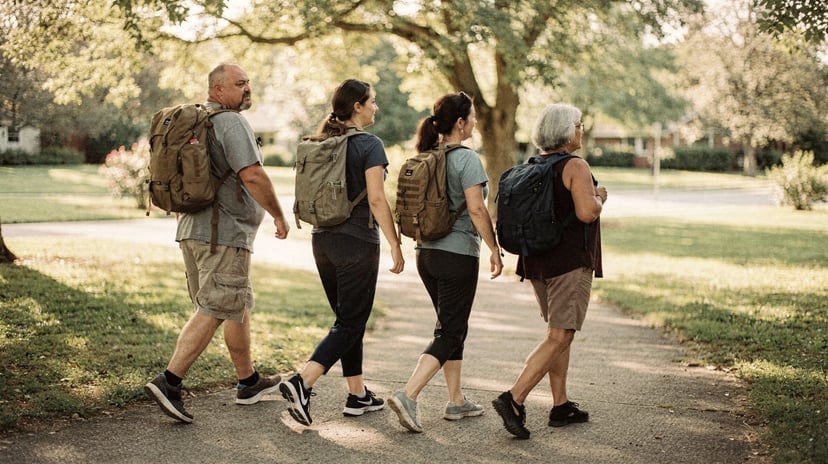
By week 4, compare the same measures you recorded at the start. Possible changes include:
Body Composition:
- Fat loss: Compare your own trend; the date alone does not establish an expected amount of weight loss.
- Visible changes: The waist or clothing fit might change slightly, though a photo may not show it yet.
- Muscle: Beginners may notice firmer legs or glutes, but visible definition is not assured.
Posture & Movement:
- Pack fit and greater trunk endurance may make an upright position easier to hold.
- Shoulder tension may improve, stay the same, or worsen. Adjust pack fit and stop if loaded walking causes pain, numbness, or tingling.
Cardiovascular Fitness:
- The same 2-mile route may feel easier or produce a lower heart rate at the same pace.
Mental Health:
- Regular outdoor exercise may help sleep or mood, but the effect varies and rucking is not treatment for anxiety or another mental health condition.
Energy Levels:
- Energy may rise after an easy session or fall after a hard one. Track the pattern rather than assuming either response.
What may still be hard to see: A month is often too short for a dramatic photo comparison. Pace, effort, waist measurement, and clothing fit can be more useful than comments from other people.

Walking programs of 4 weeks or longer raised aerobic capacity in inactive adults by about 3 mL/kg/min on average (Murtagh et al., 2015). For someone starting near 30 mL/kg/min, that's roughly a 10% gain. Measuring it takes a lab test, so at 30 days the more practical sign is the familiar route feeling easier at the same load.
After 60 days: look for repeatable changes

At 8-10 weeks, changes in pace, distance tolerance, and clothing fit may be easier to measure. Visible changes still depend heavily on food intake and starting body composition.
Body Composition:
- Fat loss: Compare your own trend; the date alone does not establish an expected amount of weight loss.
- Muscle definition: Some beginners may see more definition in the legs, glutes, or upper back. The amount varies with body fat, genetics, protein intake, and other training.
- Arms: The shoulders and upper back help stabilize the load, but rucking is not direct arm-strength training.
Cardiovascular Fitness:
- A heavier load may feel more manageable, but only increase load if posture, gait, and recovery remain good.
- Breathing at a familiar pace may become easier to control.
- Resting heart rate may start to drift down. Endurance-training trials averaged about a 4 bpm drop, in a review where programs lasted a median of 12 weeks (Reimers et al., 2018), and illness, stress, medication, sleep, and caffeine all move it too. Take it the same way each time, ideally first thing in the morning.
Posture & movement:
- Trunk endurance and pack fit may make upright posture easier to maintain.
- Varied terrain can challenge balance and ankle control, but it also adds risk and should be introduced gradually.
- Rucking may strengthen the trunk, but it can also aggravate back pain. Persistent or radiating pain needs assessment.
Mood and sleep:
- Sleep duration or quality may improve with regular activity, but an extra 30-60 minutes is not guaranteed.
- Mood or anxiety may improve for some people. Worsening or persistent symptoms deserve appropriate care.
Habits:
- A repeatable schedule may feel more automatic after two months.

At 60 days, compare effort on the same route with the same load. If it is clearly easier and recovery is good, change one variable at a time: terrain, load, distance, or pace. More work does not automatically produce faster fat loss.
After 90 days: compare the full trend
By 12 weeks, photos and measurements may show a difference, but a lack of visible change does not mean the training produced no fitness benefit.
Body Composition:
- Fat loss: Compare your own trend; the date alone does not establish an expected amount of weight loss.
- Body recomposition: Some beginners may gain a small amount of muscle while losing fat, which can make scale change differ from photo or waist change.
- Visual changes: Definition may become more visible, especially in the legs and back. It may also remain subtle.
- Waist circumference: Walking-only trials averaged about 0.6 in; a food deficit usually adds to that, but there's no reliable inches-per-pound rule, and your change can be smaller, larger, or zero.
Cardiovascular Fitness:
- Aerobic capacity: walking-program trials averaged about a 3 mL/kg/min gain, roughly 10% for an inactive beginner starting near 30 mL/kg/min. You'd need a lab test or a consistent watch estimate to see it as a number.
- A longer ruck may feel easier than it did at baseline.
- Hills or higher loads may be appropriate if the current program no longer challenges you and recovery remains good.
- Resting heart rate: about 4 bpm lower was an average across endurance interventions, not a guaranteed 12-week rucking result. People who start higher tend to drop more.
Strength:
- Muscular endurance in the legs and posterior chain may improve.
- Grip strength changes little unless the program also includes carries or other direct grip work.
- Trunk endurance may improve. Rucking does not guarantee that lower-back pain will resolve.
Mental Health:
- Mood, anxiety, and confidence may change with regular exercise, but the response differs by person.
- Rucking can support mental health; it is not a substitute for professional treatment when symptoms interfere with daily life.
How You Feel When You Move:
- Walking under the same load may feel smoother and more efficient.
- Transfer to hiking, sports, or daily tasks depends on how closely those activities match the training.
Before-and-After:
- Repeat the baseline photos under the same lighting and position. The comparison may show a change even when the scale does not, or it may confirm that more time is needed.

Take the same photos and measurements at 30, 60, and 90 days. Scale weight is one measure. Pace at a fixed load, waist size, clothing fit, energy, and sleep can show a different part of the trend.
What Changes Your Results (The Variables)
No two people follow the same timeline. These factors have the largest effect:
Diet
Food intake is the main driver of weight change. On flat ground at 3.5 mph, a 180 lb person burns about 395 calories an hour with 20 lb and about 430 with 40 lb; a 5% grade pushes a 30 lb ruck to about 635. A post-ruck snack can erase most of that.
A modest daily food deficit usually moves weight more than the pack does, but as explained above, dividing it by 3,500 overstates how many pounds it will produce. Anyone with a medical condition, pregnancy, medication effects, or a history of disordered eating should get individual guidance first.
Related: See our rucking calorie calculator guide for your specific burn rate.
Frequency
Three sessions per week is a practical starting schedule, not a biological minimum. Four or five may add volume if recovery is good, while one or two can still improve fitness. Frequency alone does not determine fat loss.
Related: How often should you ruck breaks down the frequency tradeoffs by goal (fat loss vs. event prep vs. general fitness) and the recovery rules that help limit injury risk at higher volumes.
Load
Starting too heavy can limit training volume and recovery. A lighter load that you can repeat is often more useful than a heavy load you can manage only once per week. Our budget starter kit covers beginner-friendly options.
As you adapt, a gradual load increase can renew the training stimulus. Moving from 5-10 lb in week 1 toward about 20 lb by week 8 is one example, not a required schedule. Reference our ruck plate comparison when adding load.
If you already know you want a dedicated beginner pack, the GORUCK Basic Rucker review explains its fit, plate limits, and tradeoffs. A more stable pack can make a repeatable load more comfortable to carry. It does not produce faster fat loss on its own.
Starting Fitness Level
A sedentary beginner may notice early fitness changes because loaded walking is a new training demand. Someone who already trains hard may see a smaller change because rucking adds less new work.
Age & Recovery
Age can affect recovery, but training history, health, sleep, and the size of each progression also matter. Older beginners may need more recovery between hard sessions.
Genetics
Genetics affect appetite, body composition, and training response. Two people can follow similar plans and see different changes at 90 days.
Rucking before and after for women
The same rules apply, with two practical differences.
Body weight changes the session-cost estimate. At 3.5 mph with 20 lb on flat ground, the Pandolf model estimates about 315 calories an hour for a 140 lb person and about 395 for a 180 lb person. Across three one-hour sessions, that is a modeled difference of roughly 240 calories. It doesn't predict which person's scale will change faster: intake, total activity, compensation, and water shifts also matter. Use the calorie calculator for a session estimate.
In Donnelly's ten-month trial, weight loss didn't differ significantly between men and women within the supervised exercise groups (Donnelly et al., 2013). Those participants completed a tightly controlled aerobic-exercise protocol. The result doesn't establish equal weight loss for everyone whose estimated ruck calories match.
Water shifts can hide a week's progress. In a year-long diary study of 62 women, self-reported fluid retention peaked on the first day of the period and was lowest mid-follicular (White et al., 2011). If you menstruate, compare weigh-ins and photos taken at the same point in your cycle each month rather than week to week.
Load is personal too. Starting at 5-10 lb leaves room to build. Our guide to rucking backpacks for women covers packs cut for shorter torsos.
Mental Health Changes Vary
Regular exercise can support sleep, mood, and confidence, but it does not follow a fixed weekly schedule. Track these changes alongside physical measures. If anxiety, low mood, insomnia, or another symptom persists or worsens, seek appropriate care rather than increasing training to solve it.
Related: Can rucking be your only exercise? looks at what it covers and what it leaves out.
Comparing Rucking to Other Training Modalities
How rucking compares:
- vs. Running: Rucking generally has lower impact per step but adds external load. Either may be easier to sustain depending on the person and goal.
- vs. Gym Training: Rucking trains loaded endurance. Strength training is more direct for building maximal strength and muscle.
- vs. Walking: Rucking usually raises energy cost and muscular demand at the same pace, but the size of the increase depends on load and terrain.
Deep dive: Rucking vs. Running for Weight Loss
How to adjust the plan
Focus on the parts of the plan you can measure and repeat:
- Sleep: The American Academy of Sleep Medicine and Sleep Research Society recommend at least 7 hours a night for adults (Watson et al., 2015). Poor sleep can impair recovery, but there is no fixed rule that it cuts results in half.
- Consistency: A repeatable schedule matters more than a perfect streak. Missing a week does not erase all prior adaptation.
- Progressive overload: Review the plan every 2-3 weeks and change one variable only when the current work feels controlled and recovery is good.
- Food intake: Track enough to know whether exercise calories are being replaced. This article plans around a 300-500 calorie daily deficit; that's a planning range, not a prescription.
- Recovery: Use actual rest days when soreness, sleep, or performance starts to worsen. Active recovery is optional.
Deep dive: Zone 2 Rucking for Sustainable Fat Loss explains how to keep the effort easy enough to repeat week after week.
How to Read the Timeline
For a beginner rucking 3-4 times a week with a 300-500 calorie daily food deficit:
- Week 1: Soreness is common; visible change is unlikely.
- Month 1: Assess consistency, comfort and effort on a familiar route.
- Month 2: Compare route effort, recovery, clothing fit, and measurements with your baseline; any of them may be unchanged.
- Month 3: Review fitness, measurements and recovery together, without a required scale result.
These are opportunities to review the plan. Keep the route, load and measurement conditions comparable so the trend reflects your response rather than a different test every month.
Besides the food deficit, the timeline assumes three or four rucks a week for three months, and that part depends on a setup comfortable enough to repeat. The gear for it is plain: a pack that holds the weight high so it doesn't bounce, a load you can adjust in small steps, and socks and anti-chafe so a week-two hot spot doesn't become the reason you skip week three.
Want a schedule to follow? Use the 30-day Ruck Authority Challenge to build the habit and track the same measures each week.
Common Questions
Q: What if I don't see results by 30 days?
First confirm that measurements were taken consistently. Scale weight can stall because of water, medication, menstrual-cycle changes, or other factors even when fat mass changes. Review food intake and activity, and consider a modest 200-300 calorie adjustment only if it is appropriate for your health. A doctor or registered dietitian can help with a persistent or unexplained change.
Q: Can I ruck every day?
Daily rucking can work when most sessions are easy, but more days do not guarantee faster progress. Many beginners recover better with 3-4 planned sessions per week and at least one full rest day.
Q: What if I'm already fit? Will rucking still work?
It can add a different stimulus: loaded walking, muscular endurance, and postural work. A trained person may see smaller changes than a sedentary beginner, and improvement is not guaranteed if the program does not add a meaningful or recoverable demand.
Q: How much weight should I use?
Start with 5-10 lb for 20-30 minutes on level ground, and choose a load you can repeat 3-4 times per week without worsening pain or recovery. Once the current load feels controlled, increase one variable at a time.
Q: Do I need to diet to see results?
Rucking alone can improve fitness. Fat loss requires an energy deficit, so food intake matters even when training is consistent. There is no universal percentage that applies to every person.
Keep Reading
- Rucking for Weight Loss: 12-Week Plan: the hub for load, frequency, food, and tracking
- Rucking for Weight Loss Gear Guide: the four-item starter kit in budget, mid-range, and premium tiers
- Rucking Starter Kit: the complete beginner loadout, with three budget tiers and exact links for each item
- Rucking vs. Running for Weight Loss
- Zone 2 Rucking Guide
- Rucking Calorie Calculator
- Can Rucking Be Your Only Exercise?
Frequently Asked Questions
Use those dates to compare consistency, route effort, recovery and body measurements. There isn't a typical number of pounds established for a rucking program at 30, 60 or 90 days. Calorie arithmetic alone cannot supply it.
There is no reliable day when a visible change appears. Use photos taken under the same conditions every 30 days, along with waist, pace, and heart-rate measures. Fitness can improve even when the 60- or 90-day photos look similar.
Food intake may be one factor, but water retention, medication, menstrual-cycle changes, illness, and measurement error can also affect scale weight. Calorie burn per ruck is also easy to overestimate: about 395 an hour for a 180 lb person with 20 lb on flat ground, and less for a lighter person. Track intake and weight consistently before making a change, and get medical or dietetic guidance when appropriate.
Daily easy rucking is not automatically better than 3-4 planned sessions per week. More frequency adds volume and may raise irritation or injury risk if load, distance, or terrain progress too quickly. Keep at least some sessions easy and reduce frequency when recovery worsens.
Probably, though differently from a sedentary beginner. Loaded endurance work, postural demand and a different movement pattern can still challenge fit people. Changes are more likely in muscular endurance and loaded walking than in body composition, and they aren't guaranteed if the program doesn't add a meaningful demand.
A heavier pack doesn't guarantee faster results. Choose a load and duration you can repeat with normal gait and stable recovery; an active walker new to load can try 5-10 lb or less. Review the plan every 2-3 weeks if useful, but add weight only when your goal requires it and the current work is well tolerated. The date itself isn't a reason to increase.
The pattern is the same, but a lighter person burns fewer calories per ruck: about 315 an hour for a 140 lb person carrying 20 lb on flat ground, against about 395 for a 180 lb person. Scale weight also swings with the menstrual cycle, so compare weigh-ins and photos taken at the same point in the cycle each month.
No reliable timeline exists. Regular exercise supports sleep and mood for many people, while others notice little change. Persistent anxiety, low mood, or insomnia deserves proper care rather than more training.
The check-ins in this guide assume 3-4 sessions per week. Missing a week does not reset all adaptation, though repeated gaps reduce total training. One or two sessions can still improve fitness, but body-composition change depends more on total activity and energy balance than on a fixed session count.
No. Soreness (DOMS) is normal in weeks 1-2 as your body adapts to the new stimulus. After that, mild muscle fatigue is normal, but significant soreness usually indicates you're doing too much too fast. Focus on consistent effort rather than punishing workouts.
Correction, October 9, 2026: Removed unsupported monthly fat-loss forecasts and separated calorie-model illustrations from measured exercise outcomes.


