
- Zone 2 should feel conversational but clearly like work.
- Load, pace, hills, heat, and surface can all push the same walk into a harder zone.
- Use heart rate as a guide and the talk test as the field check.
- Most health and fat-loss rucks should stay easy enough to repeat consistently.
What is Zone 2?
Rucking heart rate zones work like running or cycling zones, but load changes the equation. A pace that would be Zone 1 while walking unloaded may become Zone 2 with a 25-lb pack, Zone 3 on a hill, or Zone 4 in heat. That is why ruckers should manage intensity with four levers: load, pace, grade, and terrain.
| Zone | % max HR | Rucking feel | Best use |
|---|---|---|---|
| Zone 1 | 50-60% | Very easy, full conversation | Recovery walks, beginner adaptation |
| Zone 2 | 60-70% | Conversational, steady effort | Aerobic base, fat loss, long rucks |
| Zone 3 | 70-80% | Short sentences, noticeably hard | Hills, tempo rucks, event prep |
| Zone 4 | 80-90% | Few words, hard breathing | Short intervals only |
| Zone 5 | 90-100% | Max effort | Rarely needed for recreational rucking |
- 01
CDC intensity guidance uses the talk test: moderate intensity lets you talk but not sing, while vigorous intensity limits speech to a few words.
- 02
CDC adult activity guidelines set the baseline target at 150 minutes of moderate aerobic activity per week plus 2 days of strength work.
- 03
Birrell, Hooper, and Haslam showed that added load changes walking forces, reinforcing why ruckers need to manage load, pace, grade, and terrain as intensity levers.
Zone 2 is the second heart-rate training zone. This guide uses 60-70% of estimated maximum heart rate, while some models use 60-75% or define the zone by lactate thresholds.
For a 35-year-old with an estimated maximum heart rate of 185 bpm, this model gives a Zone 2 range of 111-130 bpm. At that effort, complete sentences should still be possible. The estimate may differ from a tested threshold.
What happens at Zone 2 intensity: Fat generally supplies a larger share of energy than it does during hard work, and lactate remains relatively stable. Repeated aerobic training can improve mitochondrial capacity and cardiovascular fitness. A single session does not guarantee those changes.
Zone 2 is popular because it combines a sustainable effort with useful aerobic volume. It is not the only intensity that improves fitness, and a higher share of fat use during the workout does not guarantee greater fat loss over time.
The "talk test" is your practical Zone 2 indicator: you can hold a conversation, but it takes slight effort. You're breathing harder than at rest, but you're not gasping.
How load, grade, terrain, and heat shift your zone
This is the part generic heart-rate-zone guides miss: in rucking, the same pace can sit in three different zones depending on four variables. A running zone chart assumes one variable (speed). A ruck has four. Here is the approximate heart-rate impact of each, holding pace constant, for a typical rucker - then verify against your own monitor, because individual response varies.
| Variable | Change | Approx. HR impact (same pace) | Zone effect |
|---|---|---|---|
| Load | +10 lb | +5-8 bpm | ~25-30 lb shifts unloaded Zone 1 into Zone 2 |
| Grade | +5% incline | +10-15 bpm | A moderate hill pushes Zone 2 into Zone 3 |
| Terrain | firm → soft (sand, mud, deep grass) | +10-20 bpm | Soft ground can cost as much as added load |
| Heat | ambient >80°F / 27°C | +5-15 bpm (cardiac drift) | Same ruck drifts up a zone as you heat up |
These ranges are modeled from the load-carriage metabolic literature - the Pandolf equation predicts energy cost from load, speed, and grade, and assigns soft surfaces a terrain factor up to ~2x firm ground. Heat adds cardiac drift on top, independent of mechanical work. The four effects stack.
Worked example. A 35-year-old whose flat-pavement Zone 2 is 111-130 bpm at 3.5 mph with 20 lb adds a 5% hill and 85°F heat. Grade adds ~12 bpm, heat adds ~10 bpm - the same pace and load now reads ~133 bpm, into Zone 3. To hold true Zone 2, they drop pace, shed 5-10 lb, or accept the higher zone for that segment. This is why a single "ruck in Zone 2" instruction fails in the field: the target pace is conditional on terrain and weather, not fixed.
The practical rule: pick the one variable you can hold constant (usually load), then manage zone with the others. On a hot or hilly day, the same ruck that was Zone 2 last week is Zone 3 today - and that is not a fitness regression, it is the variables stacking. Read effort from heart rate and the talk test, not from your usual pace.
Why Rucking Can Work for Zone 2
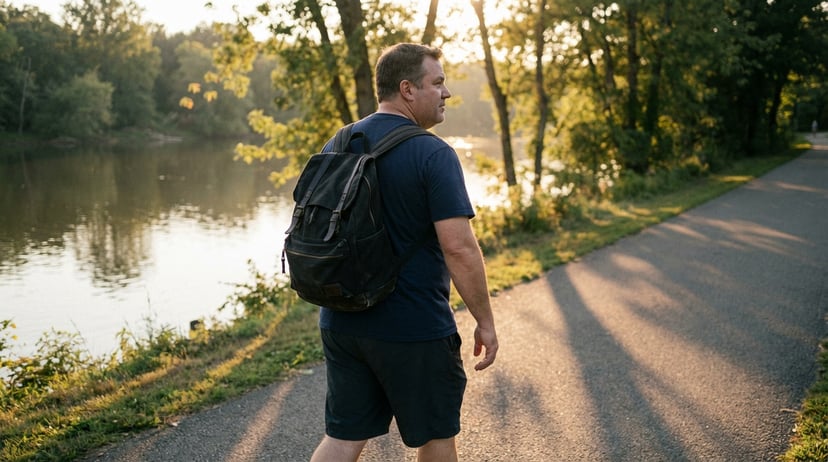
Any activity that holds a sustainable aerobic effort can train Zone 2. Rucking adds load as another way to adjust intensity.
Unloaded walking may be enough for beginners, people returning to exercise, or anyone walking on hills or at a brisk pace. A fitter person may need more pace, grade, or load to reach the chosen range.
Running may push a beginner above Zone 2 at a comfortable running pace. Experienced runners can often hold an easy Zone 2 run, so the choice depends on training history and joint tolerance.
Rucking can bridge the gap. Added weight raises energy cost at a given pace, but a 150-pound person walking at 3.5 mph with 25 lbs is not guaranteed to land in Zone 2. Measure the response, then adjust load, pace, or terrain.
Rucking requires a suitable pack and load but no gym, bike, or pool.
Loaded-walking research shows that added weight raises energy cost and often raises heart rate at the same pace. It does not establish that 20-30% of body weight at 3.0-3.5 mph places every person in the same heart-rate zone. Verify the effort with heart rate and the talk test.
How to find your Zone 2
Zone 2 can be estimated with the talk test alone. A heart-rate monitor adds data, while a bottle or hydration bladder matters only as the route and weather require. The products below are options, not a three-item requirement.
| Role | Pick | Why it earns the slot |
|---|---|---|
| Watch | Garmin Instinct Solar | Native HR zone alerts, weeks of battery, pairs with chest straps for precision. |
| Watch alt | COROS PACE 4 | Half the price of the Instinct with built-in zone tracking. Better for road-focused ruckers. |
| Hydration | Nalgene 32oz Wide-Mouth | Wide enough to drop electrolyte tabs into without slowing your pace. |
There are several ways to estimate Zone 2, and each has limits. Cross-checking a heart-rate estimate with the talk test is a practical starting point.
Method 1: Age-based formula. The simplest calculation is (220 - age) × 0.60 - 0.70 for Zone 2. A 35-year-old: (220 - 35) × 0.60 = 111 bpm (lower end) and (220 - 35) × 0.70 = 129 bpm (upper end). So Zone 2 is roughly 111 - 129 bpm.
The limitation: this formula is population average. Some people have max heart rates 20 bpm higher or lower than the formula predicts.
Method 2: MAF (Maximum Aerobic Function) method. The MAF method, popularized by Phil Maffetone, calculates aerobic threshold as 180 - age, with adjustments. A 35-year-old has a MAF of 145 bpm. Zone 2 is typically considered 10 bpm below MAF, so 135 bpm.
This method produces different numbers from the 220-minus-age formula. It is a coaching method rather than a direct measurement of an individual's physiological threshold.
Method 3: Talk test. This requires no math. Full sentences generally indicate moderate effort, while only a few words indicate vigorous effort. The talk test does not separate every numbered zone precisely.
The talk test is less precise than heart rate but aligns well with Zone 2 for most people.
Method 4: Lactate testing. A lab can measure blood lactate across progressive intensities and estimate thresholds. Roughly 2 mmol/L is sometimes used as a marker, but individual baselines and zone models vary.
Recommended approach: Start with the age-based formula to get a ballpark range. Wear a chest strap heart rate monitor (more accurate than wrist-based monitors) or a dedicated watch like the Garmin Instinct 3 Solar and validate with the talk test. Start rucking and see where your natural heart rate lands. Over 2 - 3 sessions, you'll develop intuition for Zone 2.
Carry enough water for the temperature, duration, and refill access. A Nalgene Wide Mouth Sustain 32oz is one simple option.
Programming Zone 2 rucking
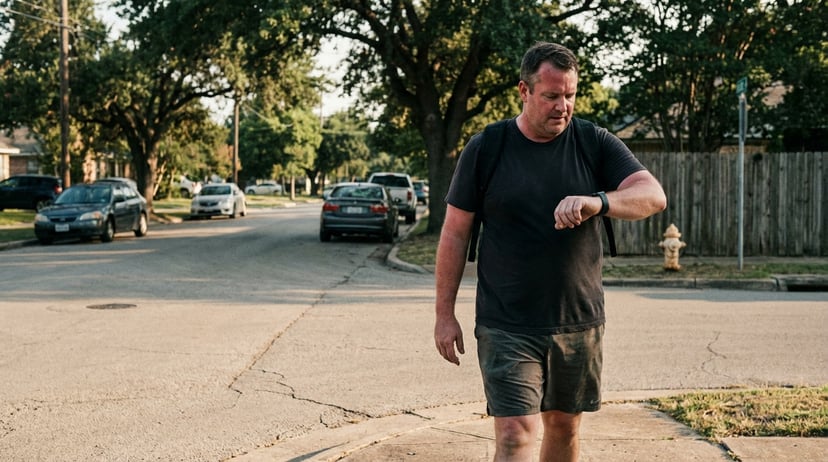
Finding Zone 2 is the first step. Programming it effectively is the second.
Finding your "Zone 2 load"
This is the load that, at a comfortable pace (3.0 - 3.5 mph), puts your heart rate into Zone 2 territory.
If you already tolerate loaded walking, 15-20% of body weight is one test range. Beginners should start lighter. Ruck for 10 minutes at a comfortable pace, then check heart rate and the talk test.
- Too low (below Zone 2)? Add 5 lbs or increase pace by 0.2 mph. Ruck another 5 minutes and recheck.
- Too high (above Zone 2)? Reduce load by 5 lbs or slow down slightly. Recheck.
The goal is a load where you naturally land in the Zone 2 band at your sustainable walking pace, with minimal perceived effort. Our backpack guide will help you find a pack that distributes weight comfortably. This is your baseline Zone 2 load.
Important: Terrain changes this calculation. The same load uphill will produce a significantly higher heart rate than on flat ground. You might be in Zone 2 with 25 lbs on flat pavement, but Zone 3 with the same load on a 5% hill. Adjust accordingly.
Weekly structure
Three sessions of 30-45 minutes per week are a practical starting plan, not a proven minimum effective dose. Use a load that keeps the effort moderate; experienced ruckers may test 15-20% of body weight, while beginners should start lighter. Our plate comparison guide covers load options.
Experienced ruckers may use 4-5 sessions of 45-60 minutes per week, including one 60-90 minute session. That is a high-volume example, not an optimal prescription for everyone.
80/20 principle: Keep 80% of your rucking volume in Zone 2, allowing 20% in Zone 3 (hills, faster segments, harder days). Don't live in Zone 2 so strictly that you never challenge yourself. But don't let Zone 2 become an afterthought-it's the foundation.
A practical weekly structure:
- Monday: 45 minutes Zone 2 ruck (moderate pace, moderate load)
- Tuesday: Rest or easy walk
- Wednesday: 60 minutes Zone 2 ruck (slightly longer)
- Thursday: 40 minutes Zone 2 ruck (shorter, recovery-oriented)
- Friday: Rest or mobility
- Saturday: 75 - 90 minute longer ruck (mostly Zone 2, allow some hills/faster sections)
- Sunday: Complete rest
This totals about 4.5 hours of Zone 2 rucking per week. Use it only if that volume is sustainable alongside the rest of the training plan.
Progression
For progression, add either 5-10 minutes of total volume or 2-5 lbs, then hold the other variable steady. Raising both at once makes recovery and form problems harder to trace.
Track whether you can sustain 45-60 minutes comfortably. Reassess after 6-8 weeks rather than treating that window as a deadline. Progress only one of distance, load, frequency, or intensity at a time.
A progression metric is aerobic drift. As your fitness improves, your heart rate should drift less throughout a given ruck. Week 1, your average HR might start at 125 bpm and end at 135 bpm (drift). Week 6, the same load and pace should show less drift-maybe 125 to 128 bpm. This shows your aerobic system is more efficient.
Measuring progress without the scale
Heart-rate data and scale weight can move in different directions. Scale weight also changes with water, food, medication, and other factors. Track more than one measure.
Cardiac drift within a single ruck session is a marker of improving fitness. Early on, your heart rate will climb throughout a 60-minute ruck due to fatigue and heat accumulation. As you adapt, your HR should stay steady. If Week 1 shows 125 - 135 bpm across your ruck and Week 6 shows 127 - 131 bpm for the same workout, you're more efficient.
Same route, same load, lower average HR can indicate improved fitness when temperature, wind, caffeine, sleep, stress, and device conditions are similar. Repeat a 3-mile route every two weeks and look for a trend rather than one reading.
Resting heart rate trending downward may reflect cardiovascular adaptation, but illness, stress, sleep, medication, and measurement error also affect it. Measure under similar conditions. A change from 72 bpm to 66 bpm over eight weeks is worth noting, not proof of one cause.
Can carry more weight at the same heart rate is a practical marker. If Week 1 required 25 lbs to reach 120 bpm and Week 6 you reach 120 bpm with 32 lbs, you're stronger and more efficient.
These metrics all point to the same thing: improved aerobic fitness, metabolic efficiency, and cardiovascular health. The scale is just one data point. For a fuller picture of what to expect visually, see the rucking before and after timeline - 30/60/90-day changes in body composition that pair with the Zone 2 cardiovascular adaptations above.
Common Zone 2 rucking mistakes
These errors make the intended effort harder to control.
Going too hard. Hills, heat, or a faster pace can move the session above the intended range. Slow down or reduce load when conversation becomes difficult. A hard segment does not erase the whole session, but repeated drift changes its purpose.
Using only one signal. Perceived effort and wrist-based heart rate both have limits. A $40-60 chest strap can improve measurement, and a watch such as the COROS PACE 4 can show zone trends. Neither is essential if the goal is simply moderate aerobic exercise and the talk test is clear.
Only doing Zone 2 for a goal that requires speed. Hills or faster segments train qualities that easy work does not. The 80/20 principle is one option, not a required ratio. General-health beginners may spend a base phase at moderate intensity before adding hard work.
Inconsistent pacing. Walking fast then slow instead of maintaining steady state defeats the purpose. You're not creating consistent stimulus. Zone 2 rucking should be steady-state: find your pace and hold it. This teaches your body to work efficiently at that intensity.
Ignoring terrain effects. A hill segment can spike you from Zone 2 to Zone 4 without realizing it. If you're tracking average heart rate for the ruck, hills will distort the data. For true Zone 2 programming, flat terrain is preferable, at least until you understand how hills affect your specific heart rate. Then you can use hills strategically.
Zone 2 should feel controlled. If a session leaves you depleted, reduce pace, load, duration, or heat exposure. Over several weeks, compare the same route and load for changes in pace, heart rate, and perceived effort. Body-composition change still depends on energy balance.
Frequently Asked Questions
Most rucks should be in Zone 2, roughly 60-70% of maximum heart rate, where you can speak in full sentences but cannot sing comfortably. Use Zone 1 for recovery, Zone 3 for hills or tempo work, and Zone 4-5 only for short intervals or advanced event preparation.
Zone 2 is low-intensity, but daily loaded walking can still strain the feet, calves, and trunk. Start with 3-4 sessions per week and add frequency only when the current load produces no persistent pain or recovery problems. Six to eight weeks is a review point, not automatic clearance for daily rucking.
Heat, hills, caffeine, stress, medication, inaccurate maximum-heart-rate estimates, poor aerobic fitness, or too much load can all raise the reading. Try 10-15% of body weight or less, slow to 2.5-3.0 mph, and use the talk test. Start with unloaded walking if needed, and discuss unusual symptoms or heart-rate responses with a clinician.
There is no reliable week when visible fat loss begins. It depends on total energy balance, starting body composition, training volume, sleep, medication, and measurement method. Track the same route and load for 6-8 weeks for fitness trends, and evaluate body-composition change over a longer window rather than promising a result by a date.
Fasted exercise may increase fat oxidation during that session, but that does not prove greater long-term fat loss. Eat beforehand if training fasted makes you weak, dizzy, or unable to hold the planned effort. Overall energy balance and a routine you can repeat matter more than the fed-versus-fasted label.
Yes. Thirty-minute sessions count toward the CDC baseline of 150 minutes of moderate aerobic activity per week. Three sessions total 90 minutes, so add other walking or aerobic work if 150 minutes is your goal. More time is not automatically better when the added load causes pain or recovery problems.
Brief spikes into Zone 3 during hills won't ruin your Zone 2 session. Either slow your pace on the hill to stay in Zone 2, or accept the spike and return to Zone 2 pace once you're back on flat ground. Don't stop and wait unless you're significantly above Zone 3.
Audio does not change the physiology, but it can distract you from traffic, footing, and effort. Pause it briefly and speak a full sentence to use the talk test. Keep the volume low enough to hear your surroundings.


