
Rucking calorie burn is best estimated from body weight, pack weight, pace, distance, terrain, and grade. For most recreational rucks, the practical range is about 240-550 calories per hour. Use the calculator for planning, then compare it against your own repeat routes and heart-rate trends.
Calculate your rucking calorie burn
Use the calculator above to estimate how many calories you'll burn during your rucks. Enter your bodyweight, ruck load, distance or duration, pace, and terrain. The calculator will show you total calories burned, calories per mile, and calories per minute, plus how your calorie burn compares to walking, running, and cycling at the same intensity. If you just need the tool without the full guide, open the standalone rucking calorie calculator.
The fast answer: most recreational rucks land between 240 and 550 calories per hour. Light beginner rucks sit near the low end. Heavy, hilly, or fast rucks sit near the high end. The biggest variables are body weight, pack weight, walking speed, terrain, and grade.
| Example ruck | Estimated burn | Why |
|---|---|---|
| 150-lb person, 15-lb pack, 2 miles flat | ~175-185 calories | Light load, short distance |
| 180-lb person, 25-lb pack, 3 miles flat | ~325-345 calories | Common beginner/intermediate ruck |
| 200-lb person, 35-lb pack, 4 miles flat | ~495-525 calories | Heavier body + heavier pack |
| 180-lb person, 30-lb pack, 3 miles with 3-5% hills | ~445-525 calories | Grade multiplies energy cost |
Gear that changes the experience
| Goal | Gear that helps | Why it matters |
|---|---|---|
| Make the load measurable | Titan Fitness Ruck Plate | A known load makes the calculator useful instead of approximate. |
| Keep the habit comfortable | Darn Tough socks and Body Glide | Weight-loss results come from repeatable sessions, not heroic one-offs. |
| Ruck longer without overdoing it | Source WXP 3L and LMNT | Heat, hills, and duration make hydration part of the plan. |
How we calculate this

Understanding the math behind calorie estimation helps you trust the numbers and understand their limits. For the full implementation notes, source block, and caveats, see our rucking calorie calculator methodology.
- 01
Pandolf, Givoni, and Goldman developed the load-carriage equation that models body mass, external load, speed, terrain, and grade.
- 02
The MET cross-check values come from Herrmann et al. (2024) - the 2024 Compendium of Physical Activities (PMC11336313), the current NIH-published reference for metabolic equivalents across activities. This is the modern replacement for the older Ainsworth compendia and the authoritative source for MET-based estimation.
- 03
Our calculator methodology documents the exact formula, terrain coefficients, unit conversions, MET cross-checks, and limitations we apply.
- 04
Field validation work on walking economy shows that loaded walking equations are useful planning tools, but real terrain and individual efficiency still create meaningful variation: Real-world walking economy.
The Pandolf equation
The most scientifically rigorous approach comes from the Pandolf load-carriage equation, developed by the US Army Research Institute of Environmental Medicine in 1977. The Army needed to know the energetic cost of loaded marching for mission planning, so researchers studied metabolic cost across different loads, speeds, grades, and terrains.
The equation is: M = 1.5W + 2.0(W+L)(L/W)² + η(W+L)(1.5V² + 0.35VG)
Breaking down the variables: W is your body mass in kilograms, L is the load mass, V is speed in meters per second, G is grade expressed as a percent, and η is a terrain factor that accounts for surface conditions.
Terrain factors are key. On a paved road, η = 1.0 (baseline). On gravel, η = 1.2. Light brush or uneven ground adds η = 1.5. Heavy brush or forest floor requires η = 1.8. Sand is brutal: η = 2.1. This explains why the same load at the same pace feels dramatically harder on sand versus pavement.
The limitation: the equation was developed for military loads (typically 40 - 100 lbs on soldiers) and longer distances. It may overestimate calorie burn at lighter loads (10 - 15 lbs) or very slow paces. But it's the most validated method for rucking specifically, which is why we use it as our primary calculation.
MET values for loaded walking
An alternative approach uses MET values, or metabolic equivalent of task, expressed as multiples of your resting metabolic rate. The authoritative reference for these values is the 2024 Compendium of Physical Activities (Herrmann et al., PMC11336313), a major NIH-published update that replaces older Ainsworth-era tables and is the source we use for MET cross-checks. Walking unloaded at 3.5 mph burns approximately 3.5 METs. Add a 10 - 20 lb load at the same pace and you elevate to roughly 5 - 6 METs. Add a 30 - 40 lb load and you're at 6.5 - 8 METs.
The formula: Calories burned = METs × body weight (kg) × hours
For example, a 180 lb person (82 kg) rucking for 1 hour at 6 METs: 6 × 82 × 1 = 492 calories. Simple, fast, and useful as a cross-check.
The limitation: MET values are population averages and don't account for individual variation in efficiency or fitness level. The 2024 Compendium notes the same caveat: METs are directionally correct but less precise than load-carriage-specific equations like Pandolf for rucking specifically.
We use the Pandolf equation as our primary method because it accounts for load weight, terrain, and grade, the specific variables that matter for rucking. MET values are provided as a secondary reference. Both are estimates: individual metabolic rates, fitness levels, and walking efficiency cause significant variation (±15-20%).
Which calorie method should you use?
| Method | Best for | Strength | Limitation |
|---|---|---|---|
| Pandolf | Rucking with known load, speed, grade, and terrain | Most specific to loaded walking | Can overestimate some light recreational rucks |
| MET estimate | Fast ballpark math | Simple and easy to explain | Does not model terrain or exact load well |
| Heart-rate tracker | Tracking your own trend over time | Personalized to your physiology | Often misses pack weight and terrain |
| Fitness app default | Rough motivation only | Convenient | Usually built for walking/running, not loaded walking |
Use Pandolf for planning, METs for cross-checking, and your watch for trend tracking. If all three disagree, trust the trend over the exact number: same route, same load, lower heart rate means you are getting more efficient.
Quick reference: calories per mile by bodyweight and load
Here's a practical table for flat terrain at a steady 3.5 mph pace on pavement. Use this for quick estimates without running the full calculator:
| Bodyweight | 15 lb Load | 20 lb Load | 25 lb Load | 30 lb Load | 35 lb Load |
|---|---|---|---|---|---|
| 140 lbs | 87 cal | 90 cal | 92 cal | 95 cal | 97 cal |
| 160 lbs | 99 cal | 101 cal | 103 cal | 106 cal | 109 cal |
| 180 lbs | 110 cal | 113 cal | 115 cal | 117 cal | 120 cal |
| 200 lbs | 122 cal | 124 cal | 126 cal | 129 cal | 131 cal |
| 220 lbs | 133 cal | 135 cal | 138 cal | 140 cal | 143 cal |
So a 180 lb person rucking 3 miles with a 25 lb pack at 3.5 mph burns approximately 345 calories. Add a 5% hill grade and the total rises by roughly 55%, to about 535 calories for the same distance. Fast reference: on flat pavement body weight moves the number more than pack weight does, and grade moves it most of all. These are Pandolf-equation figures, the same model the calculator uses.
Factors that increase calorie burn
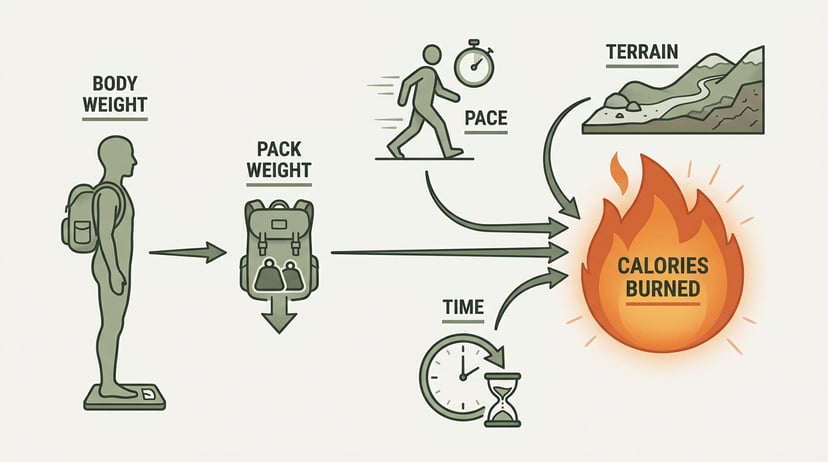
Calorie burn is not static. Several variables compound to create big differences in daily burn.
Heavier load is the most obvious. Each additional pound increases the work your body must do, but on flat ground the steps are small: for a 180 lb person at 3.5 mph, going from 15 lbs to 25 lbs adds about 16 calories an hour and 35 lbs to 45 lbs about 19. What rises faster than the calorie return is the strain, and beyond 35 - 40% of your bodyweight, the injury risk often exceeds the benefit. The sweet spot for most people is 20 - 30% of bodyweight. A Titan Fitness ruck plate gives you precise weight increments to dial in that sweet spot. Check our ruck plate comparison for more options.

Faster pace has an exponential rather than linear relationship with calorie burn. Walking at 3.0 mph versus 4.0 mph at the same load does not double your burn. It is not proportional, but it increases substantially. The faster you move, the more metabolic cost per unit distance. For weight loss purposes, a sustainable 3.0 - 3.5 mph pace is ideal. It is the speed where most people can maintain Zone 2 intensity without overheating or degrading movement quality.
Hill grade raises the predicted energy cost of a ruck. The exact change depends on body weight, load, pace, and grade. Hills let you increase effort without adding more weight or walking faster.
Soft terrain multiplies the cost. Uneven ground, sand, mud, and deep grass all force your stabilizer muscles to work harder. Your feet don't compress and rebound off the surface as efficiently as on pavement. Walking in sand, for instance, increases calorie cost by roughly 1.7x compared to firm ground in the Pandolf model. Rocky or technical terrain requires more neuromuscular attention and balance work. Proper footwear helps - see our terrain-specific shoe guide. Soft surfaces are harder but also higher injury risk - use strategically, not as a daily norm.
Hydration and electrolytes affect performance. For sessions over 60 minutes, LMNT Electrolyte Variety Pack helps maintain sodium balance and prevents the fatigue that comes with hyponatremia during long rucks. Better performance during the ruck means you maintain intensity and don't lose calorie burn to energy crashes.
Temperature extremes matter. In cold conditions, your body works harder to maintain core temperature. In hot conditions, you're also taxing your cardiovascular system to thermoregulate. Very hot or very cold rucking burns more calories than temperate conditions, though the effect is modest compared to load and grade.
Altitude increases calorie burn because there's less oxygen available. Your body works harder at the same pace to deliver oxygen to your muscles. If you're rucking at altitude, expect 10 - 15% higher calorie burn compared to sea level.
Calorie burn vs other activities
Calories an hour: walking, rucking, running
A 180 lb person. Walking and rucking at 3.5 mph on pavement unless noted
- Walking, no pack365
- Ruck, 20 lb395
- Ruck, 35 lb420
- Ruck, 30 lb, 5% grade635
- Jog, 5 mph710
- Run, 6 mph840
Walking and rucking from the Pandolf load-carriage equation (the model in our calculator), which tends to under-predict heavy loads; running from the Compendium of Physical Activities METs, as in the calculator's comparison table. On flat ground load adds modestly; grade adds a lot.
The chart shows the shape of it. Unloaded walking at 3.5 mph on flat pavement burns about 365 calories per hour for a 180 lb person. Add 20 lbs and you're at about 395, a modest increase. Add 35 lbs and you're at about 420. The bigger jump comes from grade: a 30 lb ruck up a 5% incline is about 635. That's the value of rucking: the calorie burn compounds with load, the sustainability of walking, the strength benefit of loaded work, and a joint-friendly impact profile.
Common calorie counting mistakes
Calorie math is useful for guiding behavior, but people make systematic mistakes that distort the value of their work.
Fitness tracker estimates without calibration are often 20 - 30% off for rucking specifically. Your Apple Watch or standard Garmin is built on population averages. A dedicated watch like the Garmin Forerunner 265 has better VO2 max estimation for rucking loads, but it doesn't know your exact fitness level, efficiency, or the specific terrain you're rucking. Use trackers directionally, but don't treat them as gospel. Compare your tracker's estimates to this calculator and adjust your assumptions if there's consistent divergence.
Counting gross calories instead of net is a critical error. You burn a baseline amount of calories just existing. If you burn 2,500 calories total during a ruck but would have burned 300 calories sitting, your net burn is 2,200. For weight loss, the net matters. Some people try to "eat back" all calories burned assuming they're additional. That's incorrect and stalls weight loss.
Adding back all "earned" calories to your diet is how people gain weight while exercising. A ruck burns 500 calories, so they add 500 calories to their diet. But if their goal is weight loss, they need a deficit. Rucking creates the deficit. Eating back the calories erases it. Be intentional about what you do with the caloric advantage rucking provides.
Ignoring EPOC (excess post-exercise oxygen consumption, or "afterburn") understates the total benefit. Rucking, particularly if it's moderately intense, leaves your metabolism elevated for hours afterward. The effect is modest compared to higher-intensity exercise, but it's real. You're not accounting for the full caloric benefit if you only count the hour of rucking itself. The afterburn effect might add 5 - 10% to your total daily expenditure on rucking days.
Assuming the same burn every session ignores adaptation. Your body becomes more efficient. The exact same load, pace, and distance in week 8 burns fewer calories than in week 1 because your neuromuscular system is more efficient. This is fine. It means you're adapting, but it's a factor if you're tracking calories burned. Periodically reassess your numbers rather than using week 1 estimates for month 6.
Treat calorie estimates as directionally correct, not precisely accurate. The exact number matters less than the trend: are you rucking consistently and maintaining a moderate caloric deficit? That is what drives fat loss. Use the calorie calculator as a guide to stay motivated, not as a precise accounting system.
Frequently Asked Questions
Most recreational rucks burn roughly 240-550 calories per hour depending on body weight, pack weight, pace, terrain, and grade. A 180-lb person carrying 25-30 lbs at 3-3.5 mph will land around 320-410 calories per hour on flat terrain, with hills pushing the number well past 600.
The Pandolf equation was specifically developed for loaded walking and accounts for pack weight, terrain, and grade factors that most fitness trackers ignore. Your tracker uses population averages and doesn't know you're carrying extra weight, so it typically underestimates rucking calories by 20-30%.
The Pandolf equation may overestimate calories at very light loads since it was developed using military loads of 40-100 lbs. For loads under 20 lbs, the MET method might be more accurate, or expect our calculator to be slightly high by 10-15%.
No. Rucking creates the caloric deficit you need for weight loss, so eating back all burned calories erases that benefit. The calorie burn is your advantage for creating the deficit, not permission to eat more.
Your body becomes more efficient at the movement patterns and load management. The same ruck in week 8 burns fewer calories than week 1 because your neuromuscular system has adapted. This is normal adaptation, not a problem.
Terrain has dramatic impact. Sand increases calorie burn by roughly 1.7x compared to pavement at the same load and pace. A 5% hill adds roughly 55% more burn. Sometimes terrain changes are more practical than adding weight, especially if you're already at 30% of bodyweight.
Yes, but the accuracy decreases for very short sessions. The equations work best for sustained efforts where your body reaches steady-state metabolism. For 15-20 minute rucks, expect the estimates to be slightly high.


