
The short answer
For a previously sedentary person, rucking can be a useful primary activity. It trains aerobic fitness, loaded walking, and posterior-chain endurance. It does not guarantee fat loss, and it does not fully train upper-body strength, power, or mobility. Public-health guidelines also recommend muscle-strengthening work at least two days per week, so rucking alone is not a complete program by that standard.
What rucking covers

Rucking combines aerobic exercise with the muscular demand of carrying a pack.
Cardiovascular fitness. Rucking can provide moderate aerobic work when load and pace place the effort near Zone 2. It can build an aerobic base, though heart-rate zone and VO2 max response vary.
Muscular endurance comes from the load. The glutes, hamstrings, back extensors, trunk stabilizers, and calves work through many repetitions. Some of that endurance may transfer to hiking and daily carrying tasks, but rucking is not a substitute for full-range resistance training.
Bone loading is another potential benefit. Loaded walking is weight-bearing and gives the skeleton a mechanical stimulus. The amount of bone-density change from rucking alone is not well established, and anyone with osteoporosis or fracture risk should get individual guidance before adding load.
Mental health and stress. Regular activity and outdoor time may support mood or stress management. Rucking is not a substitute for mental-health treatment, and the response varies.
Energy use rises with body weight, pack load, pace, grade, and terrain. Calculator estimates often fall around 400-600 calories per hour for some scenarios, but wearables and equations are estimates. A Garmin Instinct 3 Solar can track pace and heart-rate trends.
Task-specific fitness. Loaded walking can make stairs, hiking, and carrying gear feel easier when those tasks resemble the training.
What rucking doesn't cover well
Rucking does not develop every fitness quality strongly.
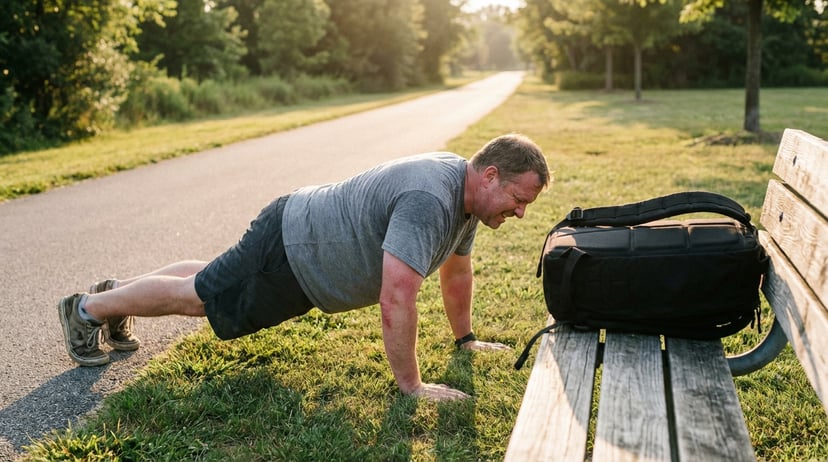
Upper body pushing strength-chest, shoulders, triceps-gets minimal stimulus from rucking. The load is on your back, distributed through your core and lower body. Your upper body muscles aren't being pushed under heavy tension. If maximum chest strength matters to you, this is a gap.
Maximal strength in the lower body is limited. Rucking doesn't place the same kind of heavy, brief mechanical tension on muscles that heavy squats or deadlifts do. The load is relatively light and the reps are very high. You'll build strength, but it's not equivalent to progressive resistance training.
Power and explosiveness-sprinting, jumping, rapid changes of direction-are largely absent from rucking. You're not moving explosively. If athletic performance matters to you, this is a meaningful gap. Zone 2 rucking is deliberate and steady, not explosive.
Flexibility and deep range of motion don't improve with rucking. In fact, if you're rucking frequently and doing nothing else, your hips, hamstrings, and shoulders may gradually tighten. Rucking doesn't include loaded ranges of motion through full extension.
Upper body pulling-beyond what your traps and upper back handle during load carrying-is absent. Your lats, rhomboids, and rear delts don't get targeted pulling stimulus. Rucking alone won't build the balanced shoulder and back musculature that rowing or pull-ups provide.
Rucking as your only exercise: who it works for

Rucking may work well as a primary activity for these groups, though "only" still leaves gaps.
People focused on aerobic health and weight management. Rucking can add repeatable activity and energy expenditure. Fat loss still requires an energy deficit, and general-health guidance still includes strength work.
People transitioning from little exercise. A simple rucking habit may be easier to follow than a complex plan. Start with 4-6 weeks of manageable loaded walks, then add strength or mobility work as capacity allows. Our budget starter kit covers beginner options.
People who dislike gyms. Rucking can be done outside, alone or with others. Bodyweight and band exercises can cover some strength gaps without a gym.
Adults over 50 who want lower-impact aerobic work. Rucking is generally lower impact than running but adds external load to joints and the spine. Start light, and get guidance when osteoporosis, balance problems, joint pain, or cardiovascular conditions are present.
People with limited time. Three 45-minute rucks can provide meaningful weekly aerobic work. Two brief strength sessions would cover more of the missing qualities.
The minimum viable supplement
If you decide you want to add just one thing to rucking to fill the biggest gap, here are three options.
Option A: Upper body push-pull (15 minutes, 2x per week). Do push-ups and inverted rows or band rows. This addresses the biggest weakness-upper body pushing and pulling. Bodyweight push-ups might be all you need, or add resistance gradually. Pair with horizontal pulling (rows) to maintain shoulder health. Fifteen minutes twice weekly takes 30 minutes total and fills the upper body gap substantially.
Option B: Basic mobility routine (10 minutes, post-ruck, 2-3x per week). Hip openers, thoracic rotations, shoulder passthroughs, and hamstring stretches require little equipment. A TriggerPoint GRID foam roller is optional. Mobility work may help maintain range of motion, but it does not guarantee pain prevention.
Option C: Hill rucking (once per week). Instead of adding another activity, dial up the intensity of your rucking. One per week at higher grade or faster pace provides the power and muscular strength stimulus that flat-ground rucking misses. Good footwear matters on technical terrain - check our shoe selection guide. This doesn't add new time - it redistributes intensity within your existing rucking volume.
The ideal rucking-plus program
If you have time for a comprehensive approach, here's the program that balances rucking's benefits with a minimal amount of additional work:
Monday: Moderate ruck (2 - 3 miles). This is your steady work. A comfortable pace, moderate load, emphasis on consistency. 45 - 60 minutes.
Tuesday: Strength session (30 minutes). Push-ups, inverted rows, weighted squats or lunges, planks. 3 sets of 8 - 12 reps each. This addresses upper body gaps and adds lower body strength work beyond what rucking provides.
Wednesday: Easy ruck (1.5 - 2 miles). This is recovery-oriented. Light load, comfortable pace, emphasis on moving without fatigue. 30 - 40 minutes.
Thursday: Rest or mobility. Active recovery if you want it. A 10-minute mobility flow or complete rest. This prevents accumulated fatigue.
Friday: Longer ruck (3 - 4 miles). Your longer session. This builds aerobic capacity and creates the substantial calorie burn that makes weight loss sustainable. 60 - 90 minutes.
Saturday: Active recovery. Hiking (unloaded), yoga, swimming, or an easy walk. Something low-intensity and enjoyable. 30 - 60 minutes.
Sunday: Rest. Complete recovery day.
This is about 5-6 hours of structured activity per week, with rucking as the centerpiece. It covers more qualities than rucking alone, though individual goals may require different work.
The verdict
Rucking is a useful primary activity, especially compared with remaining sedentary. It covers aerobic fitness and loaded endurance but leaves clear gaps in upper-body strength, power, and mobility.
If time allows, add push-ups, rows, squats, or similar resistance work twice per week. A simple plan you can follow is more useful than a comprehensive plan you abandon.
Frequently Asked Questions
Give rucking 4-6 weeks to become a solid habit before layering anything else. This article emphasizes that consistency matters more than perfect program design, and adding too much too soon often derails progress entirely.
It depends on food intake, protein, age, health, and the rest of the training plan. Rucking loads the posterior chain and lower body, but it does not guarantee muscle maintenance. Resistance training provides a stronger muscle-preservation stimulus.
Yes, the minimum viable supplement uses bodyweight push-ups and inverted rows (or resistance band rows). The article specifically mentions these can be done in 15 minutes, twice per week, addressing the upper body gap that rucking doesn't cover.
High-volume rucking can coincide with reduced range of motion, but stretching is not a guarantee against joint pain. Use 10 minutes of mobility work 2-3 times per week if it helps you maintain comfortable movement, and address persistent pain with a qualified clinician.
It may be a better fit for someone who dislikes gyms or is moving from no exercise. A traditional gym routine can train strength and muscle more directly, while rucking may be easier to follow. The better choice is the one that matches the goal and can be sustained safely.
If your primary goal is power and muscular strength rather than upper body balance, Option C suggests weekly hill rucking for higher intensity stimulus. This redistributes effort within your existing time rather than adding new activities, and works well for people with severely limited schedules.


