
Women do not need a separate set of rucking laws. The durable rules are the same for everyone: start with a load you can control, keep it close to your back, wear a pack that fits, and increase only one variable at a time.
Where women can run into different problems is equipment fit. Torso length, shoulder-strap spacing, chest-strap position, hip shape, pregnancy or postpartum status, and previous training all change how a loaded pack feels. Those are individual measurements and circumstances, not a reason to assume every woman needs the same pack or training plan.
A sensible starting weight
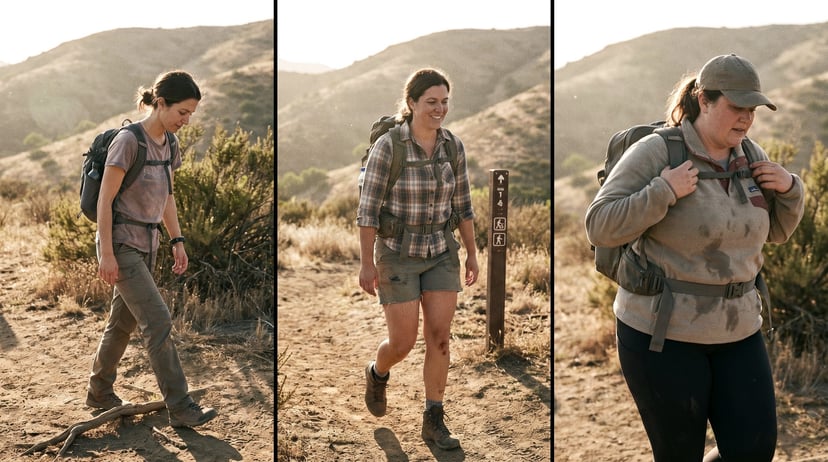
For a first session, try 5-10 lb for 20-30 minutes on level ground. That is a test load, not a target you must outgrow immediately.
Use the lower end if you are returning from inactivity, have a smaller frame, are postpartum, or have a history of foot, knee, hip, back, or pelvic-floor symptoms. A person with years of strength and hiking experience may be comfortable beginning above that range, but the first session should still feel controlled.
The useful checks are visible and repeatable:
- Your normal walking gait does not change.
- You can stand tall without leaning forward.
- The pack does not bounce, pull away from your back, or create numbness.
- You finish feeling as though you could have continued another 10 minutes.
- Ordinary muscle fatigue settles; joint pain, tingling, or increasing back pain is a stop signal.
Load-carriage research consistently finds that effort, posture changes, and discomfort increase as load rises. Female-specific studies also show that pack and belt fit can require individual adjustment; they do not establish one universal percentage that is right for every woman. See the women's MOLLE fit study and the broader load-carriage review.
Treat the calculator result as a planning ceiling, not an instruction to load that amount on day one.
Fit the pack to your body
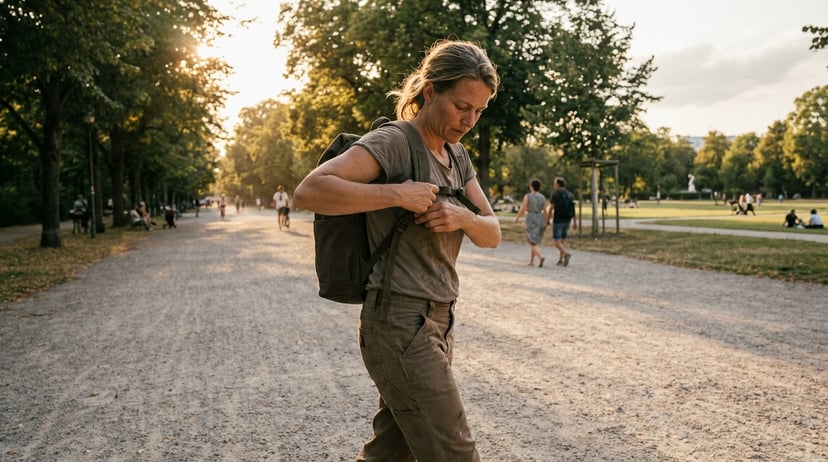
Measure your torso from the prominent C7 vertebra at the base of your neck to the line between the tops of your hip bones. Then try the pack with weight inside it. Height and gender labels are only shortcuts; the loaded fit is what counts.
Check these five points:
- Harness range: The pack's stated torso range includes your measurement.
- Shoulder spacing: The straps wrap without cutting into the neck or sitting at the edge of the shoulders.
- Sternum strap: It can sit comfortably across the upper chest without pressure on breast tissue.
- Load position: Dense weight stays high, secure, and close to the back instead of sagging away from it.
- Hip belt, when used: It lands on the hip crest and transfers load without digging into the abdomen.
Women-specific harnesses can help when their strap shape or torso range matches you, but a smaller unisex ruck may fit better than a poorly matched women's model. Try both when possible.
These are three useful starting points for fit, adjustable weight, and friction management:
| Role | Pick | Why it may fit the job |
|---|---|---|
| Pack | Osprey Tempest Velocity 20 Women's | Adjustable harness and supportive hip belt for people who prefer a hiking-pack fit. |
| Weight | Titan Fitness Ruck Plate | Multiple weight options make gradual progression easier than a single heavy fixed load. |
| Anti-chafe | Body Glide Original | Useful on any repeat friction point; apply before the ruck rather than after irritation starts. |
Our women's rucking backpack guide compares torso range, harness design, and load control in more detail.
Fat loss and bone health: what the evidence can say
Adding load raises the energy cost of walking. That can make rucking a useful part of a fat-loss plan, particularly if it is more enjoyable and repeatable than running. It does not create a women-specific hormonal fat-loss effect. Long-term weight change still depends on total activity, food intake, recovery, and consistency.
The bone-health case deserves similar restraint. Weight-bearing and resistance exercise are important for bone and muscle health, but direct rucking studies are limited. Weighted-vest trials in older women have produced mixed results: one controlled program improved strength and balance without changing bone density, while other small studies reported localized gains. A larger 2025 randomized trial found that a weighted vest did not prevent hip bone loss during intentional weight loss. Read the OsteoACTIVE trial and the 2025 randomized clinical trial.
That makes rucking a reasonable form of loaded, weight-bearing exercise, not a proven osteoporosis treatment. Anyone with osteoporosis, a previous fragility fracture, or a high fracture risk should get individualized guidance before adding external load.
Menstrual cycles and training
You may notice that energy, cramps, temperature tolerance, sleep, or perceived effort change during the month. Track those patterns if they affect your rucks, but do not assume a calendar phase automatically requires a heavier or lighter session.
A systematic review of 78 studies found only a trivial average performance difference across menstrual-cycle phases, with large variation between people and generally low-quality evidence. The practical conclusion was to use an individualized approach, not a universal phase-based prescription. See the systematic review and meta-analysis.
Use symptoms to guide the day:
- If your normal load and pace feel normal, train normally.
- If cramps, migraine, heavy bleeding, poor sleep, or unusual fatigue change the session, reduce load, distance, or pace.
- If symptoms repeatedly disrupt daily life or exercise, discuss them with a clinician rather than treating them as a training problem to push through.
The average research result cannot predict an individual's experience. A simple log of load, distance, perceived effort, symptoms, and recovery is more useful than assuming every follicular or luteal phase will feel the same.
Pregnancy, postpartum return, and pelvic-floor symptoms
Rucking with external load has not been studied well enough to offer a universal pregnancy prescription. The American College of Obstetricians and Gynecologists says most people with uncomplicated pregnancies can continue or begin appropriate aerobic and strength exercise after clinical evaluation, with modifications as needed. That broad guidance is not the same as clearance for a heavy pack. Review the ACOG guidance with your obstetric clinician.
During pregnancy or a postpartum return:
- Get individualized clearance, especially after complications or a cesarean birth.
- Begin below your pre-pregnancy load and shorten the route.
- Avoid heat stress and keep hydration accessible.
- Stop for bleeding, dizziness, chest pain, painful contractions, fluid leakage, unusual shortness of breath, or calf pain.
- Treat pelvic pressure, heaviness, leakage, or pain as a reason to reduce load and consult a pelvic-health clinician.
Loaded walking is low impact, but low impact does not mean symptom-proof. A pack can still increase trunk and pelvic-floor demand.
A conservative four-week start
This plan is suitable for a healthy beginner who can already walk for 30 minutes without pain. It is intentionally modest.
| Week | Sessions | Time | Load |
|---|---|---|---|
| 1 | 2 | 20 minutes | 5-10 lb |
| 2 | 2 | 25 minutes | Same load |
| 3 | 2-3 | 30 minutes | Same load |
| 4 | 3 | 30 minutes | Add up to 5 lb only if every prior session felt controlled |
Keep the route level at first. Add time before pace, hills, or load. If form changes or discomfort accumulates between sessions, repeat the week or step back.
A lighter load that keeps you training is more useful than a heavier load that turns every walk into a test. The goal of the first month is to establish a repeatable baseline.
Women can and do adapt to demanding load carriage. In one small study, ten weeks of specific training improved strength and reduced the oxygen cost of a standardized loaded walk in recreationally active women. That finding supports gradual practice, not an aggressive first-day load. See the female load-carriage training study.
Related reading
- Rucking research 2026: includes the 2026 trial that found loaded walking cut strength more in women than in men.
- Best rucking backpacks for women - compare torso range, harness shape, and load support
- Best rucking gear for women - footwear, socks, and friction-management options
- Rucking for bone density - the evidence and its limits
- Women's rucking loadout - a complete setup with exact product destinations
- First 30 days of rucking - a longer progression after the four-week baseline
Frequently Asked Questions
Not automatically. A women-specific harness can be useful when its torso range and strap shape match you, but a smaller unisex pack may fit just as well. Measure your torso and test the pack under load instead of buying by label alone.
Use less weight or begin with unweighted walking. The starting range is a test, not a minimum. Progress only after your gait, posture, and recovery remain normal.
Only if your actual symptoms or effort warrant it. Research does not support a universal phase-based loading rule. Track your own response and adjust the session in front of you.
Rucking is endurance-oriented load carriage, not a bodybuilding program. It can improve work capacity and muscular endurance. Large increases in muscle size generally require sustained, progressive resistance training plus adequate nutrition.
There is no evidence-based maximum that applies to every woman. Body size, training history, route, duration, pack fit, and medical history all matter. For general fitness, there is little reason to chase a maximum; use the lightest load that creates the training effect you want without changing gait or causing pain.
Either is possible. A well-fitted, modest load may be tolerated, while a heavy or poorly positioned load can aggravate symptoms. Existing or recurrent back pain deserves individualized advice, and increasing pain, weakness, or numbness is a reason to stop.


