Skip to content
Beginner Guide

Your First 30 Days of Rucking: A Day-by-Day Plan

Your First 30 Days of Rucking: A Day-by-Day Plan

A structured 30-day rucking program for complete beginners. Progressive loading, distance, and frequency - with built-in rest days and form checkpoints.

Sunlit path through a lush green forestSave
The Short RuckNew to rucking? Start here.
  • Week 1: 1-2 miles, 10-15 lbs, 3 days. Form before distance. Always.
  • Add 0.5-1 mile per week. Keep weight constant until the distance feels easy.
  • Never change load AND distance in the same week. One variable at a time.
  • Rest days aren't optional. Loaded walking creates more stress than regular walking.
  • After 30 days the goal is complete: you built the habit. Now pick a real program.

Why 30 days?

Connective tissue adaptation takes eight to 16 weeks. Your muscles will feel ready to go heavier long before your tendons, ligaments, and bones have caught up. The purpose of this plan is not to peak - it is to build a foundation that keeps you injury-free for the months and years ahead.

By day 30 you will know three things: your comfortable starting weight, your preferred terrain, and your natural pace. You will also have a habit. Research on exercise adherence consistently shows that the first 30 days are the highest-risk period for dropout. If you make it through this plan, the odds of you still rucking six months from now are dramatically higher.

This program prioritizes consistency over intensity. You are building a practice, not training for an event.

What the research says

Military research on load carriage adaptation shows that connective tissue (tendons, ligaments, bone) requires 8 to 16 weeks of progressive loading to fully adapt - roughly twice as long as muscle tissue. Rushing this timeline is the single most common cause of rucking injuries in both military and civilian populations.


The plan at a glance

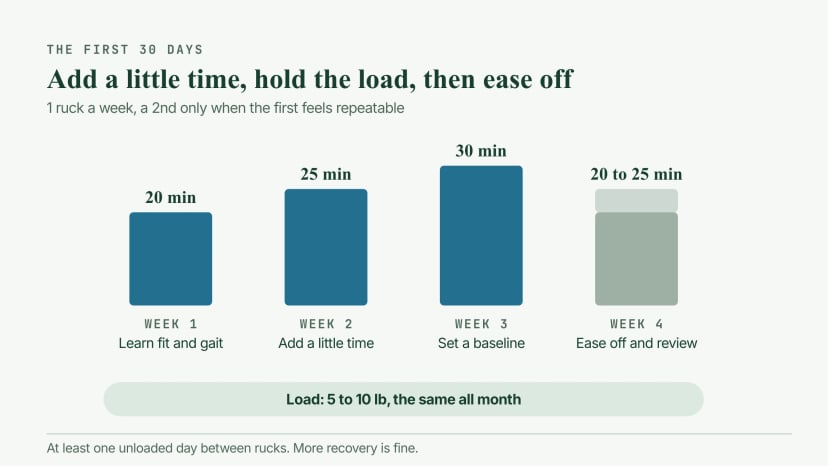
WeekSessionsDistanceWeightTerrainFocus
Week 121 mile each10-15 lbsFlat pavementForm and pack fit
Week 221.5 miles each10-15 lbsFlat pavementPace consistency
Week 331.5-2 miles each15-20 lbsIntroduce gentle hillsVolume increase
Week 432-2.5 miles each15-20 lbsMixed terrainConsolidation

Total over 30 days: 10 sessions, approximately 16 to 19 miles, progressing from 10 to 20 lbs. That is enough to build a real base without pushing into injury territory.


Group of hikers on a brown mountain trail

Week 1: Learn the movement (days 1 through 7)

This week is about learning how rucking feels, dialing in your pack, and establishing baseline form. You are not training yet - you are practicing.

Day 1 - Your first ruck. Load your pack with 10 lbs. Pick a flat route you know well - a one-mile out-and-back is ideal. Walk at a comfortable pace, somewhere around 17 to 19 minutes per mile. Every five minutes, do a quick form check: am I standing tall? Are my shoulders back and down? Is my stride shorter than my normal walking stride? Am I breathing through my nose?

Pay attention to how the pack sits on your back. The weight should ride high, between your shoulder blades, snug against your spine. If it is bouncing or sagging, stop and adjust the straps before continuing.

Day 2 - Rest. No rucking. Walk normally if you feel like moving. Drink extra water. Carry a Nalgene Wide Mouth 32oz bottle during recovery walks - staying hydrated speeds adaptation.

Day 3 - Recovery walk. Walk for 20 minutes with no weight. This is active recovery - it promotes blood flow to the muscles you used on day one without adding load stress. Pay attention to any lingering soreness. Muscle soreness in your glutes, traps, and calves is normal. Sharp pain in your knees, shins, or lower back is not.

Day 4 - Second ruck. Same distance: one mile. Same terrain: flat. Bump the weight to 10 to 12 lbs if day one felt easy, or stay at 10 if you were noticeably sore. Focus on two form cues this session: foot strike (midfoot, not heel-slamming) and arm swing (hands at your sides, relaxed, not gripping the straps).

Days 5 through 7 - Rest and light activity. Walk, stretch, foam roll. Your body is adapting to a new stimulus. Let it.

Week 1 form checkpoint: Can you maintain a conversation throughout the ruck without gasping? Is the pack riding high and stable without bouncing? If yes, you are on track. If no, slow down your pace or reduce weight by two to three lbs.

Red flags - stop and reassess: Sharp knee pain that does not fade within 10 minutes of rest. Numbness or tingling in your hands (loosen shoulder straps and check pack position). Lower back strain that worsens during the ruck rather than improving as you warm up. If any of these persist, drop five lbs and shorten your distance by half. See our injury prevention guide for a more detailed breakdown.


Week 2: Build consistency (days 8 through 14)

You have two rucks under your belt. This week you add distance - half a mile per session - while keeping the weight the same. The goal is to train your body to sustain effort for longer, not to carry more.

Day 8 - Ruck. 1.5 miles, 10 to 15 lbs. Same flat route or a new one of similar difficulty. Focus on maintaining a steady pace throughout - most beginners start too fast and slow down significantly in the second half. Aim for even splits.

Day 9 - Rest.

Day 10 - Mobility work. Spend 15 minutes stretching the three areas rucking loads most: hip flexors (kneeling lunge stretch, 60 seconds each side), calves (wall stretch, 60 seconds each side), and shoulders (doorway stretch, 60 seconds each side). This is not optional. Mobility work prevents the tightness that leads to form breakdown under load. For a full routine, see our rucking form guide.

Day 11 - Ruck. 1.5 miles, 12 to 15 lbs. Focus on maintaining pace. If you wore a different pair of shoes last time, stick with whichever pair felt better. Consistency in footwear matters more than most people realize - your feet are adapting to loaded walking and switching shoes changes the stress pattern.

Days 12 through 14 - Rest and light activity.

Week 2 milestone: You should feel noticeably more comfortable under load by the end of this week. The pack should feel like less of a foreign object on your back. If it still feels awkward, revisit your packing - the weight may be sitting too low or shifting during movement.


People walking along a tree-lined road

Week 3: Add volume (days 15 through 21)

This is the first week with three rucking sessions. You are also adding weight - five lbs over your week 1 starting point. This is the week where most beginners feel the shift from "trying rucking" to "rucking regularly."

Day 15 - Ruck. 1.5 miles, 15 to 20 lbs. This is the first session at your new weight - a ruck plate works great for precise weight. Focus on form - the added load will tempt you to lean forward from the waist. Resist it. Lean from the ankles, stand tall, keep your shoulders back.

Day 16 - Rest.

Day 17 - Ruck. 1.5 miles, 15 lbs. Try a route with a gentle incline if one is available - a gradual hill, a park with rolling terrain, or a treadmill set to three percent grade. Hills teach your body to manage load on varied terrain, and they increase calorie burn by 20 to 30 percent compared to flat ground.

Day 18 - Rest.

Day 19 - Ruck. 2 miles, 15 to 20 lbs. This is your longest ruck yet. Do not increase your pace to compensate for the added distance - if anything, slow down slightly. The goal is to complete the full distance comfortably, not to set a speed record.

Days 20 through 21 - Rest and active recovery. Walk, stretch, hydrate.

Weight progression note: Only increase weight if your previous week's final session felt comfortable. If you were struggling at 15 lbs on day 11, stay at 15 this week instead of pushing to 20. The plan is a guideline, not a mandate. Repeating a week is always the right call if the alternative is injury. For detailed weight progression rules, see our ruck weight guide.

Chafing prevention: As loads increase, strap chafing becomes more common. Apply Body Glide Original to your shoulders and anywhere the pack contacts your skin before each week 3-4 session. It eliminates friction-based discomfort without any residue.

Pro tip

Week 3 is where most dropout happens. Not because it is too hard, but because the novelty has worn off and the habit has not fully formed yet. If you feel resistance, make the ruck smaller - 15 minutes is better than skipping. Show up, even when it is boring.


Week 4: Consolidate (days 22 through 30)

You are not adding weight or significant distance this week. Instead, you are locking in the habit, testing your fitness on a slightly longer ruck, and reflecting on where you started versus where you are.

Day 22 - Ruck. 2 miles, 15 to 20 lbs. A routine session. Focus on enjoying the movement rather than monitoring metrics.

Day 23 - Rest.

Day 24 - Ruck. 2 miles, 20 lbs. Try a route you have not rucked before in proper footwear like Salomon XA Pro 3D shoes. New terrain keeps the practice interesting and challenges your body in slightly different ways - different camber, different grade, different foot placement.

Day 25 - Rest.

Day 26 - Mobility and light strength. Combine your stretching routine with bodyweight exercises that support rucking: 3 sets of 12 bodyweight squats, 3 sets of 12 glute bridges, and 2 sets of 30-second farmer carries with whatever weight you have available (dumbbells, groceries, water jugs). These movements strengthen the same muscles rucking loads and help prevent the overuse issues that show up in months two and three.

Day 27 - Your graduation ruck. 2 to 2.5 miles, 20 lbs. This is your longest, heaviest ruck of the program. Take your time. Walk at whatever pace feels sustainable. When you finish, take a moment to compare this ruck to your first one on day one - 10 lbs, one mile, probably wondering if you were doing it right. You have doubled the weight and more than doubled the distance.

Days 28 through 30 - Rest, reflect, plan your next phase.

Graduation metrics: Where you started versus where you are. On day one, you carried 10 lbs for one mile. On day 27, you carried 20 lbs for 2 to 2.5 miles. Your pace is probably faster. Your form is more natural. The pack feels like part of you rather than something strapped to your back. That is real, measurable progress.


Rest day guidelines

Rest does not mean immobile. Walk, stretch, foam roll, do household chores. Light movement promotes blood flow and speeds recovery. What rest means is no loaded exercise - your connective tissue needs time without the added stress of pack weight.

Sleep is the number one recovery tool. Seven to nine hours per night. This is not optional at any fitness level, but it matters even more during the adaptation phase when your body is building new tissue. If you are sleeping fewer than six hours, your injury risk goes up regardless of how smart your programming is.

Hydration matters more under load than you think. Rucking increases your water needs by 30 to 50 percent compared to unloaded walking. Drink an extra 12 to 16 ounces per 30 minutes of rucking beyond your normal intake. If your urine is dark yellow, you are behind.

Know the difference between soreness and pain. Muscle soreness - dull, diffuse, symmetrical ache in your glutes, traps, or calves - is normal and expected, especially in weeks one and two. It means your muscles are adapting. Joint pain - sharp, localized, or one-sided sensation in your knees, ankles, or lower back - is a signal to reduce load or distance and assess what went wrong. Soreness fades with movement. Pain does not.


What to do after day 30

Keep going

If you made it through 30 days of rucking, you are a rucker. That counts. Most people never get past week one.

You have the base. Now you choose your direction.

I want a structured training program. Our rucking training programs pillar has 12-week plans by goal - fat loss, general fitness, event prep, and maintenance. Pick the one that matches where you want to go and start week one.

I want to focus on weight loss. Head to the rucking for weight loss pillar. It covers calorie burn data, nutrition guidelines, and a three-phase fat loss program that builds on the base you just established.

I want better gear. You have earned an upgrade. The rucking gear guide reviews packs, plates, shoes, and accessories by category and budget. Start with our budget starter kit if you want to keep costs under 50 dollars.

I want to keep doing what I am doing. That is the best answer. Continue rucking three times per week, add five lbs every two weeks, and add half a mile per session every other week. You do not need a formal program to keep improving at this stage.


Frequently asked questions

What if I miss a day?

Pick up where you left off. Do not try to double up to catch up - that is how people get hurt. If you miss a full week, repeat the previous week rather than jumping ahead. Consistency beats perfection.

Can I ruck every day during this plan?

Not in weeks one and two. Your connective tissue needs 48 hours between loaded sessions during the initial adaptation phase. By week three, you can ruck on consecutive days if you feel recovered, but never more than two days in a row followed by at least one rest day.

What if the plan feels too easy?

Stay with it. The purpose of the first 30 days is adaptation, not challenge. If week one feels easy, that means you chose the right starting weight. Your tendons and ligaments are adapting even when your muscles are not sore. You will have plenty of time to push harder in months two and three.

What if the plan feels too hard?

Repeat the current week instead of moving forward. Drop the weight by five lbs if you need to. There is no penalty for going slower - the penalty is for going too fast and getting injured. If a specific session hurts (joint pain, not muscle soreness), see the red flags section in week one and consult our injury prevention guide.

Do I need to ruck at the same time every day?

No, but it helps. Consistent timing builds routine, and routine builds habit. Many ruckers find that morning rucks work best because there are fewer scheduling conflicts, the air is cooler, and the sense of accomplishment carries through the rest of the day. But any time you will actually do it is the right time.


Your next step

Pro tip

You just finished 30 days. The single best thing you can do next is decide how much weight you should carry going forward. Our ruck weight guide has a calculator and detailed recommendations by fitness level, goal, and terrain to help you plan your progression beyond this program. Consider adding a Garmin Instinct 3 Solar to track metrics and hold yourself accountable.