
Your body is smarter than you think. Give it the same rucking stimulus for a couple of months, and it tends to adapt by becoming more efficient - burning fewer calories for the same work. This is one of the most common reasons ruckers see their early weight-loss progress slow down, even when they haven't changed anything about their training or diet.
The solution is not to ruck harder or longer every week. It is to structure training in phases that balance progression and recovery while preserving a sustainable calorie deficit. Periodization can organize the work, but it does not override nutrition, sleep, medication, health conditions, or individual response.
Periodization is a sports-science framework formalized by coaches Tudor Bompa and Leonid Matveyev for endurance athletes, and now widely applied across recreational training. The phase structures and adaptation principles below draw from that literature and established exercise physiology. Rucking-specific notes reflect common practices in the rucking community, not a controlled study.
Why your body adapts to rucking

When you start rucking, your body treats it as a novel stress. Your heart rate spikes, your muscles work harder, and you burn significant calories. Within roughly the first month or two of consistent training, however, your cardiovascular system becomes more efficient, your muscles adapt to the load, and the same workout burns fewer calories than it did at the start. Exact timelines vary by individual fitness, age, and training history - some people adapt faster, some slower.
This adaptation is actually a sign that your training is working - your body is getting fitter. But for weight loss, efficiency is the enemy. You need controlled variety to maintain metabolic demand without overreaching your recovery capacity.
The principle that structured, phase-based progressions produce more consistent long-term adaptations than ad-hoc load and distance increases comes from endurance-sport periodization literature (Bompa, Matveyev). Recreational ruckers tend to encounter the same plateau pattern around the 3-6 month mark as initial novelty-driven gains slow, though individual timelines vary widely.
The three-phase periodization model
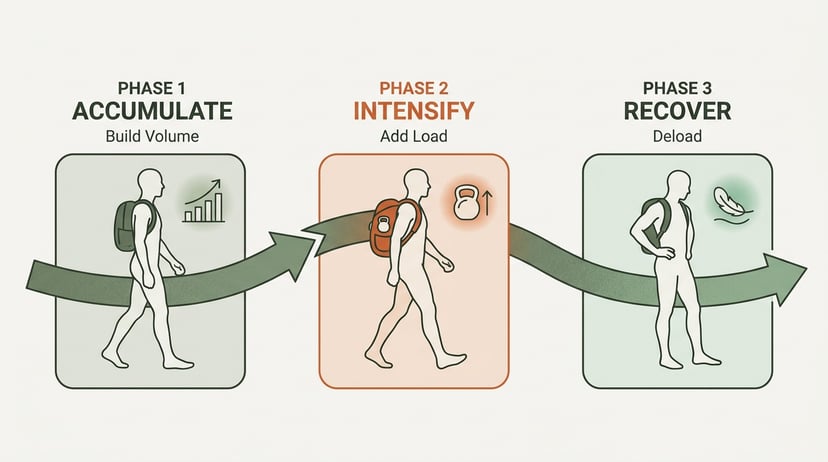
Effective rucking periodization for weight loss follows three distinct phases, each lasting 4-6 weeks:
Phase 1: Base building (weeks 1-6)
Focus: Establish consistent volume and proper movement patterns Load: 10-20% of body weight Volume: Build to 8-12 miles per week Intensity: Conversational pace (Zone 2) Frequency: 3-4 sessions per week
Start with shorter distances at lighter weights. Your goal is to build the habit and allow your connective tissues to adapt. Most people want to skip this phase, but it's the foundation for everything that follows.
Sample week 4 progression:
- Monday: 3 miles with 15 lbs
- Wednesday: 2 miles with 20 lbs
- Friday: 4 miles with 15 lbs
- Sunday: 3 miles with 10 lbs (active recovery pace)
Phase 2: Intensity development (weeks 7-12)
Focus: Add challenging elements while maintaining base volume Load: Maintain current weights but add variety Volume: Hold at 8-12 miles per week Intensity: Mix paces - some conversational, some challenging Frequency: 3-4 sessions per week
This phase introduces hills, intervals, and varied terrain while keeping your weekly mileage consistent. The metabolic demand increases through intensity variation rather than volume increases.
Sample week 10 progression:
- Monday: 3 miles with 20 lbs on hills
- Wednesday: 2 miles with 25 lbs at brisk pace
- Friday: 4 miles with 15 lbs, mixed terrain
- Sunday: 3 miles with 15 lbs, recovery pace
Phase 3: Consolidation and reset (weeks 13-18)
Focus: Reduce intensity, maintain fitness, prepare for next cycle Load: Reduce by 20-30% from previous phase Volume: Maintain or slightly reduce Intensity: Return to conversational pace Frequency: 3 sessions per week
This isn't a break - it's strategic recovery that prevents burnout and sets you up for the next training block. Many ruckers are surprised to find they continue losing weight during this phase as their bodies catch up with previous training stress.
The consolidation phase is where many people quit, thinking they're "going backward." Trust the process. This strategic reduction prevents overtraining and maintains long-term adherence - the real key to sustained weight loss.
Progressive variables in each phase

Rather than randomly changing everything, periodization targets specific variables in each phase:
Weeks 1-6: Distance and frequency progression Start with 2-3 weekly rucks and build to 4. Increase total weekly mileage by 10-15% each week until you reach your target volume.
Weeks 7-12: Load and intensity progression Weekly mileage stays consistent, but you add 5-10 lbs to your pack weight OR increase pace/hills, never both simultaneously. Discrete ruck plates like the Titan Fitness Ruck Plate make the load jumps clean and repeatable.
Weeks 13-18: Recovery and movement quality Reduce external load and focus on perfect form, breathing patterns, and movement efficiency. This phase builds the foundation for your next training block.
Nutrition periodization to match training phases

Your eating should complement your training phases, not fight against them:
Base building phase: Moderate calorie deficit (300-400 calories below maintenance) Focus on establishing consistent meal timing and adequate protein intake. Your body needs energy to adapt to the new training stimulus.
Intensity phase: Deeper deficit options (400-500 calories below maintenance) Your fitness improvements allow for slightly more aggressive fat loss without compromising performance. Monitor energy levels closely.
Consolidation phase: Maintenance or small deficit (200-300 calories below maintenance) This isn't a "diet break," but your calorie deficit can be more conservative as your body consolidates the previous training adaptations.
Never combine the most aggressive training phase with the most aggressive diet phase. This leads to overreaching, poor recovery, and eventual plateau or burnout. The calorie deficit ranges in this section are general starting points, not personalized prescriptions - if you have a medical condition, take any medication that affects metabolism or appetite, or have a history of disordered eating, talk to a doctor or registered dietitian before stacking a structured rucking program with intentional underfeeding.
Signs you need to adjust your periodization

Your body will tell you if the periodization isn't working:
Red flags requiring immediate adjustment:
- Joint pain that doesn't resolve with rest days
- Consistent fatigue that affects daily activities
- No weight loss for 3+ weeks during active phases
- Dreading your ruck sessions
- Sleep quality declining
Green lights to continue:
- Soreness that resolves within 24-48 hours
- Steady energy throughout the day
- Looking forward to ruck sessions
- Consistent sleep patterns
- Gradual strength improvements
Sample 18-week periodized plan

Here's how a complete periodization cycle can be structured. The specific weights and distances scale to the individual - the structure is what carries over. Adjust pack loads downward if you're newer, lighter, or working around an old injury.
Weeks 1-3: Foundation
- 10-15 lbs pack weight
- 2-3 rucks per week
- 1-2 mile distances
- Build to 6 total weekly miles
Weeks 4-6: Volume building
- 15-20 lbs pack weight
- 3-4 rucks per week
- 2-3 mile distances
- Build to 10 total weekly miles
Weeks 7-9: Intensity introduction
- 20-25 lbs pack weight
- 3-4 rucks per week
- Add one hill session weekly
- Maintain 10 weekly miles
Weeks 10-12: Peak intensity
- 25-30 lbs pack weight
- 3-4 rucks per week
- Mix of hills, intervals, longer steady rucks
- 10-12 weekly miles
Weeks 13-15: Active recovery
- 15-20 lbs pack weight
- 3 rucks per week
- Focus on movement quality
- 8-10 weekly miles
Weeks 16-18: Cycle transition
- 20 lbs pack weight
- 3-4 rucks per week
- Prepare for next training block
- 10 weekly miles
Planning your next training block

After completing an 18-week cycle, you have three options:
Option 1: Repeat with higher baseline Start your next base building phase 5-10 lbs heavier than your previous cycle. This works well if you responded positively to the structure.
Option 2: Extend phase lengths Move to 6-8 week phases instead of 4-6 weeks. This allows for deeper adaptations but requires more patience.
Option 3: Add complexity Introduce new variables like pack placement, walking surfaces, or time of day. Only add one new variable per cycle.
The key is avoiding the temptation to make every subsequent cycle dramatically harder. Small, consistent progressions over multiple cycles beat aggressive jumps that lead to burnout.
Across endurance-sport coaching literature, athletes and recreational trainees who sustain progress over 12+ months overwhelmingly use structured progression frameworks with planned recovery, rather than relentlessly piling on difficulty. The same pattern - consistency through planned recovery beats heroic uninterrupted progression - shows up across distance running, cycling, and load-carrying training programs.
Common periodization mistakes
Mistake 1: Skipping the base building phase Everyone wants to start heavy and fast. But your tendons and joints need 4-6 weeks to adapt to loaded walking. Rushing this phase leads to overuse injuries.
Mistake 2: Making every session harder Periodization includes easy days and easy weeks. Not every ruck should be a suffer-fest. Easy sessions allow recovery while maintaining momentum.
Mistake 3: Abandoning structure when progress slows Weight loss isn't linear. A well-designed periodization plan accounts for natural fluctuations and plateaus. Stick to the plan especially when progress seems slow.
Mistake 4: Changing too many variables at once If you increase weight AND distance AND intensity simultaneously, you can't identify what's working. Change one variable per phase.
Mistake 5: Ignoring the consolidation phase The recovery phase feels like "wasted time" but it prevents overtraining and sets up your next training block. Skip it at your own risk.
Tracking progress beyond the scale
Weight loss periodization requires metrics beyond daily weigh-ins:
Weekly measurements:
- Total weekly mileage completed
- Average pack weight used
- Resting heart rate (measure before getting out of bed - a wrist tracker like the Garmin Instinct 3 Solar does this overnight automatically)
- Sleep quality (1-10 scale)
Monthly assessments:
- Body measurements (waist, hips, chest)
- Progress photos in consistent lighting
- Fitness benchmarks (how do the same routes feel?)
- Energy levels throughout the day
Phase-end evaluations:
- Which workouts felt sustainable vs. unsustainable?
- What pack weights felt appropriate for each phase?
- How did nutrition timing affect performance?
- What adjustments are needed for the next block?
This data helps you refine your approach for subsequent training cycles.
When periodization isn't right for you
Periodization works best for people who can commit to 12+ weeks of structured training. It may not be appropriate if:
- You prefer completely flexible workout schedules
- You're dealing with significant life stress that makes planning difficult
- You have less than 8 weeks available for your weight loss timeline
- You strongly prefer variety and spontaneity in your exercise routine
In these cases, a more flexible approach like zone 2 rucking might be more sustainable.
Frequently asked questions
Honestly, results vary so widely that any specific number would be misleading. Some people see steady progress through active phases, others lose slowly or barely at all without changes to their nutrition. Rucking is one input - food intake is usually the bigger lever for weight loss. Treat periodized rucking as a way to build a sustainable fitness habit and avoid plateaus, not as a guaranteed weight-loss program.
Yes, but keep other activities consistent throughout the cycle. Don't add new strength training or running programs mid-cycle. Light yoga, walking, or existing routines are fine to maintain.
Simply repeat the previous week's plan when you return. Don't try to "catch up" by doubling the progression. Consistency over time matters more than perfect adherence to the schedule.
Generally 20-30% of body weight for most people, but listen to your body. If you can't maintain proper form or conversational pace when needed, the weight is too heavy for that phase.
No. Make smaller adjustments to your calorie deficit rather than dramatic diet changes. Your nutrition should support your training phases, not create additional stress that compromises recovery.
Plan for 3-4 hours per week during base building phases, potentially 4-5 hours during intensity phases. If you can't commit to at least 3 hours weekly, a less structured approach might be more realistic.