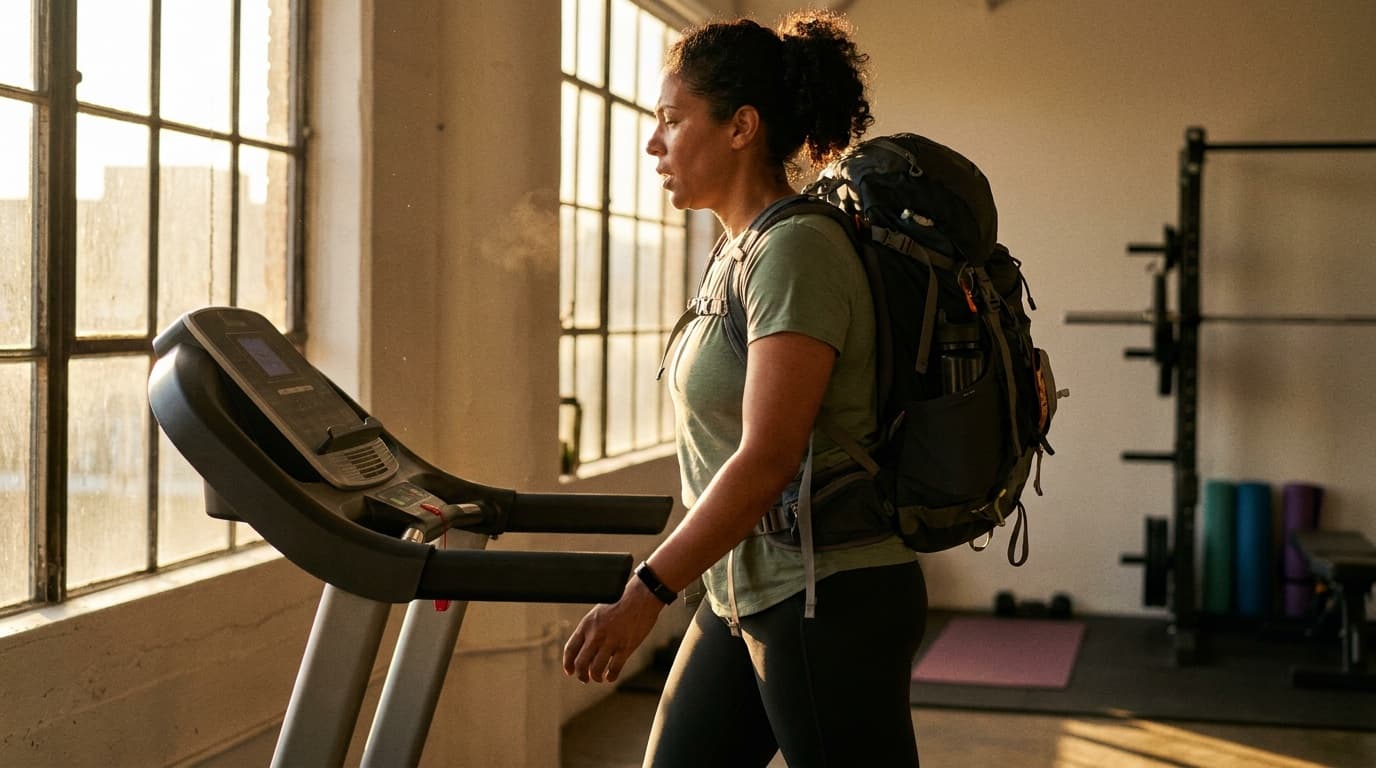
The short answer
Swimming burns more calories per hour. Rucking builds bone density and works anywhere. Both protect your joints.
If you have access to both, do both. If you can only pick one, the real question isn't "which is the better workout?" - it's what your body actually needs:
| If your main goal is... | Pick | Why |
|---|---|---|
| Maximum calorie burn in 60 minutes | Swimming | 400 - 700 cal/hr vs rucking's 395 - 430 on flat ground |
| Bone density (especially over 40) | Rucking | Weight-bearing load is the only stimulus that works |
| Joint relief (severe arthritis, post-surgery) | Swimming | Water supports 90% of your body weight |
| Functional strength for real life | Rucking | Loaded carries transfer to hiking, travel, daily tasks |
| Works anywhere, costs almost nothing | Rucking | A pack and some weight is the whole kit |
| Upper body development | Swimming | Strokes load shoulders, lats, and core in ways rucking doesn't |
| Social, talkable, weather-flexible | Rucking | Pool lanes are solitary; trails are not |
The rest of this page is the long answer with the data behind it.
Calorie burn and intensity

| Activity | Calories per hour | Impact | Muscle emphasis | Where |
|---|---|---|---|---|
| Swimming, moderate | 400 - 500 | Zero | Upper body dominant | Pool required |
| Swimming, high intensity | 550 - 700 | Zero | Upper body dominant | Pool required |
| Rucking, 20 lb @ 3.5 mph, flat | about 395 (180 lb person) | Weight-bearing | Full body, legs dominant | Anywhere |
| Rucking, 40 lb @ 3.5 mph, flat | about 430 (180 lb person) | Weight-bearing | Full body, legs dominant | Anywhere |
The data here comes from ACSM metabolic equations and established research on aquatic exercise and load carriage. Swimming edges out rucking on raw calorie burn, particularly at higher intensities. But this advantage flattens when you account for sustainability, consistency, and training cost.
One caveat on calorie math: wrist-based heart rate is unreliable in water and unreliable under shoulder straps. Your watch will undercount both modalities by 10-30%. A chest strap captures real HR through both - it stores swim data underwater and syncs after. Use our ruck calorie calculator for the math, paired with a dual-sport watch that handles both pool laps and outdoor pace.
Calorie tracking gear
The case for swimming
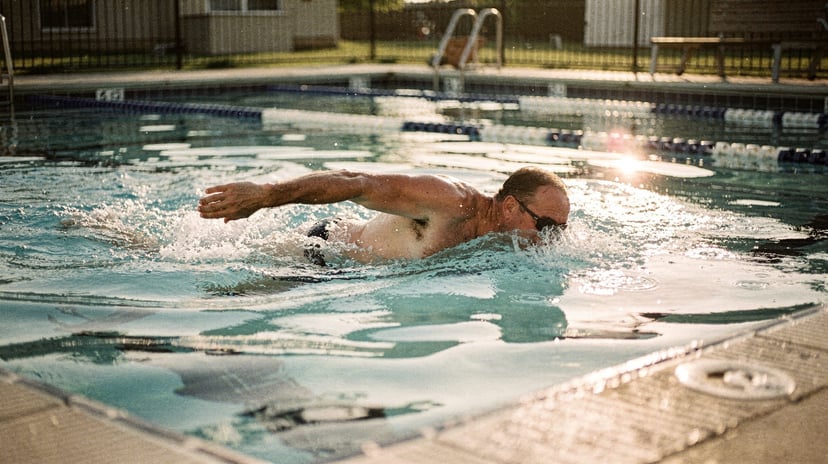
Zero impact
Swimming is truly non-impact. The water supports 90 percent of your body weight, eliminating the ground reaction forces that plague runners and even ruckers. If you have severe joint degeneration, post-surgery recovery, or inflammatory conditions like rheumatoid arthritis, swimming is unmatched.
Upper body dominance
Swimming is one of the few cardio activities that builds significant upper body and core strength. You are resisting water with every stroke. Rucking, by contrast, is primarily a lower body and posterior chain activity. If upper body development matters, swimming wins decisively.
Calorie efficiency
Swimming at moderate to high intensity burns 400 - 700 calories per hour depending on stroke, speed, and body weight. A 40-lb ruck on flat ground is about 430 at 3.5 mph, and hills push it past 600. For pure calorie output on flat routes, swimming is more efficient.
Campion et al. (2013) examined aquatic exercise outcomes across diverse populations and found that moderate-intensity swimming produces cardiovascular adaptations comparable to or better than running, despite lower impact stress. The resistance of water provides excellent training stimulus with minimal joint loading.
The case for rucking

Weight-bearing stimulus
Swimming is zero-impact, which is its strength. But zero impact also means zero bone-loading stimulus. Your skeleton doesn't experience the weight-bearing force that triggers bone density adaptation. Over decades, this matters. Rucking, by contrast, loads your skeletal system directly. Studies consistently demonstrate that weight-bearing exercise is the most effective stimulus for bone mineral density in both younger and older adults.
Accessibility and cost
A pool membership runs $300 to $800 a year. A rucksack and some weight is $60 to $200 once - the 5.11 Tactical RUSH 24 lands in the sweet spot - and works anywhere: your neighborhood, a trail, a parking lot. If cost and access are barriers, rucking eliminates them entirely. Pool access is not guaranteed across all geographies, seasons, or life circumstances.
Functional strength
Rucking builds strength that transfers to real life. Carrying a load on your back under controlled conditions trains stabilizer muscles, lower body power, and postural endurance. These adaptations carry over to hiking, moving furniture, travel, and everyday resilience. Swimming builds fitness and upper body strength, but the movement pattern is specific to aquatic environments.
Social accessibility
Rucking is infinitely more social than swimming. You can ruck and talk. You can ruck with friends, a group, or a community. Swimming requires lane discipline and is largely solitary. For solo rucks, a pair of bone-conduction headphones lets you bring podcasts or music along without plugging your ears - critical on roads and trails where situational awareness matters. If community and social accountability matter for your consistency, rucking has a decisive advantage.
Solo ruck essentials
Head-to-head: rucking vs swimming
| Factor | Rucking | Swimming |
|---|---|---|
| Calorie burn (60 min, moderate) | 395 - 430 (flat) | 400 - 500 |
| Calorie burn (60 min, high intensity) | 300 - 400 | 550 - 700 |
| Joint impact | Weight-bearing (low) | Zero impact |
| Bone density stimulus | Excellent | None |
| Upper body work | Light (shoulders, posture) | Dominant |
| Lower body work | Dominant | Light |
| Core work | Postural endurance | Stroke-driven engagement |
| Where you can do it | Anywhere | Pool required |
| Yearly cost | $60 - $200 once | $300 - $800/yr pool fees |
| Weather dependence | Some (cold/rain) | None (indoor pools) |
| Solo vs social | Easy to socialize | Largely solitary |
| Skill barrier | Walk + carry weight | Stroke technique matters |
| Injury risk | Shins, knees, lower back | Shoulders (rotator cuff) |
When to choose each
Choose swimming if:
- You have severe joint pain, arthritis, or post-surgical constraints that require true zero-impact training
- Your primary goal is upper body strength development (rowing and freestyle dominate)
- You have reliable pool access and enjoy the aquatic environment
- You want maximum calorie burn in a single activity
- You are training for a swimming event or need stroke-specific conditioning
Choose rucking if:
- Bone density matters to you (over 40, female, family history of osteoporosis, or concerned about long-term bone health)
- You lack reliable pool access or want a low-cost option
- Functional, real-world strength matters more than sport-specific fitness
- You value social and community aspects of training
- You want a training modality that works in any weather, terrain, or geography
The hybrid approach (and why it wins)

The best option for most people is both. You get bone-loading stimulus, upper body development, cardiovascular fitness, and joint-friendly recovery in one week. Here's a sample template:
| Day | Session | Why |
|---|---|---|
| Mon | Ruck - 45 min, 20 lb | Bone density + posterior chain |
| Tue | Swim - 30-40 min | Upper body, shoulder mobility |
| Wed | Rest or unloaded walk | Active recovery |
| Thu | Ruck - 60 min, 25 lb | Longer load tolerance |
| Fri | Swim - 30 min easy | Joint decompression |
| Sat | Long ruck - 60-90 min | Endurance + community ruck if available |
| Sun | Full rest | Sleep is the third workout |
Three rucks drive bone density and functional strength (your highest-consistency activity). Two swims complement with upper body work and joint-friendly recovery - the zero-impact nature means swimming doesn't interfere with rucking recovery. You avoid the boredom of any single modality and gain the synergistic benefits of both.
Hybrid week starter kit
If you're new to the pool side, the kit is genuinely small: anti-fog goggles, a compact microfiber towel that packs down to fit in your ruck, and a pull buoy if you want freestyle to become pure upper-body work.
If you only have one weekly window for the pool, schedule it the day after your hardest ruck. Swimming acts as active recovery for tight calves, lower back, and shoulders - and the cardiovascular work compounds without adding impact load to recovering tissue. For the residual tightness the pool flush won't reach, 5 minutes with a portable percussion gun on calves and glutes between sessions does more than the rest day will. And if you're swimming twice a week, get a chlorine-removal shampoo - regular shampoo doesn't strip chlorine and your scalp will know by week three.
Recovery + hair care for the two-a-week swimmer
Frequently asked questions
Does swimming build bone density like rucking does?
No. Swimming does not provide weight-bearing stimulus to trigger bone density adaptation. Your skeleton needs loading - your own body weight plus external load - to signal bone-building responses. Swimming is excellent for cardiovascular fitness and upper body strength, but for bone health specifically, weight-bearing exercise like rucking is the gold standard.
How many calories do I need to burn to see weight loss results?
This depends on your diet, baseline metabolism, and consistency. Burning 250 more calories per day through swimming versus rucking is meaningful over time - roughly 1,750 extra calories per week, or 0.5 lbs of body weight. But adherence matters more than any single number. Consistent rucking at 300 calories per session beats sporadic swimming at 500 calories per session. Choose the activity you will actually do.
Can I ruck after swimming on the same day?
Yes, but sequence it carefully. Swim first if you are doing both in one day. Swimming is lower-intensity and does not fatigue your stabilizer muscles. Rucking afterward on fatigued legs is possible but increases injury risk. Better approach: alternate days, or swim in the morning and ruck in the evening with at least six hours between. Either way, you'll sweat more than you think on a two-a-day - even in the pool. An electrolyte mix (1,000 mg sodium per stick) keeps you from cramping in the back half of session two.
Is rucking better than swimming for weight loss?
Not necessarily. Swimming burns more calories per unit time, but rucking is more accessible and more sustainable for most people. The "better" option is whichever one you will do consistently. For weight loss, adherence matters more than intensity. That said, rucking preserves more lean muscle during a caloric deficit because of the loaded resistance stimulus, so your body composition improvements may be more visible with rucking than with swimming alone.
What if I have joint pain in my shoulders or hips?
If shoulder pain is your issue, swimming aggravates many shoulder conditions. Freestyle and butterfly are high-load for the rotator cuff. Rucking is gentler on shoulders, though loaded walking does place some stress through the core and shoulders. Backstroke or breaststroke may be safer if you want to swim. If hip pain is the concern, both are low-impact, but rucking loads the hip joint more directly. In both cases, consult a physical therapist before starting either activity at volume.
Your next step
If you decide to ruck, the next critical decision is how much weight to carry. Starting too heavy is the fastest way to burn out. Our bone density rucking guide walks you through the science of load progression and how to build sustainable weight-bearing strength that actually improves bone health over time.
Related reading
- Ruck calorie calculator - get your personalized number for any pack weight and pace
- Rucking vs running for weight loss - comparing two weight-bearing cardio options
- The complete beginner's guide to rucking - everything you need to start today
- How heavy should your ruck be? - personalized weight recommendations by fitness level
- Zone 2 rucking guide - sustainable cardio for fat loss and base building
- Rucking for seniors - modifications and progressions for older adults