The short answer
Most ruckers should target 13:00-17:00 per mile pace. Beginners trend toward the slower end (17:00-18:00/mile), while experienced ruckers with lower loads move toward the faster end (12:00-14:00/mile). If you landed here before the basics, our what is rucking explainer covers the practice itself; this page covers how fast to do it. But here's the critical insight: pace matters far less than heart rate and perceived effort. Two people at the same pace might be in completely different training zones depending on their load, fitness level, and terrain.
For fat loss and aerobic fitness-the goals of most recreational ruckers-heart rate zone matters more than the actual numbers on your watch. You could ruck at 16:00/mile in Zone 2 and get better results than rucking at 13:00/mile in Zone 3, simply because the slower pace is more sustainable and allows you to accumulate more total volume.
Pace chart by fitness level and load
| Beginner | Intermediate | Advanced | |
|---|---|---|---|
| Light (10-15 lb) | 16:00 - 18:00 | 14:00 - 16:00 | 12:00 - 14:00 |
| Moderate (20-25 lb) | 17:00 - 20:00 | 15:00 - 17:00 | 13:00 - 15:00 |
| Heavy (30-40 lb) | 19:00 - 22:00 | 16:00 - 18:00 | 14:00 - 16:00 |
Pace in minutes per mile. Flat to gently rolling terrain, conversational effort.
A chart gives you a range. If you want the number for your actual load and distance, including your finish time, run it here:
How to use this chart: Find your experience level (horizontal), then match it with your current load (vertical). The resulting number is your target pace range for that combination. These are guideline ranges, not absolute laws. If you're breathing harder than expected at a given pace, slow down. Conversational pace (can speak in complete sentences without gasping) is a reliable indicator that you're in the right zone.
The underlying principle: as load increases, pace naturally decreases. A beginner with 25 pounds will move slower than an advanced rucker with 15 pounds-this is physics and biomechanics, not weakness. Account for load in your pace expectations. How that load rides matters too - a pack that holds weight high and tight against your back keeps your pace and form steadier over distance than one that sags, which is most of what separates the picks in our best rucking backpacks guide.
Approximate targets by experience and load:
- Beginner + light (10-15 lb): 16:00-18:00/mile
- Beginner + moderate (20-25 lb): 17:00-20:00/mile
- Intermediate + light (10-15 lb): 14:00-16:00/mile
- Intermediate + moderate (20-25 lb): 15:00-17:00/mile
- Intermediate + heavy (30-35 lb): 16:00-18:00/mile
- Advanced + light (10-15 lb): 12:00-14:00/mile
- Advanced + moderate (20-25 lb): 13:00-15:00/mile
- Advanced + heavy (30-40 lb): 14:00-16:00/mile
These ranges assume flat to gently rolling terrain and a conversational effort level. Mountainous terrain or race effort will be slower. Easy recovery efforts will be slower still. To see how real ruckers compare at your load and terrain, add a finished ruck to our Rucking Pace Benchmark, which publishes pace percentiles once each group reaches 30 results.
Minutes-per-mile by load bracket (the scannable table)
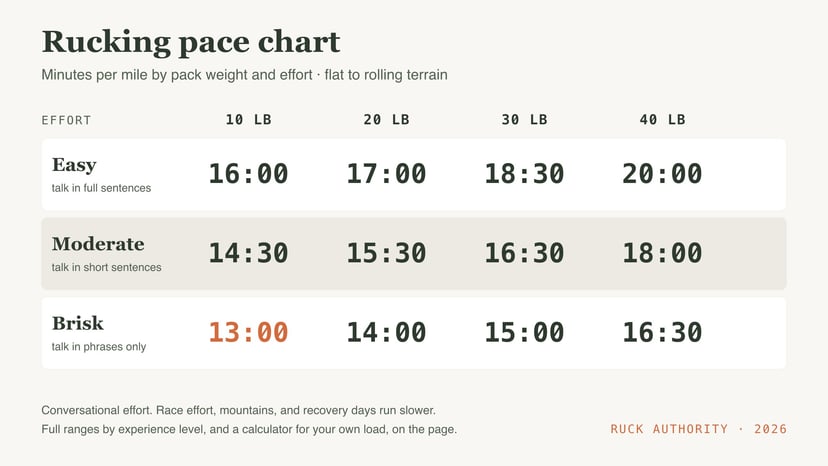
If you don't want to dig through ranges by experience, this is the same data collapsed into a single load × effort matrix. Cells are minutes per mile at a conversational effort, with light variance for fitness level.
| 10 lb | 20 lb | 30 lb | 40 lb | |
|---|---|---|---|---|
| Easy (talk in full sentences) | 16:00 | 17:00 | 18:30 | 20:00 |
| Moderate (talk in short sentences) | 14:30 | 15:30 | 16:30 | 18:00 |
| Brisk (talk in phrases only) | 13:00 | 14:00 | 15:00 | 16:30 |
Matching a row of this table on a real route takes pace and heart rate on your wrist, where you can read them without stopping. The Garmin Instinct 3 Solar is the best overall pick in our GPS watch roundup: multi-week battery, GPS pace alerts, and a heart-rate zone display that makes the effort rows above easy to check mid-ruck. The roundup compares it with five other watches on battery life, weight and price.
Why pace is secondary to effort
This is counterintuitive for people coming from running, but it's critical to understand: pace is just a number. What actually matters is the training stimulus you're creating.
Heart rate and RPE are better training signals. If you're at 13:00/mile but your heart rate is 140 bpm, you're in a completely different training zone than someone at 13:00/mile with a heart rate of 130 bpm. Load, terrain, fitness, sleep, and hydration all affect how hard a given pace feels. Your heart rate tells the truth about actual intensity; pace is just a convenient measurement.
A Garmin Instinct 3 Solar or COROS PACE 4 gives you reliable heart rate data. The practical application: work from perceived exertion and heart rate zones, and let pace fall where it falls. Conversational effort (Zone 2) should produce a heart rate of roughly 60-70% of your max heart rate. If your pace is 16:00/mile at that effort, that's your pace. If it's 14:00/mile, that's fine too. The consistency of effort matters more than the specific pace.
Pace varies wildly with terrain, weather, and fatigue. Rucking the same 2-mile loop with 20 pounds might take 31 minutes on a flat day and 38 minutes if there's 500 feet of elevation gain. Both are legitimate rucks. A pace-focused rucker might stress that they're "slower," but the terrain rucker recognizes they're doing more work. Pace without context is misleading.
Two ruckers at the same pace might be doing different workouts. A 150-pound person at 15:00/mile with 20 pounds is doing less total work than a 200-pound person at 15:00/mile with 15 pounds. Add in fitness level differences, and the training stimulus diverges further. Comparing yourself to others based on pace alone is meaningless.
Zone 2 is the right intensity for 80% of your rucking. This is the conversational pace zone where you can speak in complete sentences, your breathing is elevated but controlled, and you could sustain the effort for hours. Most rucking benefits-aerobic base building, fat loss, cardiovascular health, bone density improvement-happen at this intensity. You don't need to ruck fast to get fit. You need to ruck consistently at sustainable pace.
How pace affects calorie burn
There's a common assumption that faster pace always burns more calories, which is true in absolute terms but misleading for program design.
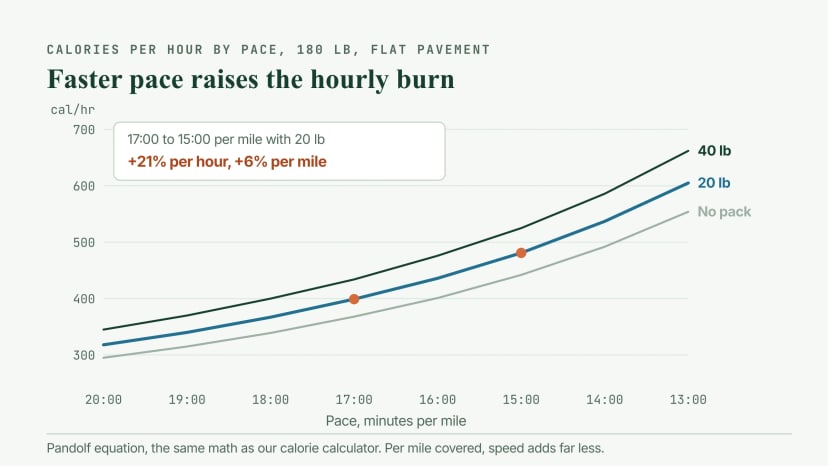
Hourly burn climbs faster than pace. Going from 17:00/mile to 15:00/mile makes you about 13% faster, but calorie burn per hour rises by roughly 20-25%. For a 180 lb rucker carrying 20 lb on pavement, the calculator below puts it at 399 versus 481 calories an hour. The original Pandolf equation (1977), published in the Journal of Applied Physiology, anchors this prediction: load, speed and grade are the three inputs that determine metabolic cost, and speed enters the equation squared, so each step up in pace costs more per hour than the last. Per mile the gap is much smaller, because you finish each mile sooner. The same move from 17:00 to 15:00 adds only about 6%, from 113 to 120 calories a mile. Pace is a good way to make an hour harder and a poor way to make a set distance burn much more.
But faster pace is harder to sustain, which reduces total volume. Most people can hold 13:00/mile under a pack for far less time than 16:00/mile, and how long you keep going matters more than the per-mile gap. For the same 180 lb rucker, 30 minutes at 13:00/mile burns about 300 calories. An hour at 16:00/mile burns about 435. The faster session is more intense by the minute, but the slower one lasts long enough to do more total work.
The math often favors slower plus longer over faster plus shorter. For fat loss-the goal most ruckers mention-sustaining a 16:00/mile pace for 50 minutes might burn more total calories than sustaining a 13:00/mile pace for 35 minutes. The slower, longer session accumulates more total volume, and total volume is the primary driver of fat loss progress.
The principle: use pace as a training tool for specific goals (event prep, fitness testing), but don't assume faster is always better for general fitness. Sustainable pace accumulates more volume, which drives more total adaptation.
Run your own numbers - pace, load, and bodyweight all feed the same Pandolf equation:
Pace targets by goal
Different goals call for different pace strategies:
Fat loss: 14:00-17:00/mile
Stay in Zone 2 (conversational). This is the pace you can sustain for 45-60 minutes. Fat loss is driven primarily by total volume and consistency, not intensity. Rucking at this pace three times per week for 50 minutes each is more effective for fat loss than rucking twice per week at a hard pace for 30 minutes. Choose sustainability over speed.
General fitness: 13:00-16:00/mile
This is the moderate-intensity zone where aerobic fitness and work capacity improve. You can still speak, but you're breathing harder. This pace is appropriate for intermediate and advanced ruckers on their harder sessions. Not race-hard, but noticeably harder than your easy effort.
Event prep: 12:00-15:00/mile
If you're training for a GORUCK event, ruck race, or rucking-specific competition, you need to spend time at the pace demands of your event. Practice at or slightly faster than your goal event pace. This teaches your body to move efficiently at that speed and builds the work capacity to handle it for the required distance. A 6-mile GORUCK at 14:00/mile pace is demanding; practicing at 13:30/mile builds confidence.
Recovery: 17:00-20:00/mile
This is genuinely easy. Conversational, minimal breathing elevation, could do this indefinitely. Recovery rucks are low-intensity efforts on easy days designed to promote blood flow and adaptation without adding training stress. They're rejuvenating, not exhausting.
How to improve your rucking pace
If pace improvement is your goal, here are the leverage points:
Lose bodyweight. A lighter body naturally moves faster. Losing 10 pounds is functionally similar to removing 10 pounds from your pack. This is the single most reliable lever for pace improvement without increasing injury risk. Every pound lost reduces the load your legs have to propel.
Improve aerobic base. Run more Zone 2 rucking volume. More aerobic capacity means more efficient movement at all paces. Ruckers with a strong aerobic base move faster with lower perceived effort than those with weak aerobic bases. This takes months, but the returns are substantial.
Strengthen your legs. Squats (bodyweight or loaded), lunges (forward and reverse), and calf raises build the leg power that propels you forward. Stronger muscles produce more force with less perceived effort, translating to faster pace at the same effort level. Do leg work 2-3x per week in cycles focused on strength or power.
Improve running form. Shorter stride, quicker cadence, and efficient foot strike reduce wasted motion. Many people ruck with exaggerated stride lengths that waste energy. Video yourself rucking and compare to runners with efficient form. Shorter stride + quicker cadence is faster and less injurious than long stride at slow cadence.
Hill training. Repeated hill efforts build strength and power that transfer to flat speed. A 4-week block of rucking hilly terrain, once per week, will noticeably improve your flat pace when you return to flat terrain. The gains come from the power built on hills.
Interval rucking. Alternate 2-3 minute hard efforts (close to race pace) with 2-3 minutes easy effort, within a single ruck session. Start with 4-6 repeats, gradually building to 8-10. This develops the ability to handle faster pace while improving recovery during hard work. Do this 1x per week on a dedicated training ruck.
Stop trying to ruck fast. The vast majority of rucking benefits come at a comfortable pace. If you want to burn more calories, add weight or distance-not speed. Speed is the least efficient lever for improvement and the most common cause of injury.
Related reading
- Rucking pace calculator - your target pace and finish time for a specific load and distance
- Rucking calorie calculator - see exactly how many calories you burn at your current pace and load
- How heavy should your ruck be? - adding more weight is more effective than chasing pace
- Best rucking gear 2026 - includes GPS watch picks for tracking your pace accurately in the field
- Rucking statistics 2026 - sourced data on calorie burn, growth, and the Army pace standard
Frequently Asked Questions
Three hours is the standard most military and event contexts use, which is a 15:00 per mile average. From the matrix above, that is a moderate effort at 20 lb or a brisk effort at 30 lb on flat ground. A competitive 12-miler lands around 2:45 (13:45 per mile), and a first attempt under load commonly runs 3:30 to 4:00. Terrain adds time before fitness does.
That is 13:20 per mile, which sits at the brisk end of the chart for a 10 to 20 lb pack and is quick for anything heavier. For a beginner it is a strong result; for an experienced rucker carrying 30 lb or more it is closer to race effort than a training pace. Judge it against your load, not against the clock alone.
Yes, absolutely. If you're breathing harder than conversational at your target pace, you're going too fast for sustainable training. The pace ranges are guidelines, but your heart rate and perceived effort are the actual training signals that matter.
Terrain, elevation gain, weather, and even time of day dramatically affect pace. A 500-foot climb can add 6-7 minutes to a 2-mile ruck compared to flat terrain. This is normal physics, not fitness regression.
Most people see meaningful pace improvement within 6-8 weeks of consistent training, but this depends heavily on starting fitness level and training frequency. Focus on building aerobic base with Zone 2 work rather than chasing speed directly.
For fat loss and general fitness, slower for longer usually wins. A 50-minute ruck at 16:00/mile often burns more total calories than a 35-minute ruck at 13:00/mile because you accumulate more total volume.
No, these pace targets assume flat to gently rolling terrain. Expect to be 2-4 minutes per mile slower on significant hills or technical trails. Use conversational effort as your guide rather than hitting specific pace numbers.
Most GPS watches are accurate within 2-3% for pace on open terrain, but they struggle under tree cover or in urban canyons. The bigger issue is that they can't account for load, so your perceived effort at a given pace will be much higher than the watch predicts.
Most military standards require 15:00/mile pace or faster with specified loads. GORUCK events typically require 15:00/mile minimum pace. This is achievable for most people within 4-6 weeks of consistent training, even starting from beginner fitness.