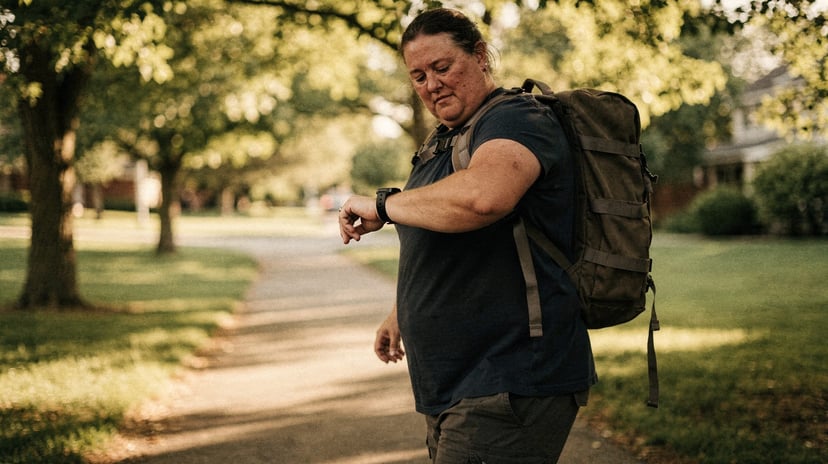
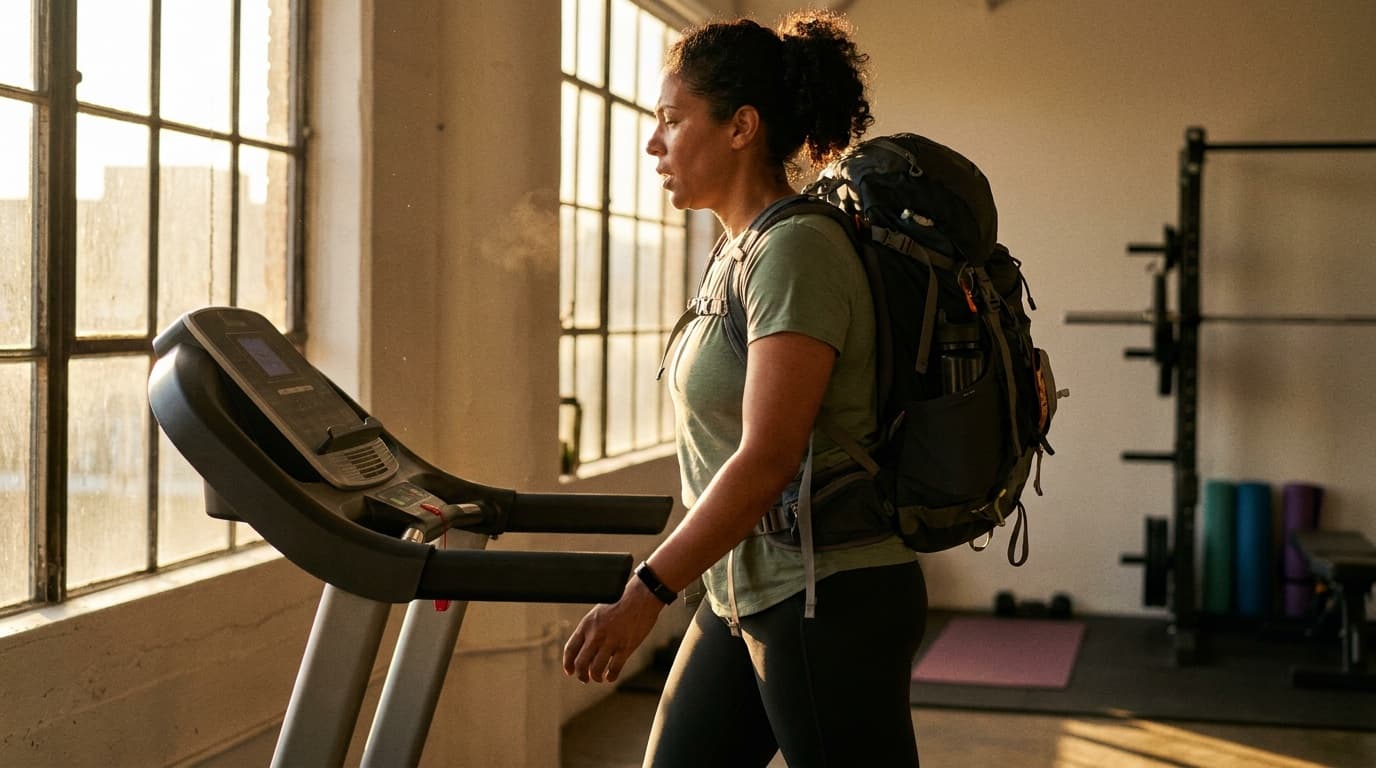
You've been rucking for a few months now. You can crush 5 miles at a steady pace. But when you check your watch, you realize you haven't gotten faster in weeks - or months.
So you do what seems logical: you push harder on every ruck. You add weight. You grind out longer distances. And somehow, you're still moving at the same 4.2 mph you were doing three months ago.
The problem isn't your work ethic. It's your programming. Speed doesn't come from doing the same thing harder. It comes from structured speed work - intervals designed to rewire your nervous system and teach your legs to move faster under load.
This is what separates casual ruckers from people who actually get faster.
Why Speed Matters (And When It Doesn't)
Let's be honest first: for general fitness, pace doesn't matter much. Rucking 4 mph for 60 minutes burns nearly as many calories as rucking 5 mph for 48 minutes. Both are excellent conditioning work.
Speed becomes relevant when:
- You're training for a ruck event. Military-style selections, GORUCK events, and civilian ruck challenges have pace minimums (typically 3.5-4 mph with a heavy load). If that's your goal, speed work is non-negotiable.
- You want to compress your training into less time. If you're time-crunched, faster rucks mean more work in fewer minutes.
- You're chasing a personal standard. Some people simply want to ruck faster - and that's a legitimate goal. Speed is a fitness attribute worth training.
If your goal is body composition, base fitness, or just enjoying time outside, you can skip this article and stick with how often you should ruck at a conversational pace.
But if speed is your goal, the path is well-mapped. Let's walk you through it.
The Science of Getting Faster Under Load
Research from the Military Training Institute (MTI) - the folks who train military professionals - found something interesting: soldiers who did 2-minute fast / 1-minute easy intervals got faster than those who just rucked at a constant, uncomfortable pace for the same total time.
Why? Because speed is a neuromuscular adaptation, not just a cardiovascular one.
When you do repeated fast efforts with recovery, you're training your nervous system to recruit muscle fibers faster and more efficiently. You're teaching your body how to move quickly under load, not just whether it can move quickly.
There's a concept called Speed Over Ground (SOG) intervals: rucking 1/3 of your target distance at 10-20% faster than your goal pace, with full recovery between sets. Research suggests this approach - shorter distances at intentionally fast paces - builds speed faster than grinding through longer distances at a slightly elevated pace.
Studies of hybrid training (mixing speed work with endurance work) show a 6.2% improvement in ruck pace compared to endurance-only training over 8-12 weeks. The key: speed work should never exceed 20-30% of your weekly volume. The rest should be easy, conversational pace.
The other finding worth noting: lighter loads teach speed faster than heavy loads do. A 20-lb ruck at 5 mph teaches your legs the movement pattern of speed. Once your legs know that pattern, you can add weight back in and maintain it. But trying to add speed and weight simultaneously is like learning to drive while also learning to speak a new language - you can do both, but you're fighting your own neuromuscular system.
Speed Rucking Fundamentals: Before You Start
Before you hit any of the workouts below, three non-negotiables:
Drop Weight First
If you're currently rucking 35-40 lbs and trying to get faster, your first move is to drop to 20-25 lbs for your speed sessions. This isn't "cheating" - it's smart programming.
Your legs learn movement patterns from whatever load they're under. Fast movement under 20 lbs teaches speed. Slow movement under 40 lbs teaches slow. Once your neuromuscular system knows what fast feels like, you layer weight back on. If you're unsure what weight is appropriate for your fitness level, use the ruck weight calculator to dial in the right load for speed work.
This is why elite distance runners don't add a 30-lb vest when they do tempo runs. They move fast unloaded, build that pattern, then apply it to harder conditions.
Fix Your Form First
Speed exposes form breakdowns. If you're slouching, your arms aren't driving, or your hips are tight, adding speed work won't fix those issues - it'll just tire you out while you're compensating.
Before doing any speed work, spend a week on the rucking form guide. Pay special attention to:
- Upright posture. Your shoulders should be back and level. Your ruck should sit flush against your back, not hanging loose.
- Arm drive. Your arms should swing naturally with your gait, not hanging at your sides. Faster walkers use more arm drive.
- Hip extension. Each step should drive your back leg fully behind you. That's where speed lives. Proper footwear matters too - Salomon XA Pro 3D shoes give you the grip and feedback to accelerate safely.
Speed work with poor form just means you'll move fast while also compressing your spine or overstressing your knees.
The 80/20 Rule
80% of your weekly rucking volume should be at an easy, conversational pace. 20% should be speed work.
If you're rucking 100 miles per week (unlikely), 20 miles would be speed work. If you're rucking 20 miles per week (more typical), about 4 miles should be intentional speed work. Everything else - easy long rucks, moderate recovery rucks, steady-state hikes - stays conversational.
This ratio prevents burnout, keeps your aerobic base strong, and ensures speed work remains truly "work" - not just a different flavor of the same grinding intensity.
Four Speed Workouts That Actually Work
Workout 1: The 2:1 Protocol
Load: 20 lbs | Duration: 30 minutes total | Rest: 1 minute easy between intervals | Rounds: 6-8
This is the workout backed by MTI research. It's simple and effective.
Go at a hard-but-sustainable pace for 2 minutes. Then drop to an easy conversational pace for 1 minute. Repeat for 30 minutes total. That's roughly 6-8 rounds depending on your fitness level.
When to use: 2x per week as your primary speed work. Monday and Thursday work well so you're not back-to-back.
Who it's for: Intermediate to advanced ruckers who have a baseline of 4+ weeks of consistent rucking. The 2:1 is demanding - it's not your first speed workout.
What "hard-but-sustainable" means: You can still talk in short sentences. You couldn't hold a full conversation, but you're not gasping. If you're running, you've gone too hard.
Workout 2: Tempo Ruck
Load: 25-30 lbs | Duration: 15-20 minutes at elevated pace | Pace: 10-15% faster than your comfortable pace | Rest: 5 minutes easy before and after
The tempo ruck is a sustained, moderately fast effort. It's not all-out speed - it's the "comfortably hard" zone.
Find your comfortable rucking pace. If that's 4 mph, a tempo ruck is 4.4-4.6 mph. Do that for 15-20 minutes straight. Warm up with 5 minutes easy before, and cool down with 5 minutes easy after.
When to use: Once per week, separate from your 2:1 protocol sessions. This is your "second speed workout" if you're doing two speed sessions weekly.
Who it's for: Anyone with 6+ weeks of consistent rucking. It's lower intensity than the 2:1 so it's good for building into speed work gradually.
Why this works: Tempo efforts train your aerobic threshold - the boundary between "easy" and "hard." By repeatedly pushing just above that line, you move it higher. Your "comfortable pace" naturally increases.
Workout 3: Speed Over Ground (SOG) Intervals
Load: 30-40 lbs (test weight) | Distance: 1/3 of your target distance at 10-20% faster than goal pace | Rest: Full recovery between sets | Sets: 3-4
This is the advanced approach. Say your goal is to ruck 10 miles at 4 mph. Your SOG intervals would be:
- 3-4 repetitions of 3.3 miles
- At 4.4-4.8 mph (10-20% faster than 4 mph)
- Full recovery (walk easy for 5-10 minutes) between each repetition
- With your target load (30-40 lbs if you're training for a heavy ruck)
The beauty of SOG is that it's distance-based, not time-based. You're hitting a specific pace over a specific distance, which is closer to what an actual event demands.
When to use: Every 2-3 weeks as a longer speed session, not as your main weekly speed work. This is mentally and physically taxing, so don't do it twice a week.
Who it's for: Experienced ruckers training for a specific event or standard. You need solid conditioning before adding SOG intervals.
The recovery piece matters. Don't just stop and sit. Walk easy. Your heart rate needs to come down enough that the next repetition feels fresh.
Workout 4: Fartlek Ruck
Load: 20-25 lbs | Duration: 30-45 minutes | Structure: Unstructured speed play | Pace: Variable - fast bursts followed by easy recovery
Fartlek is Swedish for "speed play," and it's exactly that - no structure, just playful speed work.
Pick a route. Every few minutes, pick a landmark - a mailbox, a tree, a telephone pole. Ruck fast to that landmark. Then ruck easy to the next one. Speed bursts vary from 1-3 minutes. The pace is whatever feels good in the moment.
When to use: Once per week as an alternative to structured work, especially if you're new to speed rucking.
Who it's for: Beginners to speed work. Fartlek removes the mental burden of hitting specific paces and following rigid intervals. It's playful, it's less boring than structured work, and it still teaches speed.
Why this matters: If speed work feels like a chore, you won't stick with it. Fartlek makes speed training feel like fun exploration rather than a WOD (workout of the day).
Sample Speed Week
Here's how to fit speed work into a realistic weekly routine:
Monday: 2:1 Protocol
- Warm up: 5 min easy
- Main: 6-8 rounds of 2 min fast / 1 min easy
- Cool down: 5 min easy
- Load: 20 lbs
- Total time: 35-40 minutes
Wednesday: Easy Ruck
- Conversational pace, no time pressure
- Load: 30-35 lbs
- Duration: 30-45 minutes
- Purpose: Recovery and aerobic maintenance
Friday: Rest or Mobility
- No rucking. Foam roll, stretch, easy walking if you want.
Saturday: Long Slow Ruck
- Conversational pace, focus on distance and time on feet
- Load: 25-30 lbs
- Duration: 60-90 minutes
- Purpose: Build aerobic base and mental toughness
Sunday: Off or Very Easy
- Complete rest, or a 15-20 minute easy walk with no ruck
This week has one hard speed session (Monday), one moderate session (Wednesday), one long session (Saturday), and plenty of recovery. You're hitting the 80/20 rule - about 30-40 miles easy/moderate, 4-5 miles hard.
Progression: When to Add Speed, Weight, or Distance
Progression should happen one variable at a time, never all three.
Week 1-2: Build the Baseline
- 2:1 protocol at 20 lbs, 6 rounds
- Fartlek or tempo ruck once, also at 20 lbs
- Get comfortable with the effort level
Week 3-4: Add Volume
- 2:1 protocol: increase to 7-8 rounds (add 1-2 rounds)
- Keep load at 20 lbs
- Keep pace the same
Week 5-6: Add Load
- 2:1 protocol: 8 rounds at 25 lbs
- Reduce rounds if needed (drop to 6), but the load is heavier
- Pace should feel slightly harder, but not impossible
Week 7-8: Reassess
- Test: can you do 8 rounds of 2:1 at 30 lbs comfortably?
- If yes, you're improving. If no, stay at 25 lbs for another 2 weeks.
The progression isn't linear. Some weeks you'll feel strong and want to push. Other weeks you'll repeat what you did last week. That's normal.

Common Speed Mistakes (And How to Avoid Them)
Mistake 1: Running Instead of Speed-Walking
Speed rucking is still walking, just faster. Your pace should allow both feet to stay in contact with the ground at all times. You should never be jogging or running.
How do you know if you've crossed into a run? Your feet come completely off the ground. You're bouncing. You're expending energy up instead of forward.
If you find yourself running, slow down. Speed rucking with a loaded pack is hard enough at a walk - you don't need to add the impact and inefficiency of running.
Mistake 2: Speed Work Every Session
Doing 2:1 intervals three times a week (or worse, five times a week) leads to burnout and injury. Your nervous system needs recovery to adapt.
Speed work works because it's a contrast to easy work. Lose the contrast, and you lose the stimulus.
Stick to 1-2 speed sessions per week. The rest should be easy. This feels counterintuitive - shouldn't you work hard to get results? - but the data is clear. Hard-easy programming beats consistently moderate training.
Mistake 3: Adding Speed AND Weight Simultaneously
"I want to get faster with a heavier load, so I'll add both at once."
This doesn't work. Your neuromuscular system can only learn one new thing at a time.
First: get faster with light load (20 lbs). Then: add weight back while maintaining that fast pace.
These are two separate training blocks, not one simultaneous push.
Mistake 4: Ignoring Form Breakdown
Here's what happens around minute 20 of a hard speed session: your posture collapses. Your shoulders roll forward. Your arm drive stops. Your hips don't extend fully.
Form breakdown isn't a sign you're working hard - it's a sign you should slow down. The moment your form breaks, the workout stops teaching speed and starts teaching poor movement.
Video yourself doing a speed session (just pull out your phone). Watch it back. You'll probably catch form issues you didn't feel while rucking.
The Pace Chart: Know Your Numbers
Want to know what your actual speed should be? Check out the rucking pace chart for conversions between mph, min/mile, and kilometer paces.
For speed work, here's a rough guide:
- Casual pace: 3.5-4.0 mph (15-17 min/mile)
- Conversational pace: 4.0-4.5 mph (13-15 min/mile)
- Speed ruck pace: 4.5-5.5 mph (11-13 min/mile)
- Fast speed ruck: 5.5+ mph (under 11 min/mile)
These vary based on terrain, load, and fitness level. Sand adds 10-15% to your time. Hills add 20-30%. So adjust accordingly.
A Garmin Instinct 3 Solar is invaluable for speed work. You can't dial in "10% faster" without numbers. Knowing you're doing exactly 4.7 mph is the difference between effective training and guessing. The watch also helps you track whether your pacing is consistent across different terrain and conditions.
Integrating Speed Work Into Your Routine
Speed work isn't separate from the rest of your training - it's one piece of a complete rucking program. Make sure you're also:
- Following a solid rucking weekly routine
- Hitting the how often you should ruck guidelines (3-4x per week minimum for adaptation)
- Using proper rucking form
- Following a structured training program
Speed comes from consistency over months, not heroic effort over weeks. Build the foundation, add speed work gradually, and trust the process.
The Timeline: Expect Progress in 4-6 Weeks
You won't feel dramatically faster after one 2:1 session. You'll feel sore, maybe tired. That's normal.
But here's what the research shows: after 4-6 weeks of consistent speed work (1-2 sessions per week), most people see a measurable improvement in pace. Your natural rucking speed ticks up by 0.3-0.5 mph. Your hard efforts feel a bit easier.
After 8-12 weeks, that 0.3-0.5 mph improvement becomes 0.6-1.0 mph - a significant jump. You're literally walking faster under load.
But only if you do the work consistently, keep the volume reasonable, and stay patient.
Speed rucking isn't complicated. It's just intervals with intention, structured into a program that respects recovery. You don't need to reinvent the wheel - just follow the workouts above, stick to the 80/20 rule, and give it 8-12 weeks.
You'll be faster. Guaranteed.