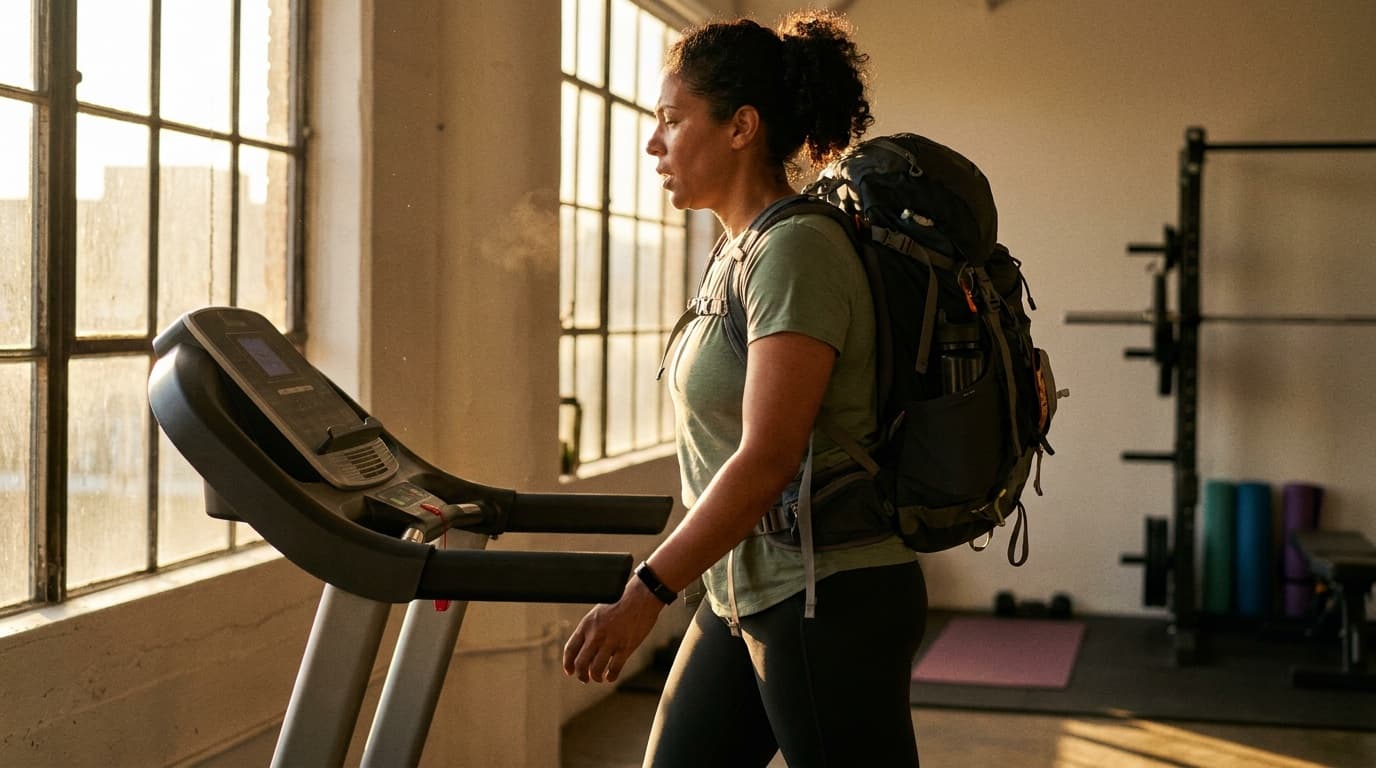
Who should use this plan
This plan is for a rucker who can already walk 20-25 minutes with the intended pack load without warning symptoms or a changed gait.
If you are new to regular walking, start with Couch to Ruck. If you walk regularly but have not carried load, use Your First 30 Days of Rucking.
Indoor rucking is useful when heat, cold, darkness, smoke, ice, or schedule makes the outdoor route a poor choice. A treadmill also makes grade and duration repeatable. It does not make an aggressive progression harmless.
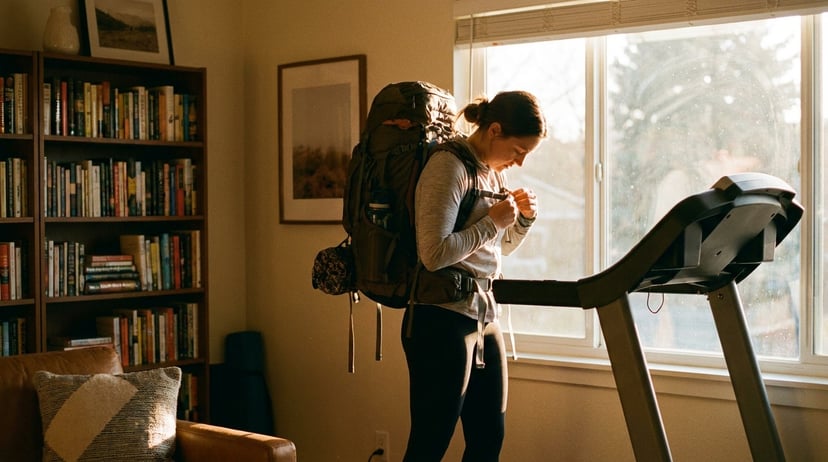
Check the treadmill’s user manual, maximum user weight, and rules for added load. Use the safety clip. Stop the belt before adjusting the pack or getting on and off. Do not rely on the handrails to hold a pace you cannot walk independently.
Replacing an outdoor session when the evenings get darker
Use an indoor session in place of that day's outdoor ruck. Keep the unloaded days in your week; a change of venue does not need to add another workout.
Start with the baseline below, even if your summer route was longer or faster. Record pack weight, time, incline and effort so you can repeat the session next week. Treat the treadmill's distance as a record of that session, without trying to make it equal your trail mileage.
Use walking shoes that fit comfortably on the belt, secure loose pack straps and keep water within reach. You do not need new shoes or a heavier plate just to move indoors. Check the machine's load rules before putting the pack on.
When you return outside, choose a familiar route and allow time to adjust to its footing. Our headlamp guide covers the darker part of the day; the cold-weather guide covers clothing and decisions about staying indoors.
Choose the baseline
Use:
- your recent comfortable pack load
- a pace that allows a natural walking stride without holding the rails
- 0-1% incline for the first steady session
- a total training time of 20-25 minutes
Hold pack load for the full block. Body weight does not determine an appropriate treadmill load by itself.
The four-week schedule
| Week | Loaded steady walk | Loaded incline practice | Unloaded aerobic work |
|---|---|---|---|
| 1 | 25 min at 0-1%, easy talk-test pace | 20 min at 0-1%, steady | 30 min easy walk, bike, or elliptical |
| 2 | 30 min at the same pace and grade | 5 min easy, 3 x 2 min at 3-4% with 2 min easy, cool down | 30 min easy |
| 3 | 35 min at the same pace and grade | 5 min easy, 4 x 2 min at 3-4% with 2 min easy, cool down | 35 min easy |
| 4 | 25 min easy | 20 min easy at 0-1% | 25-30 min easy |
Keep at least one unloaded day between the two rucks. Strength training can replace the unloaded aerobic session or sit on another day, but avoid heavy leg work immediately before the longer ruck.
Week 1: Establish treadmill pace
The first session teaches you what the same load feels like on a moving belt.
Setup
- Confirm the belt is stopped.
- Put on and secure the pack.
- Clip the emergency stop key to your clothing.
- Start slowly and increase speed in small steps.
- Settle at a pace you can walk without touching the rails.
The displayed speed is not a target. Treadmill calibration, stride, incline, footwear, and load change the effort.
If you need the handrails for balance, reduce speed or stop the loaded session. Holding the rails changes mechanics and hides the actual demand.
Week 2: Add duration and short incline blocks
The steady session adds five minutes while pace, load, and incline remain fixed.
The second session keeps the same total load and uses three short incline blocks. Slow the belt before raising grade when needed. Grade is the variable; do not also force Week 1 speed.
There is no reliable rule that 1% treadmill incline perfectly reproduces outdoor walking. Use treadmill grade as its own repeatable setting.
Week 3: Extend the two session types
The steady walk reaches 35 minutes. The incline session adds one repeat, not more load.
Use the talk test:
- full sentences during the steady session
- short but controlled phrases during incline blocks
- normal breathing again during recovery
If recovery from Session 1 is not stable, repeat Week 2 rather than adding the fourth incline block.
Week 4: Consolidate
Reduce loaded time and return both rucks to low grade. This gives you a clearer read on the next block.
Record:
- pack load
- belt speed
- incline
- duration
- effort from 1 to 10
- whether you touched the rails
- any gait, foot, shoulder, or back change
Progress only one variable next:
- add five minutes to the steady session, or
- add one incline repeat, or
- test a small load change on a shorter, low-grade session
Strength support
One or two unloaded full-body sessions can include:
- squat or step-up
- hinge
- push
- pull
- calf raise
- trunk work
Do not wear the ruck for every exercise merely because the program is about rucking. Resistance training and specific loaded walking can remain separate.
Treadmill safety and form
Do
- use the safety clip
- leave clear space behind the treadmill
- keep the load secured
- wear shoes already comfortable for walking
- reduce speed before changing a pack or setting
- choose a speed you can maintain without rails
Do not
- step onto a moving belt with the pack
- adjust or remove the pack while the belt moves
- chase a programmed speed with a run or shuffle
- use steep incline and a heavier load in the same progression
- block vents or interfere with treadmill controls
How indoor training transfers outside
The treadmill can preserve aerobic and loaded-walking consistency, but it does not reproduce:
- uneven ground
- descents
- lateral stability
- changing weather
- route finding
- outdoor pack access
If an event is outdoors, include outdoor sessions before the event. Test footwear, load security, and downhill control on the relevant terrain.
Common mistakes
Increasing load every week. Hold load and use the machine’s controllable duration and grade first.
Three loaded treadmill days for a beginner. Two loaded sessions plus unloaded aerobic work is enough for this block.
Treating the rails as normal form. Reduce speed or incline until your arms can swing naturally.
Using speed and incline as simultaneous tests. Practice one while holding the other.
Making Week 4 a capstone. Consolidation produces better information than an exhaustion test.
Frequently asked questions
Can I ruck on a treadmill?
Yes, when the treadmill permits the combined user and pack weight and you can walk independently without the rails. Follow the manufacturer’s instructions and use the safety clip.
What speed should I use?
Use the speed that preserves a normal walking gait and easy talk-test effort. The display is a repeatable setting, not a universal prescription.
What incline should I use?
Begin at 0-1%. This plan introduces short 3-4% blocks while load remains fixed. Reduce speed as grade rises.
Should I increase weight during the four weeks?
No. Hold pack load. After Week 4, test one small load change only on a shorter low-grade session if the prior block was stable.
Can this replace outdoor event training?
It can maintain and build some capacity, but an outdoor event still requires practice on relevant surface, grade, descents, weather, and gear.


