The Short Answer

Ruck commuting is the lowest-friction way to add strength training to your day. You are already walking or taking transit and walking part of it. A weighted backpack transforms that commute into a productive workout - no extra time needed, no gym visit required, and you arrive at work energized instead of sedentary.
The ideal commute distance is 1 to 3 miles. Any longer gets logistically complicated. Any shorter and the calorie expenditure barely justifies the gear investment. Pick a route that is reasonably flat and well-lit, grab a ruck designed for commuting (laptop compartment and breathable back panel), and start with 15 to 20 lbs.
The commuter ruck kit
Commuting rucks need a different gear profile than training rucks - laptop sleeve, civilian aesthetic, breathable back panel, low-profile reflectivity for road sections. Four items handle 95% of urban commutes.
| Priority | Item | Why this one |
|---|---|---|
| 1 | Evergoods CPL24 commuter pack | Padded laptop sleeve, clean civilian look, breathable mesh back panel. The pack ruckers reach for when they don't want to look tactical at the office. |
| 2 | Alt pack: Mystery Ranch 2 Day Assault | Same crossover role with better load carry, more capacity, and a stronger case for weekend training too. |
| 3 | Garmin Instinct 3 Solar | Multi-week battery, tracks Zone 2 - the heart-rate zone where a commute becomes a workout. The watch you'll keep wearing in the office. |
| 4 | Petzl Actik Core headlamp | Rechargeable, 600 lumen. Dark-morning commute essential. Lives in the pack year-round. |
| 5 | Nalgene Wide-Mouth 32 oz bottle | Fits any pack side pocket; doesn't sweat onto your laptop sleeve. |
Pack picks for commuting
Three packs handle the commuter use case from three different angles - tactical-leaning, civilian-clean, and crossover. Pick by which trade-off matters most for your office. If budget is the deciding factor, the RUSH 24 2.0 gives you a laptop sleeve and real load-carry for around a third of a premium pack's price. If you're shopping for a pack to fly and travel with rather than ruck in, our sister site Kit Authority's roundup of travel backpacks covers carry-on-friendly options built for trips, not loaded walks.
| Pack | Capacity | Laptop Sleeve | Best For | Price tier |
|---|---|---|---|---|
| GORUCK GR1 26L | 26L | 15" padded, suspended | The buy-once pick. Tactical look but Scars lifetime warranty makes it the longest-term value. | Premium |
| 5.11 RUSH 24 2.0 | 37L | 15" padded | The budget workhorse. More external organization than the GR1, less premium feel, around a third of the price. | Budget |
| Mystery Ranch 2 Day Assault | 27L | 15" sleeve | The crossover. Cleaner aesthetic than the RUSH, more load-friendly than most commuter bags, and better for weekend training too. | Mid-range |
Why Ruck Commuting Works
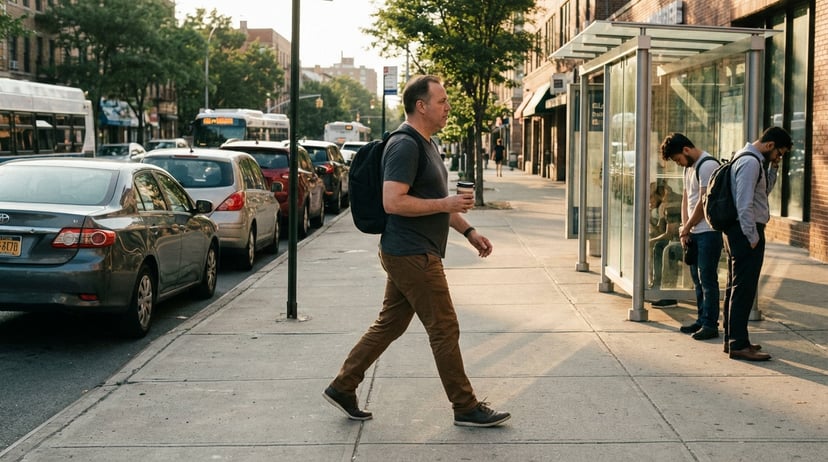
Ruck commuting wins because it solves the biggest barrier to fitness: time. You do not need to carve out a new hour. You are already moving from point A to point B. The only change is what you carry.
A commute usually lands at dawn or dusk, which means you are walking through the best light of the day. If that tempts you to start carrying a camera, our sister site Aperture Authority's golden hour guide covers how to actually use it.
A rucker walking 1.5 miles at a moderate pace burns 80 to 120 additional calories compared to the same walk unloaded - depending on pack weight and body composition. Do that four times per week and you are adding 320 to 480 calories burned per week without any lifestyle change beyond putting on a backpack.
The resistance also builds stabilizer muscles in your core, legs, and back that traditional cardio completely ignores. Rucking for six weeks straight produces measurable improvements in posture, lower back strength, and grip strength - adaptations running will not give you.
The Ideal Commute Distance

Distance determines the viability of your ruck commute. Here is the practical breakdown:
Under 1 mile: The time window is too short. The caloric burn is negligible (roughly 20 to 30 extra calories). You also have not hit the neural adaptation window where rucking starts to feel natural. Skip this distance unless you are layering it - ruck to the bus stop, take transit, ruck from the transit center.
1 to 3 miles: This is the sweet spot. A 2-mile ruck at a moderate pace takes 35 to 45 minutes, which maps to most reasonable commutes. The caloric burn reaches 100 to 180 calories. The logistics are simple - one change of clothes, one ruck, done.
3 to 5 miles: Doable but starts to require serious planning. Shower facilities at work become a hard requirement. Weight selection matters more because fatigue compounds over longer distances. Most people in this range ruck two to three times per week, not daily.
Over 5 miles: Unless you have a dedicated shower and changing area at work, this is not practical for daily commuting. Consider splitting it - ruck to transit, take transit partway, ruck the rest.

What to Carry: The Commuter Ruck Setup
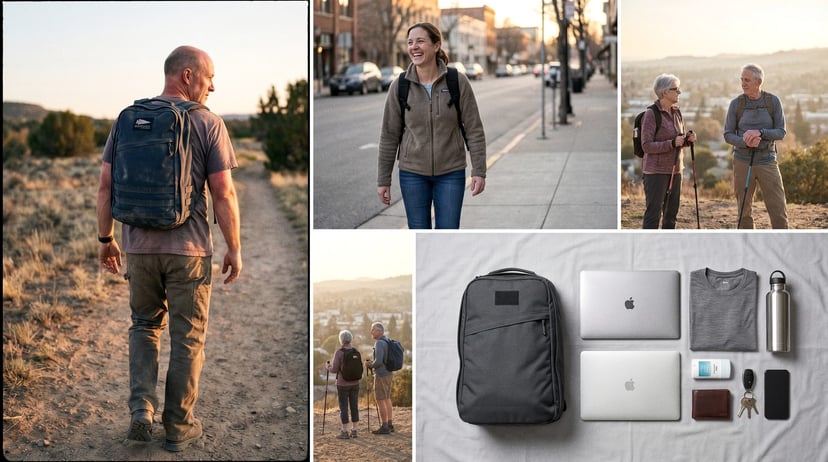
Your ruck needs three things: a laptop compartment, a breathable back panel, and enough capacity to hold a change of clothes without looking like you are packing for a weekend.
Recommended capacity: 15L to 27L is the commuter sweet spot. The Evergoods CPL24 or Mystery Ranch 2 Day Assault hit this range cleanly. Anything much larger advertises "this person is rucking" in a way that works for some workplaces and not others. Anything smaller does not fit a laptop and a change of clothes.
Essentials to pack:
- Laptop or work device
- Change of shirt (merino wool or synthetic; avoid cotton)
- Deodorant or baby wipes (more on this below)
- Nalgene Wide Mouth 32oz water bottle - stays hydrated all commute without sloshing
- Minimal phone/keys/wallet
Do not pack a full gym bag. The goal is to commute, not to haul everything you own. Keep it under 20 lbs for the first month, then adjust based on how you feel.
Invest in merino wool base layers if your commute is longer than 1.5 miles. Merino regulates temperature and resists odor better than any synthetic. You can rewear a merino shirt 4 to 5 times between washes. Cotton holds sweat and stink - avoid it.
The Sweat Problem (And How to Solve It)

The biggest concern people have about ruck commuting is arriving at work drenched. This is a logistics problem, not a fundamental limitation.
The pace matters most. You do not need to ruck fast. A leisurely 3 to 3.5 mph pace is the commuter norm. At this pace, even with a 20-lb pack, your heart rate stays in zone 2, which is the "talking pace" where you do not sweat excessively. Run the numbers: A 180-lb person rucking at 3.5 mph with a 20-lb pack on flat streets burns roughly 395 calories per hour (Pandolf equation), which is moderate intensity.
Layer strategically. Avoid cotton entirely. Start with a merino wool or synthetic base layer, add a lightweight breathable outer layer, and you can shed the outer layer halfway through the commute if needed. You regulate temperature, not sweat buckets.
Keep cleanup supplies at work. Store fragrance-free baby wipes at your desk and use them to clean your face, neck, and armpits after you arrive. They will not replace a shower, but they can make a short, easy commute more practical.
Research on load carriage gait mechanics shows that perceived exertion stays moderate when rucking at 3 to 3.5 mph with loads under 25 percent of body weight. Heavier loads or faster paces shift you into anaerobic territory where sweating increases exponentially. The solution is not to ruck harder - it is to ruck at the right pace for your goal.
Weight Progression for Commuters
Start light. This is non-negotiable. A common mistake is loading up with 30 lbs because you are "already strong." Your stabilizer muscles, tendons, and connective tissue need time to adapt.
Week 1 to 2: Bodyweight only or 10 lbs if you are large (over 200 lbs). This is your form baseline. You are learning to ruck without fatigue clouding your movement pattern.
Week 3 to 4: Add 5 lbs. Total load: 15 to 20 lbs depending on your starting point. Ruck three to four times per week.
Week 5+: Add 5 lbs every two weeks if you feel strong and your joints are not complaining. Plateau at 20 to 30 lbs for most commuters. Heavier rucks are overkill for a commute; you are not doing selection courses.
Practical load rule: Never exceed 15 to 20 percent of your body weight for commuting. A 180-lb person maxes out around 30 to 35 lbs. A 150-lb person stops at 25 to 30 lbs. This is the sweet spot where you are getting the strength stimulus without trashing your joints.
Weather and Safety Considerations
Cold weather: Merino wool works. A windproof outer layer helps. Do not overheat - you will sweat and then chill on arrival. Reflective elements on your ruck and clothing are not optional; they are essential.
Rain: Waterproof your electronics, not your ruck. A good commuter ruck has water-resistant fabric. Heavy rain is your signal to skip rucking or adjust your pace. Slick pavement and added weight are a slip risk.
Dark conditions: Use lights. A Petzl Actik Core rechargeable headlamp keeps your hands free while illuminating your path, and the compact design tucks easily into your ruck. Reflective vest over your ruck is overkill for urban environments but reasonable for rural routes. The goal is to be seen, not to look cool.
Route selection: Flat or gently rolling is ideal. Steep hills compound fatigue and increase injury risk. Major busy roads are not recommended - stick to quieter streets or dedicated paths. One change in a major intersection can derail your commute completely.
Scout your route on a weekend with a light load. Note where hills are, where there are loose surfaces or potholes, and where traffic is heaviest. This reconnaissance eliminates surprises on a heavy ruck day. A multi-week-battery watch like the Instinct 3 Solar (45mm) is perfect for tracking commute metrics and building consistency without another charger to remember.
Frequency and Programming
Four days per week is the practical sweet spot for commuters. This gives you:
- Monday: ruck commute (light, moderate pace)
- Wednesday: ruck commute (moderate load, steady pace)
- Friday: ruck commute (lighter day, recovery pace)
- Plus one weekend ruck if you are feeling ambitious (optional)
This cadence gives your body enough stimulus to adapt without hitting fatigue or overuse. It is also realistic - missing one day due to weather or scheduling does not derail your whole week.
Avoid rucking every single day. Your tendons and ligaments adapt slower than your muscles. Daily loading accelerates wear. You see this especially in people over 40 - they get strong quickly but joint complaints emerge after a few weeks of daily rucking.
The Money Math: Ruck Commuting vs. Gym Membership
Assume a 2-mile ruck commute, four days per week, 50 weeks per year.
Annual calorie burn: 400 to 720 calories per week (depending on load and pace) = 20,000 to 36,000 calories per year. This is equivalent to roughly 6 to 10 lbs of pure fat loss, assuming diet stays constant.
Cost: A good commuter ruck runs $150 to $200. Lifespan is 10 years minimum. Annual cost: $15 to $20 per year.
Gym membership: $50 to $150 per month = $600 to $1,800 per year.
You are not saving a fortune - but you are getting a legitimate fitness stimulus for essentially free, and you actually stick with it because the friction is zero. There is no "I am too tired to go to the gym." The gym is on your way home.

Frequently asked questions
How do I avoid sweating through my work clothes?
Use the pace and layering approach. Ruck at 3 to 3.5 mph (the talking pace), not fast. Wear a merino base layer under a breathable outer layer you can shed. Baby wipes plus deodorant at your desk handle the rest. You will have a light sheen, not soaked through clothes.
Can I ruck commute in winter?
Yes, but adjust your load. Cold makes muscles stiffer and more prone to strain. Start 5 lbs lighter than your summer load. Merino wool under a windproof shell keeps you warm without overheating. Avoid icy or heavily wet routes - your stability matters.
What if my commute is shorter than 1 mile?
Ruck to the bus stop or train station, then ruck from the transit stop to your final destination. Or combine it with a weekend longer ruck. Or layer it - walk light to a landmark, then add weight for the last half mile. The 1 to 3 mile window is ideal, but you can get creative.
Should I ruck commute on my heaviest day?
No. Save your heaviest rucking for a separate session where you can control pace and distance perfectly. Commute rucking should be conversational pace and planned load. Your one ultra-heavy ruck per week belongs on the weekend where you control the variables.
How do I handle my laptop during the ruck?
Use a ruck with a dedicated laptop compartment and padded interior. Brands like Evergoods and Peak Design make exactly this. The laptop sits vertically in the main compartment with other gear. As long as you are not bouncing or running, the laptop is fine. This is the reason commuter rucks have structure - they are not floppy.
Your next step
Once you start commuting, the next critical decision is weight progression. How much is actually optimal for your body? Our ruck weight guide answers this with a calculator that personalizes the recommendation based on your weight, fitness level, and goals.
Related reading
- Best rucking backpacks under $200 - stealth commuter packs like the 5.11 RUSH 12 that pass as normal office bags
- Best shoes for rucking on pavement - concrete-optimized footwear for daily commutes
- The complete beginner's guide to rucking - everything you need to start, from equipment to form
- How heavy should your ruck be? - weight recommendations by body weight and goal
- Best rucking gear 2026 - commuter-focused rucks and gear reviews
- Rucking vs walking - the difference and why both matter
- Rucking for weight loss - the full calorie and body composition picture