Rucking vs Walking: The Short Answer
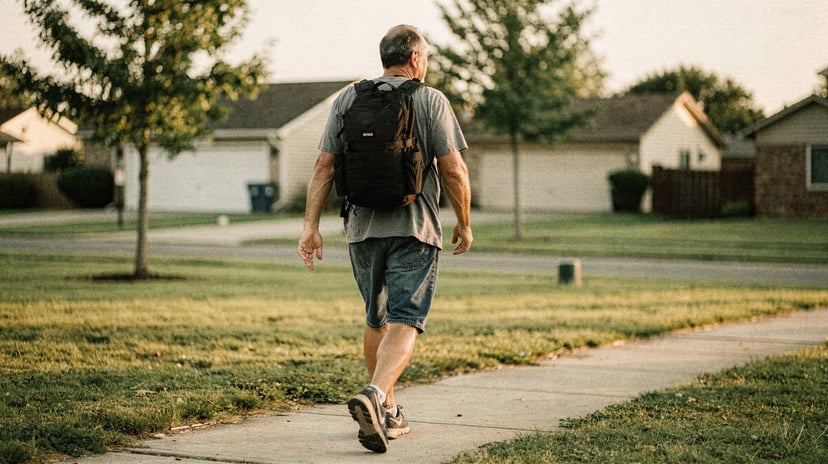
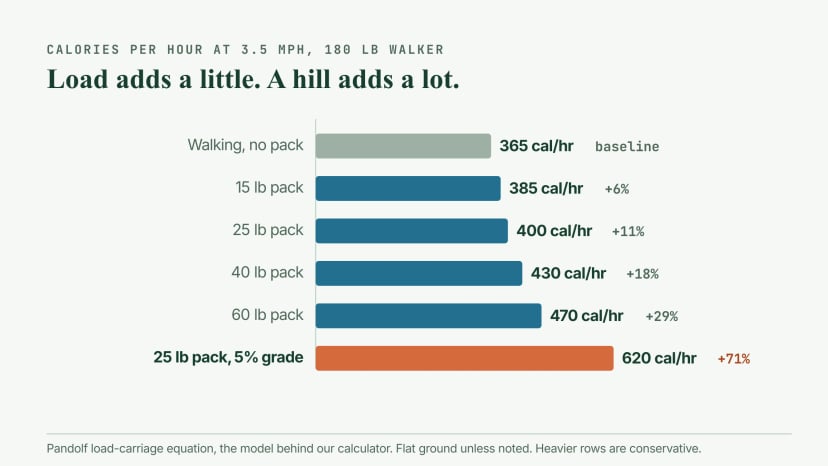
Rucking is walking with a weighted backpack. A 180-lb person walking at 3.5 mph on flat pavement burns about 365 calories an hour. Add a 25-lb pack and that rises to about 400, roughly 11 percent more in the same hour. Take the same pack up a 5 percent grade and it is about 620. On the flat, the pack's bigger contribution is strength and bone loading; on hills, it is calories too.
The real benefit: Rucking adds strength and bone density gains to cardiovascular work. Walking gives you cardio. Rucking gives you cardio plus resistance training in a single, sustainable activity. If you already walk, rucking is the natural next step.
What the research says. The metabolic cost of walking under load is well-established in peer-reviewed literature. Pandolf, Givoni & Goldman (1977), published in the Journal of Applied Physiology, developed the foundational equation predicting energy expenditure under load - still the gold standard 49 years later. Looney et al. (2022), a meta-regression in Medicine & Science in Sports & Exercise, updated the metabolic-cost curves for healthy adults. The convergent finding: on flat ground a moderate pack adds a modest share to the cost of walking at the same pace, while grade adds far more, which matches the numbers above.
What to do if you already walk
If you already walk 30 minutes a few times per week, you do not need a complicated training plan. Add a light load, protect your feet, and keep the pace conversational.
| Situation | Best next step |
|---|---|
| You walk for fitness but want more calorie burn | Use the calorie calculator, then start with 10-20 lb. |
| Your knees or feet get cranky on pavement | Start with the Longevity Athlete loadout or compare pavement rucking shoes. |
| You want one basic setup | Use the Beginner Starter Kit: pack, plate, socks, and anti-chafe. |
| You are training for longer events | Start with the ruck weight guide, then build toward the GORUCK Event Day kit. |
The upgrade is intentionally boring: keep walking, add enough weight to matter, and make the setup comfortable enough that you repeat it.
If you already walk, the missing pieces are usually a pack that holds weight high and still, the weight itself, and socks and anti-chafe for longer loaded miles. Walking shoes that already fit you can stay.
Calorie Burn Comparison
| Activity | Body Weight | Pace | Pack Weight | Calories per Hour | % Increase |
|---|---|---|---|---|---|
| Walking (unloaded, flat) | 180 lbs | 3.5 mph | None | about 365 | Baseline |
| Rucking (light, flat) | 180 lbs | 3.5 mph | 15 lbs | about 385 | +6% |
| Rucking (moderate, flat) | 180 lbs | 3.5 mph | 25 lbs | about 400 | +11% |
| Rucking (heavy, flat) | 180 lbs | 3.5 mph | 40 lbs | about 430 | +18% |
| Rucking (very heavy, flat) | 180 lbs | 3.5 mph | 60 lbs | about 470 | +29% |
| Rucking (moderate, 5% grade) | 180 lbs | 3.5 mph | 25 lbs | about 620 | +71% |
These numbers come from the Pandolf equation, the load-carriage model behind our calculator. On flat pavement each 10 lb adds roughly 15 to 20 calories an hour, rising slightly as the load gets heavier. Grade is the bigger lever: a 5 percent incline adds more than a 60-lb pack does on the flat. Pandolf tends to under-predict heavy loads, so treat the heavier rows as conservative.
The practical point: you don't walk faster or longer to get more out of the hour. Add a hill, or add load, or both. A flat, snug-fitting plate like the Titan Fitness Cast Iron Ruck Weight is the simplest way to add that load without the shifting and rattle of household objects.
Why Walkers Should Ruck
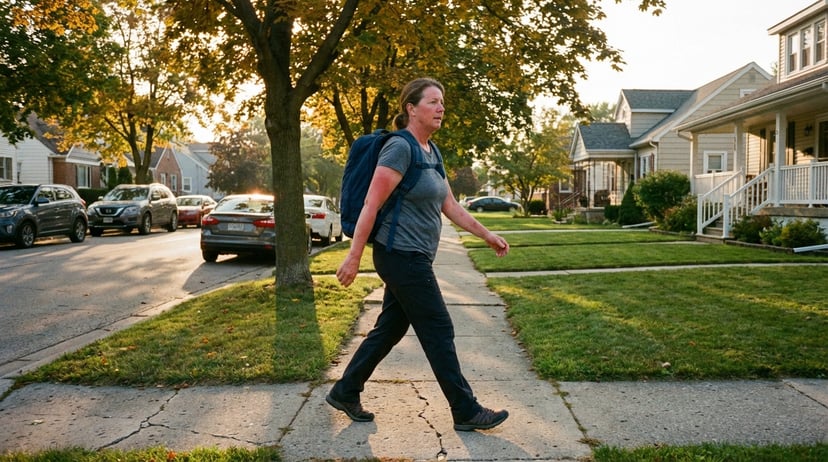
1. Strength Without Learning New Movement
Walking is already ingrained. Your body knows how to do it. Rucking is not a new skill - it is walking with weight. There is no learning curve, no form breakdown, no "wait, where does my knee go?"
By contrast, switching to running means learning a new movement pattern. Runners have higher injury rates partly because they are doing something their body did not grow up doing. Rucking? Your nervous system already knows.
2. Bone Density Stimulus
Walking alone does not strongly stimulate bone density. Rucking does. The loaded stimulus from carrying 20 to 40 lbs triggers bone adaptation - your skeleton gets stronger.
This matters more as you age. Bone density peaks in your 30s and declines thereafter. Rucking at any age builds bone resilience. Walking does not.
Studies on load carriage show that the mechanical stress of carrying external weight increases bone mineral density, particularly in the hips, spine, and legs. Walking alone does not produce sufficient stress to trigger significant bone adaptation. This is why military recruits carrying heavy loads show faster bone density gains than unloaded marchers over the same duration.
3. Strength Maintenance
Walking is cardiovascular. Rucking is cardiovascular plus strength. The load creates continuous resistance against gravity - your posterior chain, core, and legs are all working harder to stabilize and move the pack.
If you are over 40, maintaining muscle mass becomes critical. Walking preserves what you have. Rucking adds to it.
4. Time Efficiency
A 60-minute flat walk burns about 365 calories with little strength stimulus. A 60-minute ruck with 25 lbs burns about 400 on the same route and loads your legs, trunk and skeleton. Route it over a hill and the ruck climbs past 600. Same time, more work.
You are not training harder or longer. You are training smarter in the same time.

How Rucking Is Different From Walking
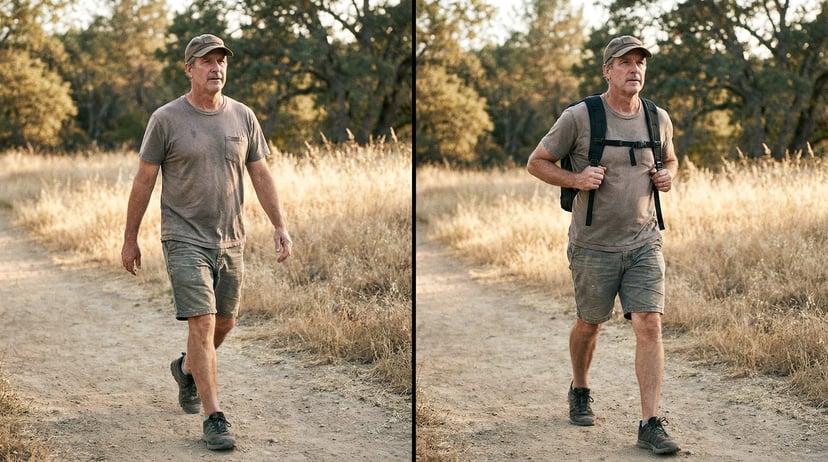
| Element | Walking | Rucking |
|---|---|---|
| Calorie burn (180 lb, 3.5 mph, flat) | About 365 cal/hr | About 400 cal/hr with 25 lb; about 620 up a 5% grade |
| Strength stimulus | Minimal | Significant |
| Bone density impact | Low | High |
| Joint impact | Very low | Low |
| Barrier to entry | None | Minimal (just add weight) |
| Time investment | Same | Same |
| Skill required | None (already have it) | None (already have it) |
The Progression: From Walking to Rucking
If you walk regularly, you are ready to ruck. Here is a safe progression:
Weeks 1 - 3: 15 lb pack Walk your normal distance at your normal pace. The weight should feel noticeable but not exhausting. You should be able to hold a conversation. Three times per week is a good baseline. A right-sized starter like the RUSH 12 2.0 holds a 15 lb load close to your back without swallowing it in extra space.
Weeks 4 - 6: 20 lb pack Keep the same distance and pace. You may feel it more in your calves and lower back - this is normal and means your stabilizer muscles are activating.
Weeks 7+: 25 - 30 lb pack This is the "sweet spot" for most people - enough load to get strength and bone density benefits without excessive joint stress. Many people stay here indefinitely.
Optional progression: 35+ lb packs Only go here if you have a specific goal (military prep, ultra-endurance, pure strength) and have been rucking consistently for three months or more.
The most common mistake new ruckers make is starting too heavy. Start at 15 lbs. It feels light. That is the point. Your tendons and ligaments need time to adapt to load. Tendons adapt slower than muscles - patience prevents injury.
When Walking Is Actually Better

Walking is the better choice in specific situations:
- Total beginners to exercise: If you have not been active in years, start with unloaded walking for 2 - 4 weeks. Let your body adapt to the movement pattern first.
- Active recovery days: Ruck your main days; walk unloaded on recovery days.
- Joint recovery: If you are coming back from injury, clear unloaded walking first with your PT before adding load.
- Social walks: If you walk with a partner or group who is not interested in rucking, walk unloaded and maintain the social connection.
Will Rucking Make Walking Uncomfortable?
No. Many people ruck two to four times per week and walk unloaded on other days. Your body adapts quickly. Within two to three weeks, rucking becomes your new baseline - it will not feel strange.
Actually, many ruckers report that unloaded walking feels easier and lighter after getting used to load. Your proprioception improves, your posture strengthens, and walking becomes almost effortless by comparison.
The Strength Gains Are Real
After six to eight weeks of consistent rucking, people report:
- Improved posture (the load trains upright alignment)
- Stronger calves and legs
- Better core stability
- Less back pain during daily activities
- Feeling "stronger" in everyday life
These are not dramatic strength gains, but they are cumulative and sustainable. Walking does not deliver any of these.
Frequently asked questions
Rucking vs walking: which is better?
For most people rucking is the better use of the same hour, because it adds load without adding impact. Walking stays the right call if you are returning from injury, carrying a lot of extra body weight, or building the habit itself. The honest answer is that rucking is walking with a progression dial attached, so it is less a competitor to walking than the next setting on it.
How heavy should my first pack be?
Start at 15 lbs. This feels light and might even seem too easy - that is intentional. Your tendons, ligaments, and connective tissues adapt slower than muscles. Starting light prevents injury and builds a sustainable base for progression. After three weeks at 15 lbs, move to 20. After three more weeks, you can go to 25 or higher.
Can I ruck every day?
Most people can ruck four to five times per week indefinitely. Some people ruck six days a week without issue. The limiting factor is usually boredom, not injury. We recommend three to four times per week as an optimal baseline that leaves room for unloaded walking, recovery, and other activities.
Is rucking better than walking for weight loss?
Rucking burns more calories than walking at the same pace and distance, so yes - it is more efficient for fat loss. On flat pavement the difference is modest: about 400 calories an hour with 25 lb against 365 unloaded, for a 180-lb person at 3.5 mph. On hilly routes it grows quickly, to about 620 at a 5% grade. However, the best exercise for weight loss is the one you will actually do consistently. If rucking appeals to you more than walking, the adherence advantage makes rucking better for you personally.
Will rucking hurt my knees?
Rucking produces far lower impact than running because you are walking, not bouncing. It produces roughly the same impact as unloaded walking, just with external load. For most people with healthy knees, rucking is safer than running. That said, if you have a diagnosed knee condition, consult your physical therapist before adding load. Start light and progress slowly. For more detail, see our rucking knee pain guide.
What pack should I use?
Any backpack designed to carry weight will work. Purpose-built packs like the GORUCK Rucker 5.0 hold plates high and close to your back if you plan to ruck regularly. Traditional hiking packs work fine too. Avoid messenger bags and other single-strap setups that load one side. We have a detailed gear guide here.
Can I walk and ruck on the same day?
You can, but mixing them is unnecessary. Your 60-minute ruck gives you all the cardio and strength work you need. If you do both in one day, walk unloaded in the morning and ruck in the evening with at least six hours between sessions. Most people find a simple split (ruck on Monday / Wednesday / Friday, walk or rest on other days) works best.
Your next step
The most important question is not whether to ruck - it is how much weight to carry. Our ruck weight guide gives you a personalized recommendation based on your body weight, fitness level, and goals, with a calculator that does the math for you.
Related reading
- The complete beginner's guide to rucking - everything you need to start, from form to gear selection
- How heavy should your ruck be? - personalized weight recommendations by fitness level and goal
- Rucking for weight loss - the science of loaded cardio and a 12-week fat loss program
- Best rucking gear for 2026 - complete equipment guide with product comparisons
- Zone 2 rucking guide - how to optimize rucking for aerobic conditioning and fat loss
- Rucking knee pain guide - what causes it and how to prevent it
- Sticking with plain walking? Our sister site Kit Authority covers the best walking shoes and fitness trackers for walking