Can You Combine Rucking and Lifting?

Rucking and lifting can share a training week. The main constraint is recovery: both can fatigue the legs, hips, and lower back, especially when loads are heavy. A workable plan separates the hardest sessions and adjusts total weekly volume to the goal.
The Science of Concurrent Training

Concurrent training means doing strength and endurance work in the same training phase. It can improve both qualities, but poor scheduling can add more fatigue than useful training.
A Mountain Tactical Institute study compared three groups: strength-only, endurance-only, and hybrid (2 days strength + 3 days endurance). In that study, the hybrid group outperformed endurance-only on strength measures, matched strength-only on those measures, and scored higher than both groups on work capacity. One study does not establish the best split for every athlete, but it shows that well-planned concurrent training can work.
Rucking is a loaded carry, so it combines endurance work with demand on the posterior chain and trunk. It is lower impact than running, but heavy or long rucks still create meaningful recovery demands. The "interference effect," in which endurance work can limit strength gains, can often be managed by controlling volume and separating hard sessions.
Studies on concurrent training suggest that strategic periodization - alternating focus blocks between strength and endurance - tends to outperform balanced concurrent training. The takeaway: you don't have to do both at full intensity every week. One insight we'll use below.
Scheduling Rules

Use these rules as starting points, then adjust them to your training history and recovery.
Rule 1: Avoid a Heavy Ruck and Heavy Lower-Body Lift on the Same Day
Squatting, deadlifting, and carrying weight all load the legs and spinal erectors. Combining a heavy squat (5x3 @ 85%+) with a 45-pound, 60-minute ruck on the same day may make fatigue harder to manage. A well-fitted Mystery Ranch 2 Day Assault backpack and hip belt can improve load distribution, but they do not remove the shared training demand.
Rule 2: Separate Hard Sessions by 24+ Hours
If Monday is a heavy lower-body day, keep Tuesday's ruck light (15-20 lbs for 30 minutes) or take the day off. Avoid placing a hard ruck (35+ lbs for 45+ minutes) immediately after heavy squats until you know that you recover well from the combination.
Rule 3: Treat Light Rucking as Low Training Stress, Not Zero Stress
A 30-minute ruck with 15-20 lbs at an easy pace usually demands less recovery than a heavy session, but it still counts toward weekly load. Some trained people can do this 4-5 days per week. Beginners and anyone with pain or poor recovery may need less. Easy movement can support active recovery, but added weight is not required for that purpose.
Rule 4: Total Weekly Training Load Matters More Than Any Single Session
You can fit rucking and lifting together, but you can't do both at maximum intensity every week. If you're pushing hard on your lifts, rucking volume should be moderate that week. If you're building a long rucking distance, don't also chase 1RMs on your lifts. Periodize focus.

Three Sample Splits
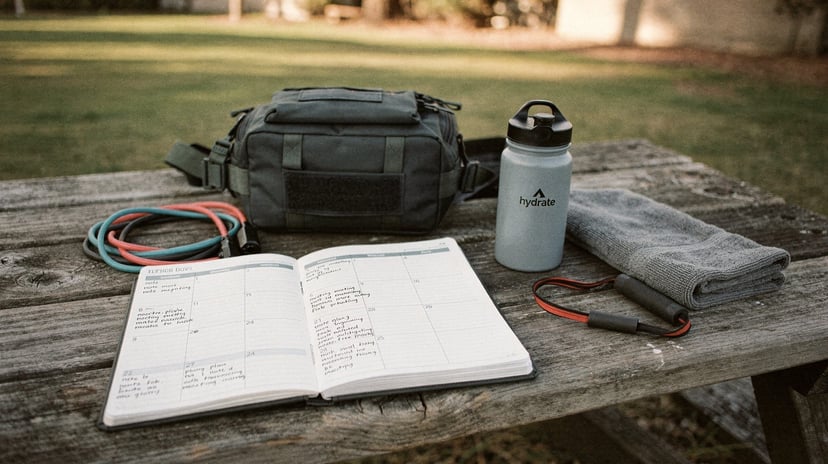
Split A: Alternating Days
This is the split we recommend for most people because it's flexible and doesn't require precision timing.
Weekly Layout:
- Monday: Upper body lift (push or push/pull)
- Tuesday: Moderate ruck (30-45 min, 25-35 lbs)
- Wednesday: Lower body lift (squats, deadlifts, or variation)
- Thursday: Rest or light ruck (20 min, 15-20 lbs, easy pace)
- Friday: Full body lift or push/pull split focus
- Saturday: Long ruck (60-90 min, 20-30 lbs, conversational pace)
- Sunday: Rest
Why it works: You're never stacking heavy lower body with heavy rucking. Upper body days get paired with rucking, which is fine because your legs are fresher. Saturday's long ruck is at an easy pace, so it's more work capacity building than training stress.
Who it's for: People juggling a 4-5 day lifting routine with consistent rucking. Office workers who can break rucking into a lunchtime session.
Split B: Morning and Evening Sessions
This is higher frequency but demands more discipline.
Structure:
- AM ruck / PM lift (or vice versa), 3-4 days per week
- Minimum 6 hours between sessions
- Full rest day Friday or Sunday
- This might look like: Mon AM ruck + Mon PM lift, Tue rest, Wed AM ruck + Wed PM lift, etc.
Requirements:
- Sleep: enough to recover consistently, usually 7-9 hours for adults
- Nutrition: dialed in, with refueling between sessions
- Experience: you need to know your body well enough to dial back one modality if you're getting wrecked
Why it works: Higher frequency, but lower daily volume. Each session is shorter and more focused.
Who it's for: People with limited windows per day but flexibility on timing. Advanced lifters with good recovery practices.
Split C: Three Training Days
Not everyone wants to train 5-6 days per week. This is the "maintain both without obsessing" approach.
Weekly Layout:
- Monday: Full body lift (compound focus)
- Wednesday: Moderate ruck (45 min, 30-35 lbs)
- Saturday: Full body lift + short ruck warm-up (5-10 min, 20 lbs)
Why it works: You hit the gym hard twice, get a solid ruck in the middle, and you're done. Minimal time, full-body adaptations.
Who it's for: People who work long hours, have limited schedule flexibility, or aren't competing in lifting or rucking specifically. Anyone who wants to be generally strong and fit without obsessing.
Exercise Selection That Supports Rucking
Not all lifts are created equal when you're also rucking. Here's what to prioritize:
Do These:
- Squats and deadlifts - These build hip extension power and posterior chain strength, which directly transfers to rucking power and efficiency
- Farmer's carries and loaded carries - Rucking-specific grip and core strength; this is almost identical to rucking minus the weight distribution
- Rows and pull-ups - Spinal stability and upper back strength under load, critical for posture during long rucks
- Pallof press and anti-rotation work - Core stability under unilateral load (your ruck pulls to one side)
- Face pulls - Shoulder health, which takes a beating under load
Minimize or Skip:
- High-volume leg accessories (leg press, leg curls) in heavy rucking weeks - your legs are already fatigued from loading
- Excessive core work (high-rep crunches) - loaded carries already thrash your core; you don't need more flexion work
- Plyometrics on heavy ruck days - the impact is extra stress your nervous system doesn't need
The principle: keep lifts complementary, not redundant with rucking.

Recovery Management When Doing Both
Recovery problems often start when rucking is treated as "just walking" instead of training stress.
Sleep
Aim for 7-9 hours of sleep per night and watch how you recover. A persistent drop in sleep can reduce performance and make combined training harder to tolerate.
Nutrition
Protein needs go up. Aim for 0.8 to 1 gram per pound of bodyweight daily. You're building muscle from lifting and repairing muscle from rucking; protein is the raw material.
Carbs matter too, especially if you're doing a ruck and a lift on the same day. Refuel between sessions or the second session will suffer.
Deload Weeks
A planned deload is one option when fatigue is building. For example, every fourth week you could cut lifting and rucking volume by 40-50%. Not everyone needs the same schedule, so use performance, soreness, sleep, and motivation to decide when to reduce volume.
Signs You're Overdoing It
- Grip strength drops or plateau despite trainer frequency
- Chronic shoulder or hip tightness that won't resolve
- Your rucking pace degrades at the same weight (you're slowing down on familiar routes)
- Elevated resting heart rate (5+ bpm higher than baseline) - easier to spot if you're tracking trends on a watch like the Garmin Instinct 3 Solar
- Irritability or mental fog
If you're seeing these, you're accumulating debt faster than you can repay. Cut volume 20-30% for a week and reassess.

Common Programming Mistakes (And How to Avoid Them)
Mistake 1: Treating Rucking as "Just Walking"
Rucking is strength training. It requires recovery. If you're rucking 45 minutes at 35+ lbs, you've done meaningful work. Your body needs to adapt. Don't program it like it's an afternoon stroll.
Mistake 2: Heavy Squats + Heavy Ruck Back-to-Back Days
Back-to-back heavy sessions can leave the lower back and legs under-recovered. Separate them or make one session light.
Mistake 3: No Deload Weeks
Three weeks of feeling strong doesn't mean you're not fatigued. Deload weeks prevent injury and extend your training career.
Mistake 4: No Clear Training Priority
If the schedule repeatedly falls apart, the plan probably includes too many sessions. Choose a primary goal, reduce the weekly load, and build from a schedule you can follow.
Try one split for 4-6 weeks, then compare performance and recovery with your baseline. Adjust the number or difficulty of sessions if either measure worsens.
Use a simple spreadsheet or training app to track which rucks and lifts you hit that week. You don't need to obsess, but visibility helps you notice patterns - like "every week I skip Thursday rucks" or "my lifts suffer on heavy ruck days." Then you adjust the split.
A Practical Starting Point
Rucking and lifting can complement each other, but neither is free of recovery cost. A hybrid plan works best when the hard sessions are separated and total weekly load fits your current capacity.
The alternator split (Split A) works for most people because it naturally prevents heavy overlap and maintains progression in both modalities. If you're just starting out with either rucking or lifting, master one first, then layer in the other. If you're already training both, pick one of these splits, commit to it for a month, and reassess based on how you feel.
Track your lifting performance, ruck pace, sleep, and soreness for a month. Keep the split if both forms of training are progressing without persistent fatigue; reduce volume or set a clearer priority if they are not.
Related Reads
- Rucking Weekly Routine - A concrete week-by-week plan
- How Often Should You Ruck - Volume guidelines from scratch
- Rucking Prehab Routine - Bullet-proofing your body before load
- Benefits of Rucking - The science of why rucking works
- Training Programs - All our training resources in one place
Frequently Asked Questions
Not necessarily, but you'll need to be strategic about intensity. If you're currently doing high-volume accessory work, replace some of that with rucking rather than adding on top. The key is managing total weekly stress, not just session count.
A 5-10 minute ruck with 15-20 lbs works fine as a dynamic warm-up and doesn't violate the "no stacking" rule. Just don't call a 30-minute, 30-pound ruck a "warm-up" - that's real training stress that needs recovery time.
If your lifting performance drops noticeably (reps decrease, form breaks down earlier) or your ruck pace slows at familiar weights and distances, you're likely overdoing the ruck load. Drop 10-15 pounds and reassess after a week.
Never double up to "catch up" - that's exactly how you violate the recovery rules and burn out. Either skip the missed session entirely or do a lighter version if you have extra time later in the week.
Ruck first if it's a light recovery ruck (15-20 lbs, easy pace), lift first if it's a moderate to heavy ruck. The harder session should come first when your nervous system is fresh, with at least 6 hours between sessions.
Give any split 4-6 weeks minimum before evaluating. Your body needs time to adapt to the stress pattern, and switching every 2 weeks prevents you from seeing whether the approach actually works.
The minimalist split maintains general fitness but won't build event-specific capacity. If you're training for a long ruck event, you'll need more ruck-specific volume than 45 minutes once per week provides.