
- Heart rate variability (HRV) reflects variation in the time between heartbeats. Some HRV measures are influenced by parasympathetic activity, including signals carried through the vagus nerve.
- Compare readings with your own baseline and use the same device, time, posture, and measurement length.
- A low reading can follow hard training, poor sleep, alcohol, stress, travel, dehydration, or illness. It is not a diagnosis.
- Use the trend with how you feel and perform. Slow breathing is a low-cost stress-management practice, not a guaranteed way to raise a score.
What vagal tone means
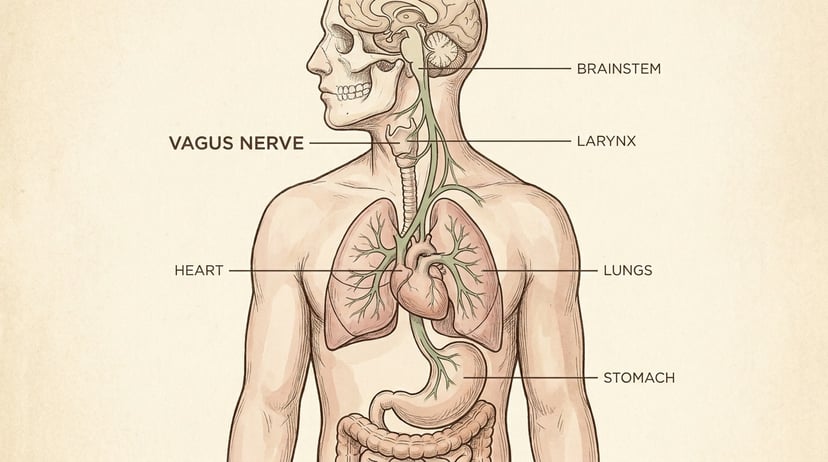
Your autonomic nervous system has two main branches. The sympathetic branch is the "go" signal. It raises heart rate, dilates the pupils, pauses digestion, and sends glucose into the blood. The parasympathetic branch is the "rest and rebuild" signal. Much of it runs through the vagus nerve. This nerve links the brainstem to the heart, lungs, gut, and other organs.
"Vagal tone" is a shorthand for parasympathetic influence on the heart and other organs. It is one part of recovery, not a complete score for sleep, fitness, digestion, or health.
At home, you can track heart rate variability (HRV), the change in time between one heartbeat and the next. RMSSD is one HRV measure commonly used to estimate cardiac parasympathetic activity. It is affected by age, sex, breathing, posture, measurement length, device, time of day, health, and training status. Shaffer and Ginsberg's 2017 review explains why readings taken under different conditions should not be compared as if they were interchangeable.
HRV is a measurement, not a diagnosis. Evidence for consistent measurement and slow breathing is stronger than the evidence behind products marketed as "vagus nerve hacks," including ear-clip TENS units, 30-second exercises, and supplements.
Why load can increase training stress
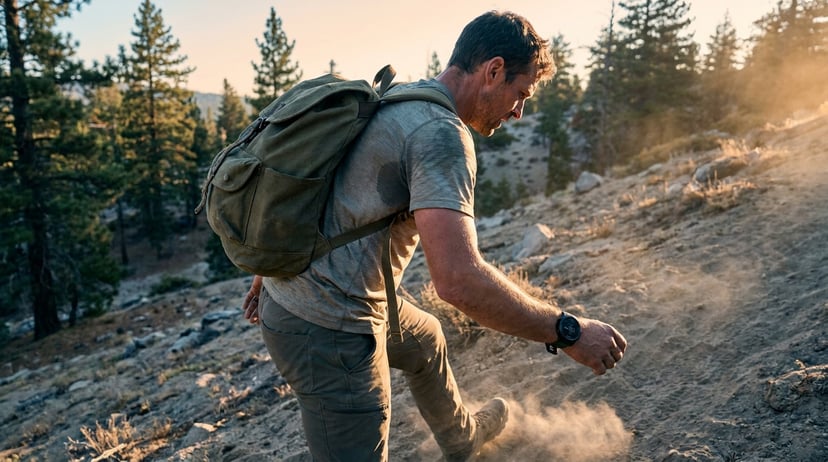
Adding a pack raises the energy and cardiovascular cost of walking at a given speed. The size of that increase depends on the load, pace, grade, terrain, heat, and the person carrying it.
Three forms of stress can stack during a ruck:
- A steady heavy load. The pack stays on for the whole session. Your trunk and shoulder muscles work the entire time. This muscle tension can raise sympathetic activity even at a moderate heart rate.
- Higher cardiovascular demand. Looney and colleagues (PMID 33652153) found that relative peak heart rate increased as soldiers walked with heavier loads. The study did not establish one heart-rate range for recreational ruckers.
- Heat. A pack covers part of the back and can reduce airflow. Hot or humid conditions add to the total strain.
Together, these factors can increase recovery needs. The appropriate response may be less weight, a slower pace, a shorter route, or more time before the next hard session.
Looney et al. studied 15 U.S. Army soldiers carrying 0%, 22%, 44%, or 66% of body mass. Peak heart rate rose from 71% of maximum without a load to 83-88% across the loaded conditions. These were young soldiers in an incremental walking test, so the result shows the direction of the effect rather than a universal heart-rate target for recreational rucking.
How HRV is measured
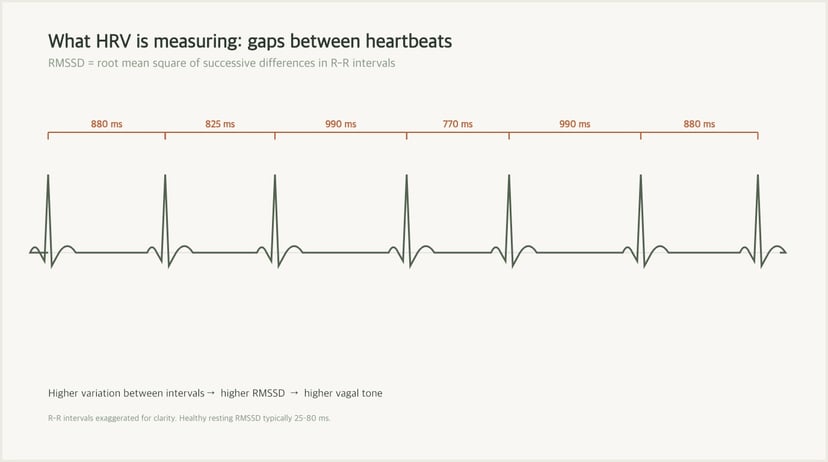
Two HRV metrics matter for at-home tracking.
- RMSSD (root mean square of successive differences): most consumer trackers report this measure. It has the closest link to vagal tone. A higher number points to a stronger parasympathetic state.
- SDNN (standard deviation of normal-to-normal intervals): this broader measure covers both branches of the autonomic system. It has a weaker link to vagal tone but is used in some clinical settings.
Consumer wearables may report RMSSD directly or convert it into a proprietary score. A chest strap records beat-to-beat intervals differently from an optical wrist sensor. Whichever device you choose, use the same one under the same conditions so the trend is comparable.
For most ruckers, a GPS watch can track HRV, pace, and heart rate in one place. We often recommend the Instinct 3 Solar for this use. Its HRV Status feature uses a 7-day baseline, solar charging helps on multi-day trips, and it costs less than half as much as a Fenix.
RMSSD is reported in milliseconds, but there is no single healthy target that works across devices and measurement methods. Published reference values change with age, sex, recording length, posture, and context. Track your own trend instead of comparing one wearable's score with another person's result.
Take your reading at the same time every day, ideally first thing after waking and while lying still for two minutes. Measure before using the bathroom or drinking coffee so the conditions stay consistent.
Read the 7-day trend
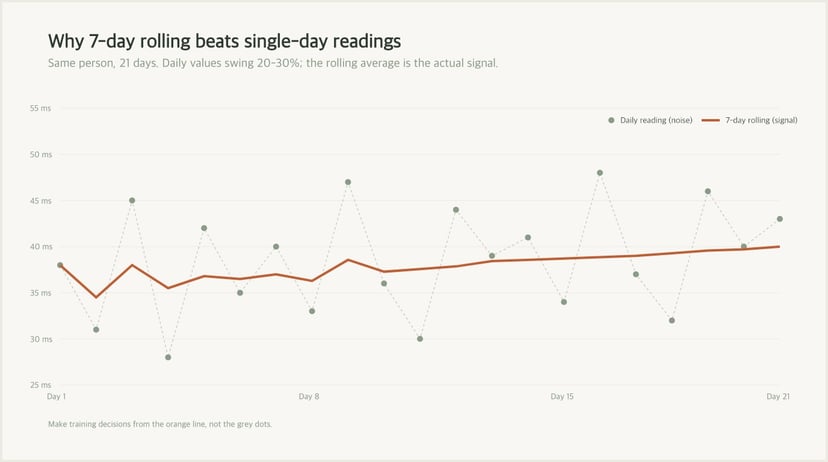
Do not react to a single HRV reading. HRV can swing 20-30 percent from one day to the next in healthy people. Sleep, alcohol, time-zone shifts, early illness, hydration, and stress can all change it. One low reading tells you little.
Use the 7-day rolling average. Do not change training based on one reading alone.
Use HRV as one input:
| Reading and context | Training decision |
|---|---|
| Within your usual range and you feel normal | Train as planned. |
| One unusual reading without symptoms | Check the measurement conditions and avoid changing the week on that number alone. |
| Several readings below your usual range with poor sleep, soreness, unusual fatigue, or declining performance | Reduce the load, pace, or duration, or take a rest day. |
| An unusual reading with chest pain, fainting, severe shortness of breath, palpitations, or signs of illness | Do not use a training chart to self-diagnose. Stop and seek appropriate medical care. |
Slow breathing and HRV
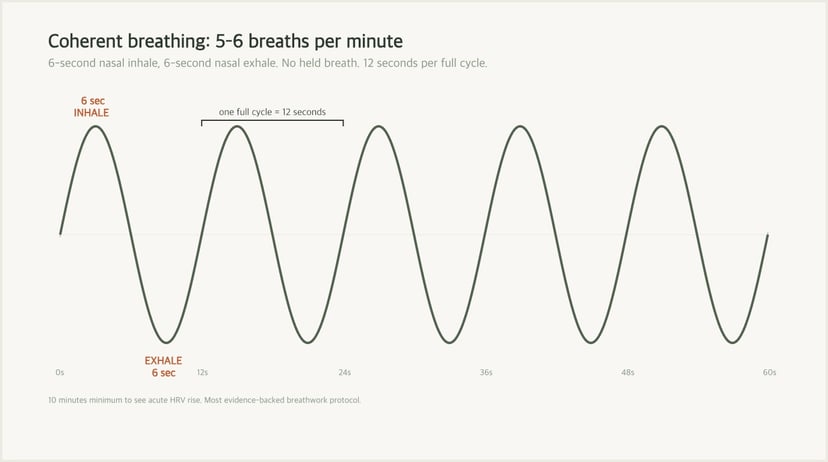
Slow breathing can increase HRV during the exercise and requires no equipment. Evidence for a lasting increase in resting HRV is less certain.
The breathing method matters. Wim Hof-style rapid breathing lowers HRV in the short term because it creates a sympathetic response. Some pranayama methods are hard to study. The three methods below have the strongest evidence for this use.
1. Slow nasal breathing at 5-6 breaths per minute
This is also called "coherent breathing" or "resonance-frequency breathing." At about 5-6 breaths per minute, breathing interacts with the baroreflex and can increase HRV during the session. Laborde and colleagues (PMID 28265249) discuss paced breathing as a methodological and biofeedback consideration when studying cardiac vagal activity.
Try breathing in gently for about 5-6 seconds and out for the same length of time for 5-10 minutes. Stop if you feel lightheaded or uncomfortable. The goal is a calm, sustainable pace, not a particular score after the session.
2. Box breathing (4-4-4-4)
Inhale for 4 seconds, hold for 4, exhale for 4, and hold for 4. Breath holds can feel uncomfortable for some people. Use a shorter count or skip the holds if needed.
3. The physiological sigh
Take two breaths in through the nose, one normal breath followed by a short top-up, then breathe out slowly through the mouth. In a four-week remote trial, Balban et al. (2023, PMID 36630953) found that five minutes of daily cyclic sighing improved mood and reduced respiratory rate compared with mindfulness meditation. The study does not establish cyclic sighing as a treatment for poor recovery.
Heat and cold exposure
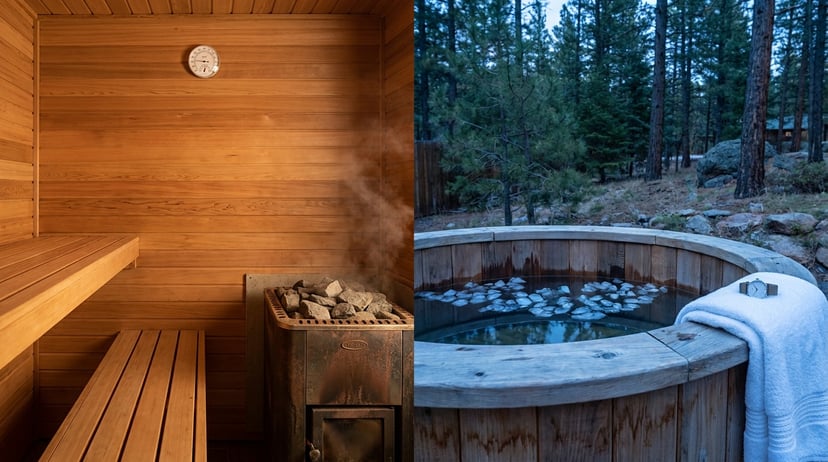
Sauna and cold exposure change heart rate, blood pressure, and perceived stress in the short term. Evidence that either reliably improves resting HRV or rucking recovery is limited.
Sauna raises heart rate and heat strain during use. It may feel relaxing afterward, but this article does not have enough evidence to prescribe a temperature, duration, or weekly dose for raising HRV. Avoid sauna when dehydrated or ill, and ask a clinician first if you have a cardiovascular condition or take medication that affects blood pressure.
Cold exposure creates an immediate stress response. Evidence for cold plunges as a recovery tool is mixed, and sudden cold can be dangerous for some people. It is not a proven shortcut for improving HRV.
Neither practice is required. Sleep, food, hydration, sensible training load, and medical care when needed matter more.
Foam rolling, percussion massage, and HRV
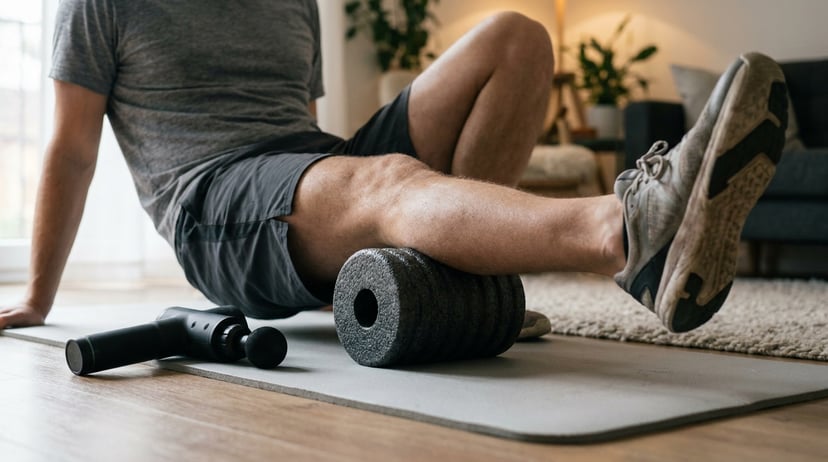
Foam rolling and percussion massage may reduce soreness or help you relax, but evidence for a meaningful long-term change in resting HRV is thin.
A pack can leave the upper traps, lats, spinal erectors, and calves feeling tight. Brief, comfortable rolling may help those areas feel better. Avoid painful pressure and do not use a change in the wearable score as proof that the tissue has recovered.
A foam roller is the least costly option with the most evidence. Many clinicians and physical therapists use the TriggerPoint Grid. Its texture helps target tight spots without the harsh pressure of a dense roller, and it holds up to long-term use.
Percussion guns work faster on a small tight spot and are easier to use on a stiff back. The Lifepro Sonic offers similar percussion depth to a Theragun at about one-third of the price. That makes it a practical choice unless you use a massage gun every day.
After a hard ruck, try the roller on the calves, glutes, and lats for 5-10 minutes. If you use a percussion device, follow its instructions and avoid injured, numb, swollen, or painful areas.
A 4-week HRV tracking trial
This four-week plan adds one change at a time so you can track whether it helps.
Week 1: baseline only.
- Take an HRV reading at the same time every morning. Track it.
- Do not change anything else. You need a clean baseline to measure against.
- Note your average sleep duration and any alcohol intake. These dominate HRV more than anything you can train.
Week 2: add 5-10 minutes of comfortable slow breathing daily.
- Use the same time each day if possible.
- A timer or metronome is enough. You do not need a paid subscription.
Week 3: keep the measurement and breathing routine stable.
- Note soreness, mood, illness symptoms, training performance, and perceived effort.
- Do not add another intervention yet; changing several things at once makes the result harder to interpret.
Week 4: review the trend.
- Compare the four-week HRV trend with your sleep, symptoms, and training notes.
- Keep the routine only if it is useful and does not make you anxious about normal day-to-day changes.
There is no promised percentage increase. A stable number can still be useful if it helps you recognize how hard sessions, poor sleep, travel, illness, or alcohol affect your own baseline.
What an HRV-guided ruck week looks like
Use HRV trends to adjust training load.
| Day | HRV reading | Plan |
|---|---|---|
| Mon | Within baseline | 60 min ruck at 30 lb, easy pace |
| Tue | Above baseline | Strength + 30 min walk |
| Wed | At baseline | 75 min ruck at 30 lb, steady |
| Thu | -1 SD below baseline | Reduce to 45 min at 20 lb, easy |
| Fri | Rebound, above baseline | Rest day. Coherent breathing only |
| Sat | At baseline | Long ruck. 90+ min at planned weight |
| Sun | Below baseline | Walk only, no pack |
Treat this as an example, not a prescription. HRV can support a decision to reduce training, but a high reading is not a reason to exceed the planned load.
The Program Builder makes a four-week plan that you can adjust with the green/yellow/red guide above. The Zone 2 calculator gives pace targets for a chosen heart rate zone.
How this fits with the rest of the program
This guide covers recovery. The Zone 2 rucking guide covers effort during a session, and the injury prevention pillar covers broader recovery and load management.
If you track HRV, combine the trend with perceived effort, sleep, soreness, symptoms, and training performance. Use that combined picture to choose between the planned session and an easier day.
Frequently Asked Questions
Is HRV useful for planning ruck training?
HRV may help with training decisions when it is measured consistently and interpreted with other recovery signs. Most research involves endurance athletes rather than recreational ruckers, so use the trend as supporting information rather than a command.
Which HRV tracker should I get for rucking?
A compatible chest strap can provide beat-to-beat intervals for a short morning reading. WHOOP, Oura, and Garmin offer overnight or rolling trends with different sensors and algorithms. Choose one device and keep the measurement conditions consistent; values from different products may not be directly comparable. If overnight recovery trends fit the way you train, you can see current WHOOP membership options.
Disclosure: The WHOOP link is an affiliate link. If you subscribe through it, Ruck Authority may earn a commission at no extra cost to you. That does not change the comparison above.
Can supplements raise vagal tone?
Do not take a supplement just to move an HRV score. Evidence for products marketed as "vagus nerve support" is weak, and supplements can interact with medication or be inappropriate for some medical conditions. Before paying for one, check what Examine says about the ingredient and claimed outcome. Its research summaries are not personal medical advice; discuss a suspected deficiency with a qualified clinician.
Disclosure: The Examine link is a referral link. If you subscribe through it, Ruck Authority may earn a commission at no extra cost to you.
How long until I see HRV improvement from breathwork alone?
HRV often changes during slow breathing because respiration affects the spacing between heartbeats. That immediate effect does not guarantee a lasting change in your morning baseline. Track several weeks under consistent conditions if you want to see whether the practice changes your own trend.
Will rucking improve my HRV over time?
Regular aerobic training may change your HRV over time, but the direction and size vary by person and measurement method. Track the trend without treating a higher number as the goal of training.
What about vagus nerve reset claims online?
Be skeptical of products or videos promising a "vagus nerve reset" in seconds. HRV is not a diagnosis, and a short-lived change in a wearable reading does not prove better health or recovery.
Related Articles
- Zone 2 rucking guide - the work-side counterpart to this recovery piece
- Zone 2 heart rate calculator - calculate your zone-2 band using Karvonen + Tanaka
- Program Builder - generates a 4-week ruck plan you can overlay HRV on
- Rucking injury prevention pillar - broader recovery and load-management framing


